

Executive Overview
In an era where social media validation often eclipses common sense and respect for private property, a routine Saturday morning in a quiet Phoenix neighborhood turned into a terrifying ordeal for one local family. What began as an apparent bid for digital clout—a reckless stunt known across various platforms as the "Door Kick Challenge"—has resulted in approximately $10,000 worth of property damage, profound psychological distress, and a renewed, urgent warning from law enforcement regarding the very real dangers of viral internet trends.
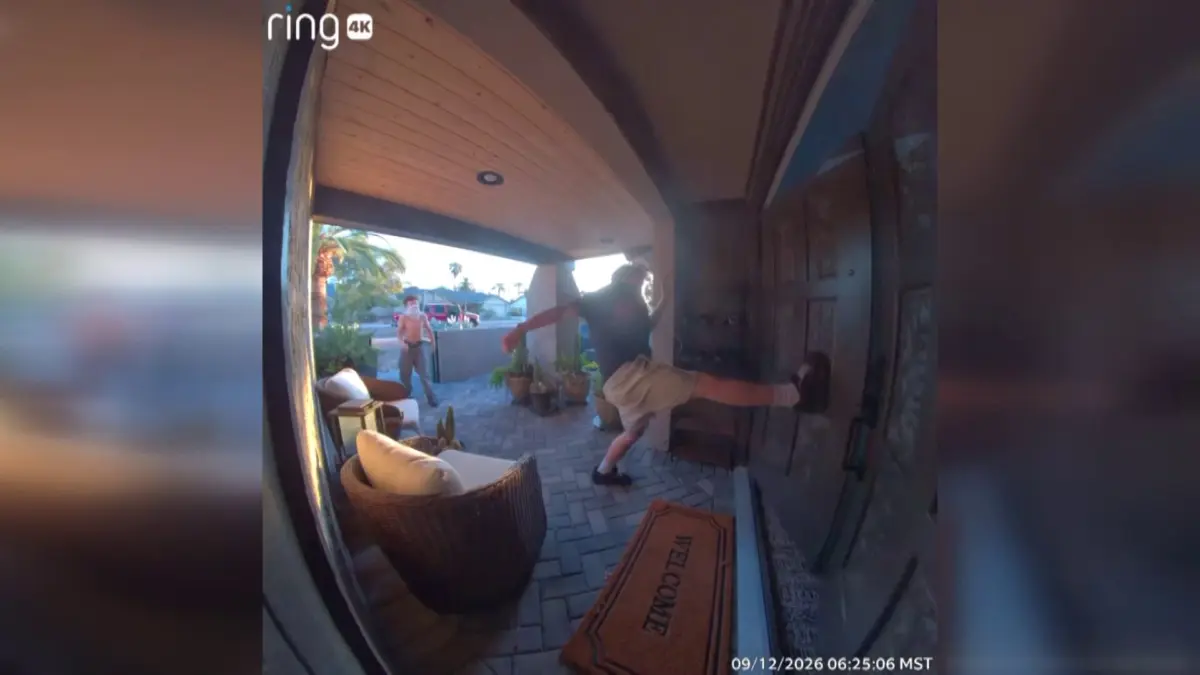
At approximately 6:00 a.m., home security cameras captured two individuals, believed to be teenage boys, as they breached a residential front gate, concealed their faces, and violently targeted the home’s entryway. In a matter of seconds, a single forceful kick shattered a custom-built front door, leaving the residents scrambling for self-defense and police launching an active investigation.
While internet pranks are hardly a novel phenomenon, the escalation from harmless mischief to severe property destruction and potential life-or-endangering confrontations highlights a deeply concerning cultural shift. Local authorities are treating the incident with the utmost gravity, emphasizing that what perpetrators often dismiss as harmless internet fun can quickly transform into felony-level criminal damage, severe legal liabilities, and—most critically—fatal misunderstandings. As detectives comb through high-definition security footage and search for a distinctive red truck tied to the suspects, the broader community is left grappling with a sobering question: Where do we draw the line when the pursuit of online likes threatens the safety of our homes?
Detailed Chronology: How a 6 a.m. Stunt Shattered a Family’s Peace
The sequence of events unfolded rapidly in the early morning hours, catching a Phoenix family completely off guard.
The Approach and Breach
At roughly 6:00 a.m. on a Saturday, the peaceful atmosphere of the residential neighborhood was broken by two figures caught on the family’s Ring security camera system. The footage paints a clear picture of premeditation: the two individuals, appearing to be teenage boys, carefully open the front security gate of the property.
With their movements calculated and deliberate, they rush toward the front entrance. Recognizing the presence of security cameras or anticipating future identification, both boys attempt to obscure their faces. Without hesitation or warning, one of the suspects winds up and delivers a powerful, calculated kick directly to the center of the front door. The structural integrity of the entryway fails immediately under the sudden blunt-force trauma, the heavy door bursting open from its frame. Following the impact, the pair turns and flees the scene, leaving chaos in their wake.
The Resident’s Perspective and the Reality of Self-Defense
Inside the home, a female resident—who has chosen to remain anonymous for security and privacy reasons—recalled the sheer terror of the initial moments. Awoken by a concussive, thunderous bang, her immediate instinct was not that of a prank victim, but of a survivor facing a worst-case scenario.
"I heard a loud bang and first thought someone was breaking in or that a car had crashed into the home," she explained, detailing the instant flood of adrenaline that accompanied the noise.
In a state governed by robust self-defense and castle doctrine laws, the resident’s immediate reaction underscores the terrifying gamble participants in the "Door Kick Challenge" are taking. Without pausing to investigate whether it was a joke, the homeowner instinctively reached for her firearm.
"I carry, personally, just because you never know what’s going to happen. I think it’s always safer that way," she stated candidly. "I immediately reached for that because what else are you supposed to do when you think someone is in your home? You’re not going to be walking around just like, ‘Hello, come get me.’"
The homeowner’s candid admission sheds light on a horrifying possibility: had she reacted a fraction of a second faster, or stepped into the line of fire with her weapon drawn before assessing the fleeing suspects, this viral prank could easily have concluded in a tragic, fatal shooting.
The Aftermath and Financial Toll
Once the dust settled and the immediate threat subsided, the family assessed the physical damage. The architectural casualty of the morning was not a mass-produced, off-the-shelf barrier, but rather a meticulously crafted, custom-built front door.
Because of its unique dimensions and artisanal construction, the door cannot simply be patched up or replaced with a standard hardware store model. Contractors and carpenters have estimated that the total cost to completely remake, paint, and install a comparable custom replacement will run approximately $10,000. For the family, the financial burden is matched only by the lingering violation of their personal sanctuary.
Determined to hold the culprits accountable, the family quickly shared their high-definition security footage with local news outlets and investigators. Crucially, the camera footage also captured the suspects fleeing the scene in a distinct red truck, notably outfitted with what appears to be a custom license plate—a glaring detail that investigators hope will prove pivotal in tracking down the vehicle and its occupants.
Supporting Context & Metrics: The Anatomy of the "Door Kick Challenge"
To understand why two teenagers would deliberately destroy private property for a digital audience, one must examine the broader ecosystem of modern social media culture and the mechanics of viral contagion.
The Rise of the "Door Kick Challenge"
The "Door Kick Challenge"—sometimes referred to by law enforcement under various other destructive internet monikers—is a dangerous trend that has intermittently surfaced across platforms like TikTok, Instagram Reels, and Snapchat. The core mechanics of the trend are simple: participants target residential neighborhoods, single out homes with front doors facing the street, and charge them with the intent of delivering a heavy, echoing kick.
The primary objective is the production of sudden, loud concussive noise, paired with the shock value of the homeowner’s startled reaction. The entire encounter is filmed, typically from the perspective of a secondary participant holding a phone, and subsequently uploaded to social media. The "success" of the video—measured in views, shares, and algorithmic promotion—is directly tied to the level of shock, fear, or confusion captured on the homeowner’s security camera or through the open door.
The Psychology of Digital Validation
Behavioral experts and sociologists point out that stunts like the "Door Kick Challenge" are fueled by the modern obsession with clout culture among adolescents. In an environment where standard social validation has migrated entirely to digital metrics, the barrier to what constitutes "content" has lowered dramatically.
Teenagers seeking peer approval, algorithmic amplification, and ephemeral internet fame often experience a profound sense of detachment from reality behind the screen. The victimized homeowner ceases to be a human being with rights, feelings, and safety concerns; instead, they are reduced to a prop, an NPC (non-player character) in a real-world video game designed to entertain a digital audience. This dissociation allows teenagers who might otherwise be considered "good kids" to engage in deeply antisocial, destructive, and dangerous behavior without immediate emotional friction.
The Escalating Wave of Prank-Culture Criminality
This incident in Phoenix is far from an isolated anomaly. Over the past several years, law enforcement agencies across the United States and internationally have grappled with a rising tide of criminal pranks inspired by viral social media formats. From the "Orbeez challenge" (where teens shoot gel pellets at unsuspecting pedestrians from moving vehicles) to flash-mob retail thefts and destructive bathroom vandalism trends (originally dubbed "Devious Licks"), the intersection of youth culture, mobile connectivity, and anonymity has created a perpetual cycle of one-upmanship.
Unfortunately, as the baseline for online shock value rises, the stunts inevitably become more physical, more invasive, and infinitely more dangerous. What starts as ringing doorbells and running away ("Ding-Dong Ditch") has escalated into structural battery against private residences.
Official Statements: Law Enforcement Responds
The Phoenix Police Department has taken a firm, uncompromising stance on the incident, recognizing that treating these actions as mere teenage pranks trivializes a severe public safety hazard.
Investigation and Criminal Charges
Local police confirmed that patrol officers promptly responded to the residence following the emergency call. After reviewing the homeowner’s crystal-clear security footage and documenting the destruction, officers officially took a formal criminal damage report. Due to the high financial threshold of the damage ($10,000) and the deliberate nature of the crime, the case has been escalated and assigned directly to a detective unit for active follow-up and suspect identification.
In an official statement addressing the incident, the Phoenix Police Department minced no words regarding the legal ramifications awaiting the suspects:
"While some may view it as a prank, this behavior poses serious risks to residents and offenders alike. Door kicking can cause property damage, frighten families, escalate confrontations, and lead to criminal charges including disorderly conduct, criminal damage, or trespassing."
Authorities noted that because the damage exceeds certain financial thresholds, the perpetrators could face felony criminal damage charges alongside trespassing and disorderly conduct violations—permanent blemishes on their legal records that could profoundly impact their educational and professional futures.
The Danger of Escalation and 911 Strain
Beyond the immediate property damage, law enforcement highlighted the secondary and tertiary dangers associated with the "Door Kick Challenge."
First is the acute risk of physical confrontation. In states with robust self-defense laws, homeowners who believe their lives or properties are under violent siege have every legal right to defend themselves with lethal force. Police have repeatedly warned that viral pranks run a terrifyingly high risk of provoking armed responses from terrified residents, transforming a juvenile prank into a fatal tragedy.
Second is the strain placed on emergency services. When homeowners experience what sounds precisely like a violent home invasion, their immediate reaction is to dial 911. This floods dispatch centers with emergency calls, diverts police resources away from actual crimes in progress, and creates unnecessary blue-light panic across neighborhoods.
A Direct Plea to Parents and Guardians
Recognizing that policing alone cannot curb the relentless tide of internet-driven delinquency, the Phoenix Police Department issued a direct, urgent appeal to the community’s primary line of defense: parents and guardians.
Law enforcement is strongly urging parents to have frank, open conversations with their children and teenagers about the real-world consequences of participating in online trends. Officers emphasize that parents need to monitor their children’s digital consumption, establish clear boundaries regarding social media behavior, and ensure that their teens understand that online anonymity is an illusion when actions cross over into the physical realm of criminal law. Furthermore, police are asking anyone in the community who recognizes the distinctive red truck, the custom license plate, or the suspects captured in the video to step forward and contact law enforcement or Silent Witness immediately.
Future Outlook: Accountability, Prevention, and the Path Forward
As the investigation into the Phoenix door-kicking incident continues, the community—and society at large—is forced to confront uncomfortable truths about the trajectory of modern digital culture.
The Push for Platform Accountability
While law enforcement focuses on apprehending the individual teenagers responsible for this specific $10,000 act of vandalism, a larger, systemic debate is quietly unfolding regarding the role of technology platforms. Critics and safety advocates increasingly argue that social media giants—such as TikTok, Meta, and Alphabet—bear a corporate responsibility to aggressively monitor, flag, and suppress content that encourages illegal activity, property destruction, and dangerous stunts.
While algorithms are remarkably swift at detecting copyright infringements or policy violations regarding commercial content, critics contend that platforms often allow dangerous challenge trends to proliferate because high-engagement controversy drives advertising revenue. As legal pressures mount, lawmakers may increasingly examine whether tech companies should be held partially liable when their platforms actively promote and monetize criminal challenges.
Strengthening Community Resilience and Neighborhood Watch
On a local level, the incident has served as a powerful catalyst for neighborhood vigilance. Residents in the affected Phoenix neighborhood, along with communities across the Valley, are re-evaluating their home security infrastructure. The widespread adoption of smart-home ecosystems—including high-definition Ring cameras, motion-activated floodlights, and reinforced entry hardware—has proven vital in providing the evidence needed to track down offenders.
However, technology alone cannot replace human connection. Neighborhood associations and community groups are emphasizing the importance of proactive communication, cross-watching properties, and fostering tight-knit relationships where suspicious behavior, unfamiliar vehicles, and loitering teenagers are quickly identified and reported before incidents escalate.
Conclusion: A Costly Lesson in Responsibility
For the Phoenix family whose custom door was reduced to splintered lumber, the road to normalcy will involve thousands of dollars in repairs and an enduring sense of lost security. For the teenagers behind the camera and the boot, the consequences—once detectives track down that distinctive red truck—will likely involve severe legal repercussions, court-mandated restitution, and a harsh, sobering lesson in accountability.
Ultimately, this incident stands as a stark warning to a digital generation: the internet may treat the real world as a virtual playground, but the laws of physics, property, and personal safety remain stubbornly absolute. When online clout is pursued at the expense of human safety, the laughs fade instantly, leaving behind real damage, real terror, and very real justice.

0 Comments