

Executive Overview
In the modern digital landscape, consumer curiosity is mapped out in real-time through search engine queries. Every click, keystroke, and search query offers a window into the consumer psyche, revealing aspirations, practical necessities, and emerging trends. Recently, a comprehensive research study conducted by automotive accessory provider Car Mats Customs has shed fascinating light on the shifting priorities of American motorists. By evaluating Google Keyword Planner data across a robust array of 175 automotive-related keywords in all 50 states, the study unveils which specific car models capture the imagination—and search bars—of drivers nationwide.
The findings challenge certain stereotypes while reinforcing others. While traditional gas-powered sedans and rugged pickup trucks continue to dominate the American consciousness, unique regional quirks and economic factors heavily influence what people are looking up online. Out of the myriad vehicles available on the global market, exactly seven distinct models emerge as the heavyweight champions, capturing the top spot across the 50 states.
From the bustling corridors of the Northeast to the expansive ranches of Texas, and from the sun-drenched highways of California to the humid coastal byways of Florida, the data tells a compelling story of American mobility. Sedans like the Honda Civic and Toyota Camry maintain an iron grip on commuter-heavy states, while the legendary Ford F-150 dominates the heartland and the American South. Intriguingly, the data also highlights the nascent yet undeniable shift toward electrification, punctuated by California’s unique preference for battery-powered mobility. This report delivers an in-depth exploration of the study’s findings, complete with regional breakdowns, overarching consumer trends, expert commentary, and a look at what the future holds for the American automotive market.
Detailed Methodology and Chronology of the Study
To understand the weight of these findings, one must first examine the architecture behind the research. The project, conceptualized and executed by Car Mats Customs, was designed to eliminate speculative biases by anchoring its conclusions strictly in empirical search engine data.
The Data Collection Framework
The researchers utilized the Google Keyword Planner—an industry-standard tool leveraged by marketers and analysts to gauge the frequency with which specific terms are entered into the world’s most popular search engine. Rather than looking merely at brand-level queries (such as just typing "Toyota" or "Ford"), the team cast a wide net encompassing 175 granular, model-specific keywords.
By analyzing the estimated monthly search volumes for these models across all 50 individual states, the analysts were able to isolate the vehicle that generated the highest localized interest in every corner of the country. This method provides a clear baseline: the vehicle that commands the highest search volume in a given state is crowned that state’s most-Googled car.
Tracing the Consumer Curiosity Pipeline
While the study’s public release captures a specific snapshot in time, the underlying mechanics of consumer search behavior represent an ongoing, dynamic process. The timeline of automotive interest typically follows several distinct phases:
- Inception of Curiosity: Driven by rising fuel prices, new vehicle announcements, or shifting lifestyle needs, consumers turn to search engines for preliminary research.
- Comparative Evaluation: High search volumes for specific models often indicate a deep consideration phase where buyers weigh specs, reliability ratings, and pricing.
- Regional Amplification: Localized environmental factors—such as severe winters, rugged terrain, or heavy urban traffic—accelerate searches for vehicles tailored to those specific conditions.
The resulting data reveals that American consumer curiosity is far from uniform. Instead, it forms a mosaic of regional preferences, economic realities, and cultural attachments to specific automotive archetypes.
Supporting Context, Metrics, and Regional Breakdown
The most striking revelation of the Car Mats Customs study is the dominance of just seven car models at the pinnacle of state rankings nationwide. While dozens of manufacturers vie for market share on dealership lots, the digital landscape is heavily consolidated among a select few perennial favorites.
The Undisputed King of the Map: The Honda Civic
Earning the crown for the widest geographical reach, the Honda Civic secured the number-one ranking in an impressive 15 states. The Civic’s massive digital footprint spans multiple regions, proving that its appeal transcends local demographics.
- Key Strongholds: The compact sedan dominates searches in populous and economically diverse states such as Illinois, New Jersey, Ohio, Virginia, Connecticut, Oregon, and Washington.
- The Appeal: For decades, the Honda Civic has served as a benchmark for practical, reliable, and fuel-efficient personal transportation. Its strong search performance suggests that budget-conscious commuters and first-time car buyers continue to view the Civic as an ideal benchmark during their automotive research phase.
The Industrial Heavyweight: The Ford F-150
If the Honda Civic represents the pragmatic urban and suburban commuter, the Ford F-150 represents the rugged backbone of American labor, recreation, and utility. Capturing the top spot in 12 states, the F-150 boasts the second-widest geographical reach in the study.
- Key Strongholds: Unsurprisingly, the Ford F-150 recorded its highest figures in the Lone Star State, pulling in a staggering 74,000 monthly searches in Texas alone. Beyond Texas, the truck commands digital attention across vast, rugged expanses including Montana, Oklahoma, and Wyoming.
- The Appeal: The F-150’s immense search volume in states characterized by heavy agricultural, industrial, and outdoor lifestyles underscores the enduring cultural and functional importance of the American pickup truck.
The Sunbelt and Suburban Staple: The Toyota Camry
Positioned firmly as a cornerstone of mid-size sedan reliability, the Toyota Camry secured the top spot in 10 states, making it a formidable contender in the national landscape.
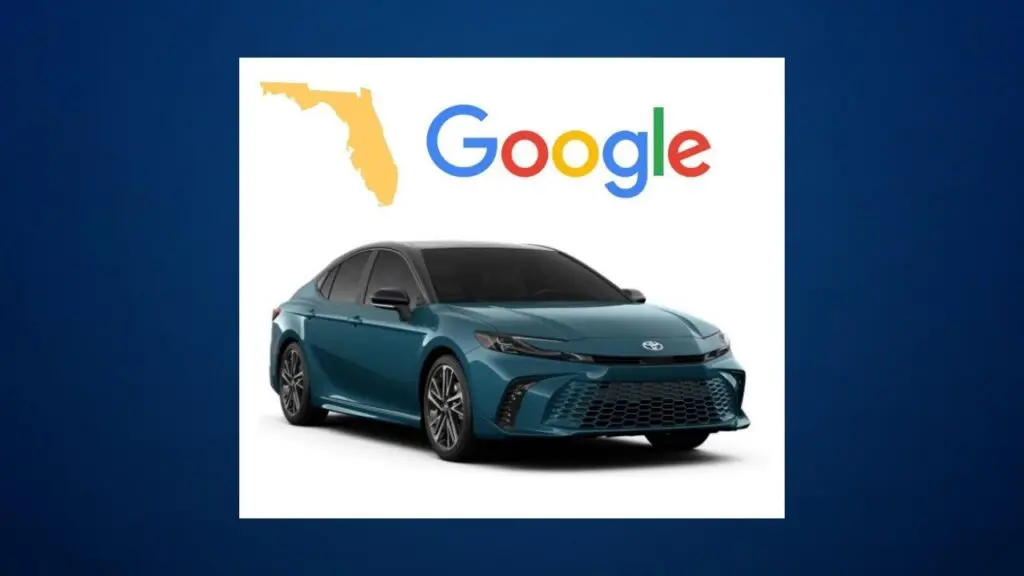
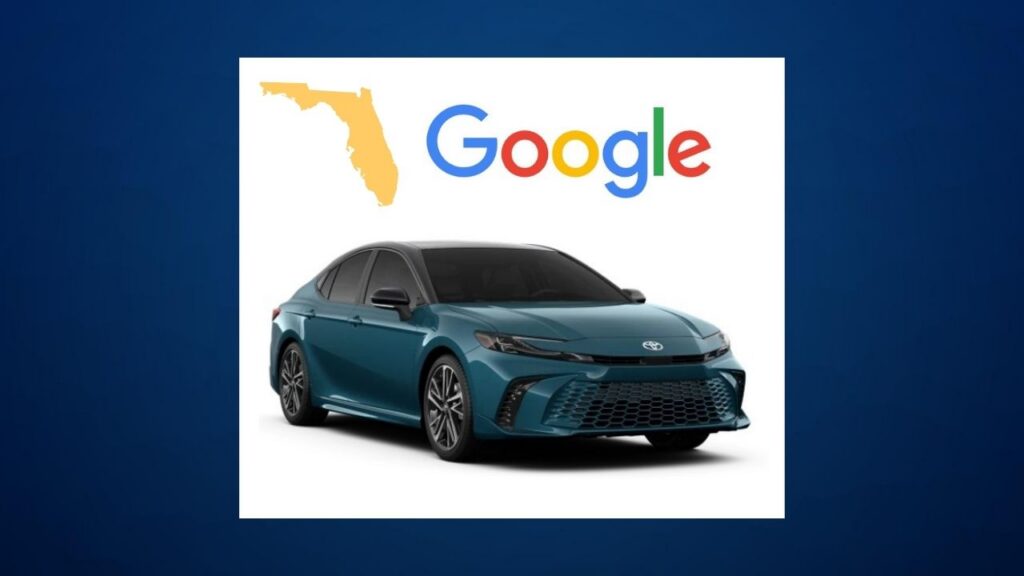
- Key Strongholds: The Camry leads searches across a sun-drenched swath of the country, including Florida, Georgia, Arizona, and Maryland.
- Florida Focus: In the Sunshine State, the Toyota Camry reigns supreme. Florida’s unique demographic mix—featuring high numbers of retirees, long-distance commuters, and families seeking dependable transportation—finds an ideal match in the Camry’s reputation for longevity, comfort, and respectable fuel economy.
The All-Electric Outlier: California and the Tesla Model Y
Perhaps the most telling geographical anomaly in the entire study involves the nation’s most populous state: California.
- The Metric: California recorded the highest individual search volume of any state in the entire dataset, with a massive 135,000 monthly searches dedicated to a single vehicle: the Tesla Model Y.
- Significance: California stands out as the only state in the Union where an electric vehicle ranks as the most-Googled car. This metric mirrors California’s aggressive regulatory environment, robust charging infrastructure, and cultural alignment with sustainable technology. While traditional gas-powered vehicles dominate the rest of the map, the Golden State’s digital obsession with the Model Y serves as a bellwether for the future of American driving preferences.
Other Notable Contenders
Rounding out the top tier of the study are models like the Toyota RAV4, which captured the top spot in six states—including cold-weather bastions such as Alaska, Colorado, and Minnesota. The RAV4’s success highlights the skyrocketing popularity of compact crossovers, which successfully bridge the gap between the fuel efficiency of a sedan and the utility of an SUV.
Official Statements and Expert Analysis
To contextualize these findings, industry leaders and researchers have weighed in on what these search metrics reveal about the broader American automotive ecosystem.
Karsten Kiilerich, CEO of Car Mats Customs, offered detailed insights into the geographic distribution of the data:
"The Honda Civic has the widest geographical reach in the study, leading searches in 15 states. It performs strongly across several different regions, from Connecticut and New Jersey to Oregon and Washington."
Kiilerich’s observations emphasize that despite the proliferation of larger SUVs and trucks, the compact sedan remains intensely relevant to American households. The high search volume for the Civic indicates that consumers are actively comparing fuel-efficient options to hedge against fluctuating gas prices and economic uncertainties.

Regarding the dominance of utility vehicles, industry analysts note that the staggering search volumes for models like the Ford F-150 in Texas and the Toyota RAV4 in mountainous states like Colorado reflect a lifestyle-driven search pattern. Consumers do not merely view these vehicles as appliances; they view them as extensions of their professional and recreational lives—capable of handling everything from hauling heavy equipment through Oklahoma oilfields to navigating snow-packed mountain passes in Alaska.
Furthermore, market researchers observing California’s infatuation with the Tesla Model Y point out that regional search volumes often precede physical purchasing trends. High digital interest in electric crossovers signals a deep-seated curiosity and intent that eventually translates into showroom conversions, even if adoption rates vary wildly across different state lines.
Future Outlook: What the Search Data Tells Us About Tomorrow’s Roads
As the automotive industry stands on the precipice of a massive technological and structural transition, data from studies like the one conducted by Car Mats Customs provides a valuable compass for what lies ahead.
The Tug-of-War Between Tradition and Transition
The current automotive landscape, as reflected by Google search habits, is defined by a fascinating duality. On one hand, traditional internal combustion engine (ICE) vehicles—exemplified by the Honda Civic, Toyota Camry, and Ford F-150—continue to command the lion’s share of consumer attention across the vast majority of the United States. Their dominance in search volumes indicates that for millions of Americans, tried-and-true engineering, familiar refueling infrastructure, and accessible price points remain paramount.
On the other hand, the outlier status of California and the Tesla Model Y—alongside the strong showing of crossovers like the Toyota RAV4—suggests that the automotive paradigm is slowly shifting. As battery technology improves, purchase prices equalize, and charging networks expand beyond coastal enclaves into the American heartland, digital interest in electric and hybrid vehicles is expected to ripple outward from states like California into the rest of the country.
Economic Pressures and Consumer Research
In an era marked by persistent inflation, fluctuating interest rates, and evolving supply chains, consumers are spending more time researching their purchases than ever before. The high volume of searches for practical sedans and reliable crossovers points toward a cautious, highly analytical consumer base. Buyers are carefully vetting fuel economy ratings, maintenance costs, and long-term durability before committing to a vehicle purchase.
Conclusion
Ultimately, the study by Car Mats Customs does more than simply rank car models by search volume—it provides a vivid snapshot of America on the move. Whether it is the industrious Texan searching for a Ford F-150, the Florida commuter looking up a Toyota Camry, the Pacific Northwest resident researching a Honda Civic, or the Californian exploring the Tesla Model Y, these digital footprints map out the diverse needs, values, and driving aspirations of a nation. As technology evolves and economic landscapes shift, monitoring these search patterns will remain one of the most effective ways to understand the road ahead.

0 Comments