

Executive Overview
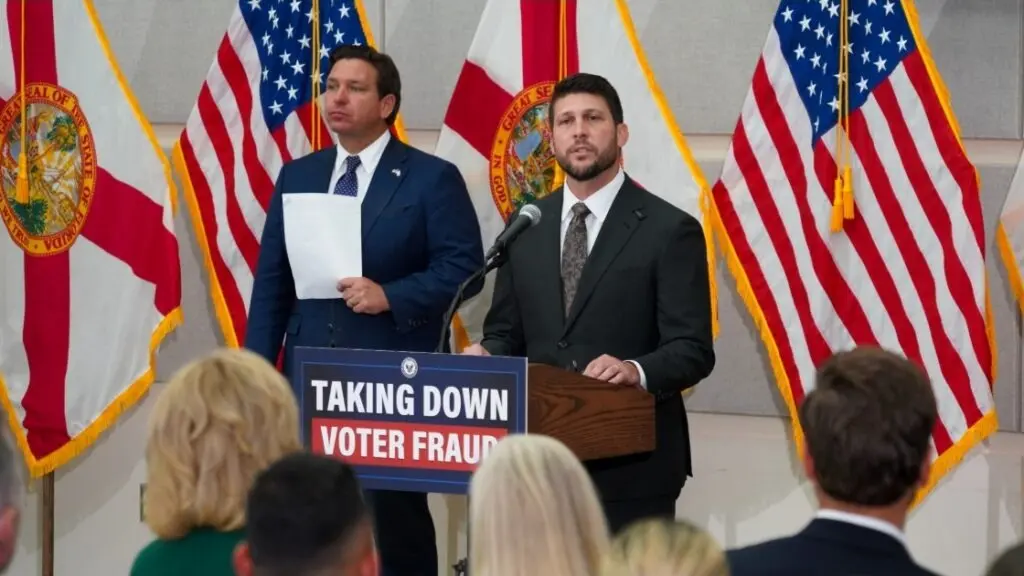
In a sweeping joint announcement that underscores the escalating nationwide debate over election security, Florida state officials have arrested and charged 20 individuals in connection with an alleged statewide voter-fraud operation. The crackdown, spearheaded by Florida Attorney General James Uthmeier and backed by Governor Ron DeSantis, targets individuals accused of illegally registering to vote or casting ballots in Florida elections—including the pivotal 2024 General Election.
The high-profile arrests are the latest manifestation of Florida’s aggressive posture toward election administration, an approach that has transformed the Sunshine State into a laboratory for stringent ballot security measures. According to state prosecutors, the multi-agency dragnet ensnared 16 non-U.S. citizens who allegedly falsified their citizenship status on official voter-registration applications before casting ballots, as well as four convicted felons accused of illegal voting while still serving terms of probation.
"Florida will not allow anyone to steal the vote of Americans at the ballot box," Attorney General Uthmeier declared during the joint press conference detailing the arrests.
The investigation, which spanned multiple counties and utilized federal immigration databases alongside state election logs, highlights the intricate mechanisms state authorities are deploying to scrub voter rolls of ineligible participants. While state officials herald the crackdown as a vital defense of the democratic process, civil rights organizations and legal watchdogs continue to monitor such prosecutions closely, raising questions about the line between administrative errors and intentional criminal conduct. As the legal proceedings unfold across various judicial circuits, state authorities have emphasized that the investigation remains active and that additional charges are anticipated.
Detailed Chronology and Case Breakdown
The genesis of this statewide operation traces back to routine administrative data-matching protocols. According to the Attorney General’s Office of Statewide Prosecution, the cases originated when comprehensive immigration-status reviews and cross-checks with federal databases flagged registered voters who appeared to meet the criteria for ineligibility.
Once these red flags were raised, a coalition of state investigators initiated deep-dive forensic audits. They meticulously reviewed original voter-registration applications, physical poll-book signatures, vote-by-mail envelope certificates, and historical election participation records. The collaborative effort ultimately spanned multiple jurisdictions, with the resulting indictments touching nine distinct Florida counties: Lee, Hillsborough, Marion, Polk, Okeechobee, Columbia, Collier, DeSoto, and Brevard.
The Scope of Allegations: Non-Citizen Voting
The most prevalent category of charges involves foreign nationals who allegedly bypassed federal and state restrictions prohibiting non-citizens from voting in U.S. federal and state elections. Under Florida law, applicants for voter registration must explicitly affirm under penalty of perjury that they are United States citizens. Investigators allege that 16 defendants knowingly falsified this crucial attestation.
State authorities highlighted several egregious, long-standing patterns of illegal voting among the accused:
- Giorgio Dominique Mucelli (Melbourne, Brevard County): Prosecutors allege that Mucelli, a non-citizen, managed to cast ballots in an astonishing seven General Elections spanning a two-decade window from 2004 through 2024.
- Selvin Uton Whilby (Tampa, Hillsborough County): Whilby is accused of participating in a voting history that dates back to 2008. Most recently, investigators allege he utilized the state’s vote-by-mail system to cast ballots in both the 2024 Primary and General Elections despite his ineligible status.
Felon Disfranchisement Enforcement
In addition to the non-citizen voting allegations, the sweep targeted four convicted felons who allegedly violated Florida’s constitutional and statutory requirements regarding voting rights restoration. While Florida voters approved a constitutional amendment (Amendment 4) in 2018 intended to restore voting rights to certain felons upon the completion of their sentences, state law mandates that all terms of sentence—including probation and the full payment of any court-ordered financial obligations—must be completed before eligibility is restored.
Among those charged in this category is Donta Ta White of Tampa. According to investigative files, White was still actively serving a term of criminal probation when he completed a voter registration application and subsequently cast a ballot in October 2024, just weeks before the presidential election.

Legal Classifications and Potential Penalties
The legal jeopardy facing the 20 defendants is severe. According to the Attorney General’s Office, each individual charge filed in connection with this operation is classified as a third-degree felony under Florida law.
In the Florida legal system, a third-degree felony carries a statutory maximum penalty of up to five years in state prison, a $5,000 fine, or both. However, because many of the defendants are facing multiple criminal counts—such as false swearing/perjury in connection with voting, alongside illegal voter registration and unauthorized voting—their cumulative sentencing exposure is substantially higher. Several defendants could face up to 10 years or more behind bars if convicted on all counts as charged.
Despite the gravity of the accusations, state and federal protocols dictate that all defendants are presumed innocent until proven guilty in a court of law, and each individual will be afforded full due process through the state court system.
Supporting Context, Metrics, and Interagency Collaboration
The success of the operation depended heavily on an unprecedented level of cooperation among state and federal entities. The investigation was jointly conducted by:
- The Attorney General’s Office of Statewide Prosecution
- The Florida Department of Law Enforcement (FDLE)
- The Florida Department of State’s Office of Election Crimes and Security
- U.S. Citizenship and Immigration Services (USCIS)
This cross-jurisdictional framework allowed state investigators to bridge the historical information gap between federal immigration tracking systems and local county supervisor of elections databases. For decades, election integrity advocates argued that local election officials lacked the tools, authorization, and real-time data access required to cross-reference voter rolls with federal immigration databases effectively.
The Evolution of Florida’s Election Security Infrastructure
The architecture enabling these investigations was formally codified in 2022, when Governor Ron DeSantis signed landmark legislation creating the Office of Election Crimes and Security within the Florida Department of State. This specialized division was granted dedicated investigative powers, independent of local law enforcement agencies, to track, investigate, and prosecute election-related irregularities across the state’s 67 counties.
The creation of the office marked a distinct shift in how Florida polices its elections. Rather than relying solely on post-election audits or reactive investigations prompted by public complaints, the state established a proactive apparatus designed to continuously audit voter rolls against external databases.
Since the inception of the Office of Election Crimes and Security, state authorities report that more than 100 election-fraud-related prosecutions have been initiated. These actions have ranged from high-profile arrests of individuals voting in multiple states to localized investigations into forged signature petitions and, increasingly, non-citizen registrations flagged through federal system integration.
Official Statements and Political Implications
The announcement of the arrests has reverberated across the political landscape, drawing sharp distinctions between Florida’s governance model and those of other states regarding election administration.
Governor Ron DeSantis, who has made election integrity a cornerstone of his gubernatorial administration, framed the latest arrests as validation of the state’s aggressive reform agenda.

"When we created the Office of Election Crimes and Security, critics claimed it was unnecessary, that our elections were already secure, and that we were tilting at windmills," administration officials noted in related background briefings. "Today’s announcement proves precisely why those measures were necessary. We promised the people of Florida that every legal vote would count and that illegal votes would be hunted down and prosecuted to the fullest extent of the law. We are keeping that promise."
Attorney General James Uthmeier echoed these sentiments, emphasizing that public confidence in the electoral system depends on absolute adherence to the rule of law.
"Elections are the bedrock of our constitutional republic," Uthmeier stated. "When ineligible individuals—whether through fraudulent claims of citizenship or active criminal probation statuses—cast a ballot, they intentionally dilute and steal the lawful vote of an American citizen. Florida has zero tolerance for this behavior, and our multi-agency task force will continue to scour our rolls to ensure complete integrity."
Conversely, voting rights advocates and defense attorneys have raised concerns regarding the messaging surrounding such arrests, particularly when individuals claim they misunderstood complex eligibility laws or were erroneously issued voter information cards by state or county agencies. Civil liberties groups argue that aggressive criminal prosecutions of individuals who may have made bureaucratic or administrative errors—or who received mixed signals regarding their post-felony voting status—can create a "chilling effect," deterring eligible minority and low-income voters from participating in future elections out of fear of inadvertent legal noncompliance.
Legal experts point out that a critical element for prosecutors to prove in these cases will be mens rea—the legal requirement to establish criminal intent. Prosecutors must demonstrate that the defendants knowingly and willfully falsified their applications or voted while knowing they were ineligible, rather than simply succumbing to administrative confusion during the registration process.
Future Outlook and Ongoing Investigations
As the 20 components of this statewide sweep move through the preliminary arraignment and discovery phases in their respective county circuit courts, the operational footprint of Florida’s election integrity apparatus continues to expand.
State officials have made it clear that the current round of arrests is merely a milestone in an ongoing, continuous campaign. Investigators from the Florida Department of Law Enforcement and the Office of Election Crimes and Security are continuing to analyze data sets from the 2024 General Election and preceding election cycles.
Key areas of focus for future phases of the investigation include:
- Expanded Database Integration: Deepening data-sharing agreements with federal agencies to catch changes in citizenship status, naturalization proceedings, and interstate residency shifts in near-real-time.
- Vote-by-Mail Audits: Increasing forensic scrutiny on signature verification processes and mail-in ballot drop-off chains of custody.
- Third-Party Registration Drives: Examining the collection practices of political committees and non-profit voter-registration organizations to ensure compliance with Florida’s strict laws governing the handling of registration applications.
With additional arrests and charges explicitly anticipated by state prosecutors, Florida remains at the epicenter of the American experiment in election administration. As these 20 defendants face the heavy weight of third-degree felony charges in courtrooms from Brevard to Hillsborough counties, the outcome of these trials will likely set crucial legal precedents regarding the enforcement of voter eligibility laws in the digital and data-integrated age of American elections.

0 Comments