

Executive Overview
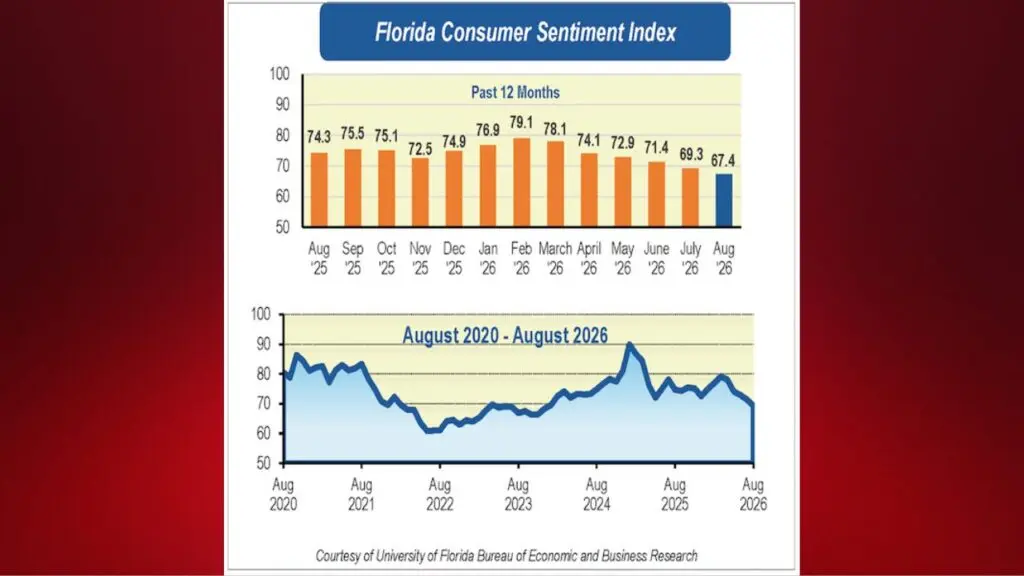
Economic pessimism deepened across the Sunshine State as consumer confidence slumped for the sixth consecutive month, according to the latest data released by the University of Florida (UF). In August, the state’s consumer sentiment index fell 1.9 points to settle at 67.4, down from a downwardly revised July reading of 69.3. This latest reading underscores a persistent and widening disconnect between macroeconomic indicators and the lived financial realities of everyday Floridians.
The decline mirrors broader national trends, yet the localized trajectory paints a particularly striking picture of consumer fatigue. According to researchers at UF’s Bureau of Economic and Business Research (BEBR), August marked a rare and troubling milestone: every single component of the consumer sentiment index declined for the second consecutive month. This widespread contraction signals that Floridians are not merely anxious about a single facet of the economy, but rather view their personal finances, short-term prospects, and long-term horizons through an increasingly pessimistic lens.
At the heart of this downturn is a mounting anxiety surrounding the trajectory of the national economy. While inflation has cooled from its historic peaks and retail gasoline prices have moderated, elevated costs continue to strain household budgets. Concurrently, a softening labor market, shifting trade policies, and persistent geopolitical instability have conspired to erode consumer trust. For policymakers and economists alike, the sustained downward drift in Florida sentiment serves as a flashing warning light, suggesting that economic friction remains a heavy burden for residents navigating an unpredictable financial landscape.
Detailed Chronology: Tracking the Six-Month Slide
To fully understand the gravity of the August report, one must examine the steady, unyielding erosion of confidence that preceded it. The current downward trend is not the result of a sudden economic shock, but rather the cumulative effect of six months of mounting consumer apprehension.
The Turning Point in Spring
The downward trajectory began earlier this year, interrupting what had been intermittent periods of post-pandemic economic recovery. As persistent inflation refused to recede to historical targets and borrowing costs remained elevated due to Federal Reserve interest rate policies, Florida consumers began tightening their purse strings. By the early spring months, the optimism that had characterized parts of the previous year began to give way to caution.
Summer Stagnation and Acceleration
By midsummer, the decline transitioned from a gentle slope to a steeper descent. July’s figures—initially viewed with concern—were subsequently revised downward to 69.3, setting a bleak baseline for the late-summer surveys. As the survey window opened on July 1 and stretched through August 27, respondents were absorbing a continuous stream of mixed economic signals: cooling job growth figures nationally, stubborn housing costs within Florida, and global headlines dominated by geopolitical friction and supply chain reconfigurations.
By the time the August data was compiled, the six-month slide had erased substantial ground. Most notably, views regarding the country’s economic outlook over the next 12 months have plummeted by nearly 17 points over this six-month window, touching their lowest watermark since November 2023. This continuous deterioration highlights a profound loss of faith in the immediate economic future among the state’s populace.
Supporting Context & Metrics: Inside the UF Consumer Sentiment Index
The University of Florida consumer sentiment index is calculated using a rigorous methodological framework benchmarked against 1966—meaning a baseline value of 100 represents the level of confidence recorded in that foundational year. The index scale spans from a theoretical low of 2 to a maximum of 150.
Breaking Down the Five Components
The index relies on five core questions designed to gauge personal financial situations and broader economic outlooks. In August, all five of these pillars moved downward in tandem:
- Personal Finances Now vs. Year Ago: Floridians’ assessments of their current personal financial situations compared to a year ago experienced a noticeable dip, reflecting the lingering pressure of cumulative price increases on household balance sheets.
- Personal Finances Expected in a Year: Optimism regarding individual financial mobility over the coming year also contracted, as residents braced for ongoing cost-of-living pressures and modest wage growth.
- U.S. Economic Conditions Over the Next Year: This component suffered the steepest drop in the August survey, falling 3.1 points from 68.5 down to 65.4. This sharp contraction underscores deep-seated anxieties about the immediate macroeconomic climate.
- U.S. Economic Conditions Over the Next Five Years: Long-term confidence in the national economy also faltered, decreasing 2.6 points from 72.2 to 69.6. This indicates that consumers harbor lingering doubts about structural economic stability over the half-decade horizon.
- Expected Good Times for Business Conditions: Assessments regarding the broader business environment deteriorated further, dampening expectations for corporate expansion, investment, and hiring.
Methodological Rigor and Demographic Representation
The integrity of the UF consumer sentiment report rests on a meticulously controlled survey methodology. Conducted continuously between July 1 and August 27, the study captured the voices of 358 individuals across the state, reached exclusively via cellphones to ensure an inclusive demographic cross-section.
To prevent sampling biases, the raw data undergoes a sophisticated weighting process. Responses are adjusted based on the respondent’s Florida county of residence, age group, and sex to mirror the true demographic profile of the state’s population. These weighting targets are anchored directly in official population estimates produced by BEBR’s Population Program—the designated state authority for demographic tracking in Florida. Furthermore, data quality is actively safeguarded through rigorous monitoring, interview reviews, and strict automated protocols designed to detect and eliminate duplicate records.
Official Statements and Expert Analysis
The release of the August figures prompted immediate analysis from economic researchers, who emphasized the unusual nature of the broad-based decline and the specific catalysts driving consumer pessimism.
Hector H. Sandoval, director of the Economic Analysis Program at UF’s Bureau of Economic and Business Research, provided critical context on the findings, pointing to the rarity of a synchronized collapse across all index components.
"Consumer sentiment deteriorated further in August, driven primarily by Floridians’ expectations for the national economy, particularly in the short run," Sandoval noted. "In fact, views about the country’s economic outlook over the next 12 months have declined consistently over the past six months, falling nearly 17 points and reaching their lowest level since November 2023."
Sandoval elaborated on the complex web of economic forces weighing on the minds of residents. While headline figures often point toward stabilization, the ground-level reality for consumers remains fraught with contradictions.
"This growing pessimism is consistent with an economic environment that remains challenging for consumers," Sandoval explained. "Although inflation and gasoline prices have moderated recently, both remain elevated. At the same time, labor market conditions have softened over the past year, although recent developments in Florida’s labor market point to some stabilization. Combined with continued geopolitical uncertainty and recent trade policy changes, these conditions help explain why consumer sentiment has remained on a downward trajectory."
Economists point out that consumer sentiment is not merely a lagging indicator of past financial pain, but a potent leading indicator of future economic behavior. When confidence wanes, discretionary spending typically contracts, businesses pull back on expansion plans, and localized economic growth can experience a cooling effect.
Future Outlook: Navigating Uncertainty in the Sunshine State
As Florida looks ahead to the final quarter of the year, the trajectory of consumer sentiment remains a critical variable for business leaders, investors, and policymakers. The widening chasm between national economic policy discussions and consumer perception presents a complex challenge.
Key Variables to Watch
Several macroeconomic and regional factors will dictate whether consumer confidence can stabilize or if the downward trend will persist into the winter months:
- Inflation and Cost of Living: While the rate of price increases has slowed compared to pandemic-era spikes, the cumulative effect of higher prices for housing, insurance, groceries, and utilities continues to strain household budgets. Future sentiment will heavily depend on whether wage growth can meaningfully outpace these baseline living costs.
- Labor Market Resilience: While national labor markets have shown signs of cooling, Florida’s unique economic ecosystem—bolstered by continuous in-migration, tourism, and construction—has exhibited pockets of resilience. However, any widespread softening in hiring or wage stagnation could further depress personal financial outlooks.
- Monetary Policy and Interest Rates: With speculation mounting over potential adjustments to Federal Reserve interest rates, borrowing costs for mortgages, auto loans, and credit cards remain a focal point. Relief in borrowing costs could provide a much-needed psychological and financial boost to hesitant consumers.
- Geopolitical and Trade Dynamics: International trade policies and global supply chain stability continue to cast a shadow over long-term economic forecasting, directly influencing the five-year expectations component of the index.
Ultimately, the persistent slide in Florida consumer sentiment serves as a reminder that economic recovery is rarely linear. For the millions of residents navigating the Sunshine State’s dynamic economy, the path forward will require balancing cautious household financial management against an uncertain national backdrop. Detailed monthly breakdowns and historical datasets of the survey remain publicly accessible through the Bureau of Economic and Business Research portal at bebr.ufl.edu/florida-consumer-sentiment/.

0 Comments