
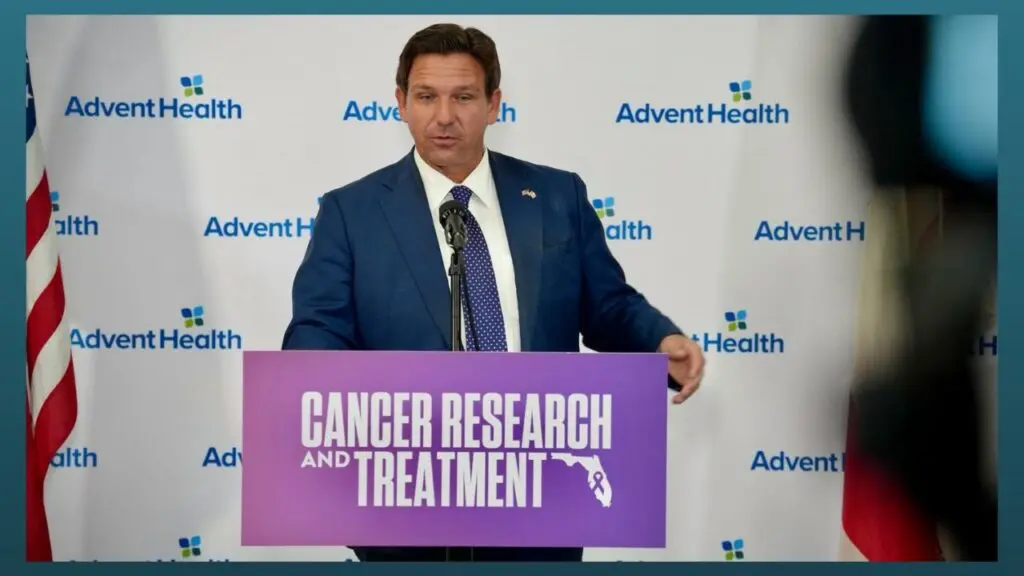

ORLANDO, Fla. — In a significant push to solidify the state’s standing as a premier hub for biomedical innovation, Governor Ron DeSantis announced $60 million in targeted cancer research and innovation awards on Wednesday. Simultaneously, the state officially opened a new application cycle for the upcoming fiscal year, unlocking an unprecedented $70 million for Florida-based researchers, universities, medical institutions, and biotech startups.
The newly distributed $60 million comes via the Fiscal Year 2025–26 Florida Cancer Innovation Fund. Building on this momentum, the upcoming Fiscal Year 2026–27 funding cycle represents a decisive $10 million increase from the previous round, pushing state-backed financial support for cutting-edge oncology initiatives to historic heights.
With cancer continuing to pose a severe public health challenge—remaining the second-leading cause of death in Florida while touching the lives of nearly 40 percent of residents—state leaders are framing these multi-million-dollar injections not merely as financial grants, but as vital lifelines aimed at accelerating breakthroughs, expanding clinical trials, and fundamentally changing the trajectory of patient care.
Executive Overview
The announcement, made in Orlando, underscores a sustained legislative and executive focus on positioning Florida at the vanguard of the global fight against cancer. Over recent years, state leadership has systematically ramped up investments in research infrastructure, striving to create an ecosystem where academic institutions, private enterprises, and community healthcare networks can collaborate seamlessly.
The newly launched $70 million funding cycle for Fiscal Year 2026–27 is designed to cast a wide net, supporting a diverse array of projects ranging from preventive nutrition and epidemiological data infrastructure to novel therapeutic modalities and patient-centered care programs.
State health officials emphasize that the primary goal of the Florida Cancer Innovation Fund is to eliminate bureaucratic bottlenecks, empowering principal investigators and medical pioneers to pursue high-risk, high-reward concepts that might otherwise struggle to secure traditional federal backing through agencies like the National Institutes of Health (NIH).
Detailed Chronology of the Florida Cancer Innovation Fund
To understand the trajectory of Florida’s current oncology funding strategy, it is essential to examine the rapid evolution of the state’s financial commitments over the past several years.
Inception and Early Growth (2019–2023)
Prior to the formal establishment of specialized innovation funds, Florida’s state budget allocated comparatively modest sums to oncology initiatives. However, beginning in 2019, a strategic shift occurred within the executive branch and the Florida Legislature. Recognizing that world-class cancer treatment facilities are vital economic and social drivers, state leaders began systematically increasing appropriations for biomedical research.
The watershed moment for targeted state grants arrived in 2023 with the creation of the Florida Cancer Innovation Fund, which debuted with an initial investment of $20 million. Conceived as a nimble funding mechanism, the fund was structured to distribute competitive grants specifically tailored for projects pushing the boundaries of cancer prevention, early diagnosis, and targeted treatment methodologies.

Scaling Up: The 2025–26 and 2026–27 Funding Cycles
Following the successful deployment of earlier allocations—which Agency for Health Care Administration (AHCA) Secretary Shevaun Harris noted have now collectively touched nearly 150 individual projects across the state—the legislature moved to scale up appropriations.
- Fiscal Year 2025–26: The state disbursed $60 million following a rigorous, competitive peer-review process. These awards targeted a balanced mix of legacy medical centers and nimble, up-and-coming research entities.
- Fiscal Year 2026–27: Announced this week, this upcoming cycle elevates the funding pool to $70 million—a $10 million year-over-year increase and part of a broader commitment that will see nearly $228 million dedicated to cancer research and innovation for the fiscal year.
Applications for this latest $70 million cycle are officially open, accompanied by the publication of the complete roster of recipients who secured backing from the 2025–26 distribution.
Supporting Context & Financial Metrics
The scale of Florida’s recent financial commitments to cancer research represents a fundamental transformation in state health policy. A deep dive into the numbers reveals a concerted, long-term strategy designed to yield measurable dividends in public health and economic development.
Unprecedented Capital Injection
According to official figures released by the governor’s office, the state of Florida has injected more than $1.4 billion into cancer research and treatment infrastructure since 2019. To contextualize this figure, state funding for cancer research programs has surged by more than 175 percent over the same period.
This capital has not been concentrated solely in a few elite, metropolitan research hospitals. Instead, the state’s broader strategy leverages a three-pronged institutional approach:
- The Florida Cancer Innovation Fund: Focused on rapid-cycle innovation, early-stage startups, and translational research.
- The Casey DeSantis Cancer Research Program: Honoring the state’s First Lady—herself a breast cancer survivor—this program provides dedicated funding to major cancer centers to recruit top-tier global talent and expand clinical trial access.
- The Cancer Connect Collaborative: Designed to foster institutional synergy, bridging data systems, sharing clinical insights, and promoting cross-disciplinary cooperation among Florida’s premier universities and hospital networks.
The Public Health Stakes
Behind the financial metrics lies a sobering epidemiological reality. Cancer remains the second-leading cause of mortality in Florida, trailing only heart disease. Demographic analyses project that approximately 40 percent of all Floridians will receive a cancer diagnosis at some juncture in their lives.
With a rapidly aging population drawn to the state by its climate and lifestyle, the demand for advanced oncology services is projected to escalate. State health economists argue that proactive, state-level investments are essential not only to alleviate human suffering but also to mitigate the long-term economic burden of cancer care on the state’s healthcare system.
Official Statements and Leadership Perspectives
At the press conference in Orlando, state leaders articulated a shared vision centered on institutional flexibility, geographical equity, and relentless scientific inquiry.
Governor Ron DeSantis emphasized the state’s emerging role as a global destination for medical science.

"This promising initiative now has $70 million in funding for groundbreaking cancer research projects, $10 million more than the previous cycle," DeSantis stated. "Congratulations to the awardees, and thank you for all you do to make Florida a beacon of hope in cancer research and treatment."
State Surgeon General Dr. Joseph Ladapo focused on the philosophical underpinnings of the grant distribution process, stressing the necessity of unconstrained scientific exploration.
"These investments give researchers the freedom to ask important questions, explore new ideas, and follow the evidence wherever it leads," Dr. Ladapo remarked. By reducing administrative hurdles and providing flexible capital, the state hopes to empower investigators to pursue unorthodox hypotheses that traditional funding bodies might deem too speculative.
Weighing in on the logistical and societal impact of the grants, Agency for Health Care Administration (AHCA) Secretary Shevaun Harris highlighted the democratization of advanced medical care across the state’s diverse geography.
"From rural communities to major cancer centers, Florida patients are getting access to groundbreaking research and life-changing care close to home," Harris said. She noted that nearly 150 unique projects have now benefited from state-backed oncology initiatives, ensuring that cutting-edge clinical trials are no longer confined strictly to elite coastal research hubs.
Future Outlook: What Lies Ahead for Florida Oncology
As the application portal for the Fiscal Year 2026–27 Florida Cancer Innovation Fund swings open, the scientific community is already preparing proposals that reflect the evolving frontier of modern medicine.
State officials have signaled that the upcoming funding cycle will place special emphasis on several high-impact domains:
- Preventive Nutrition and Lifestyle Medicine: Investigating the biochemical mechanisms by which diet, metabolism, and environmental factors influence oncogenesis and tumor progression.
- Emerging Therapeutics: Funding Phase I and Phase II clinical trials for novel immunotherapies, gene-editing applications (such as CRISPR-based oncology treatments), and precision medicine protocols tailored to individual genetic profiles.
- Data Infrastructure and Artificial Intelligence: Modernizing the state’s health data networks to utilize machine learning algorithms for early cancer detection, predictive patient risk modeling, and optimized clinical trial matching.
- Patient-Centered Supportive Care: Enhancing survivorship programs, managing long-term treatment side effects, and improving quality-of-life outcomes for patients undergoing aggressive therapies.
The Path Forward
The convergence of record-level state funding, institutional collaboration, and administrative flexibility has positioned Florida at the vanguard of the American biomedical landscape. While the war against cancer is far from won, the systematic expansion of programs like the Florida Cancer Innovation Fund ensures that the state’s brightest scientific minds are well-equipped to turn laboratory hypotheses into clinical realities.
Researchers, academic institutions, and biotech enterprises seeking to participate in the Fiscal Year 2026–27 funding cycle can access application guidelines through the state’s designated health administration portals. As these new projects take root, Florida continues to cement its reputation as a place where bold scientific ambition meets unwavering state support.

0 Comments