

LAKELAND, Fla. — In the fiercely competitive landscape of higher education, consistency is often the hardest metric to achieve. Yet, for the fourth consecutive year, Florida Polytechnic University (Florida Poly) has not only maintained its ground but solidified its dominance, capturing the coveted No. 1 public college in the Southeast ranking in the U.S. News & World Report 2024–2025 Best Colleges guide.
This latest triumph is accompanied by a wave of national accolades, including a secure Top 20 ranking for national public engineering programs (without a Ph.D.) for the second year running, and a prestigious No. 2 best value public college designation in the region.
For an institution founded just over a decade ago as Florida’s only public university dedicated exclusively to Science, Technology, Engineering, and Math (STEM), these rankings are more than just bragging rights. They represent a powerful validation of a hyper-focused, industry-aligned educational model that is rapidly reshaping the future of technological higher education in the American South.
Executive Overview: A Triumph of Focused STEM Education
The release of the U.S. News & World Report rankings serves as an annual temperature check for the health, competitiveness, and prestige of American colleges and universities. For Florida Poly, the 2024–2025 results confirm that the university’s strategic gamble—eschewing the broad liberal arts model in favor of an elite, purely STEM-centric curriculum—is paying massive dividends.
Key Accolades at a Glance:
- No. 1 Public College in the Southeast: Retained for the fourth consecutive year.
- Top 20 National Public Engineering Programs (No Ph.D.): Secured for the second consecutive year.
- No. 2 Best Value Public College in the Southeast: Highlighting affordability paired with elite academic output.
These high-level recognitions arrive at a pivotal moment in the university’s history. Far from resting on its laurels, Florida Poly is concurrently managing explosive student enrollment, expanding its academic program offerings, and breaking ground on multi-million-dollar campus infrastructure projects. As traditional universities grapple with shifting enrollment cliffs and identity crises, Florida Poly’s singular focus on high-demand technical degrees has transformed it into a formidable economic and educational engine for the State of Florida.
Detailed Chronology: The Journey to Consistent Excellence
To understand the magnitude of Florida Poly’s current standing, one must look at the rapid trajectory of the institution. Established by the Florida Legislature in 2012, the university welcomed its inaugural class in 2014. In just ten years, the institution has transitioned from an ambitious greenfield project into an accredited, globally recognized powerhouse of applied sciences.
The Milestones Leading to 2024:
- 2014–2018: The formative years. The university opened its iconic Innovation, Science, and Technology (IST) Building, secured initial accreditation from the Southern Association of Colleges and Schools Commission on Colleges (SACSCOC), and achieved initial ABET accreditations for its core engineering programs.
- 2021: Florida Poly captures the No. 1 public regional college spot in the Southeast for the very first time in the U.S. News rankings, establishing a regional benchmark that it has refused to relinquish.
- 2022–2023: The university successfully defends its top ranking year after year, all while breaking enrollment records and forging deep partnerships with defense, aerospace, and tech industries in Central Florida’s high-tech corridor.
- 2024: The current academic year marks a high-water mark. In addition to securing its fourth consecutive No. 1 ranking, the university hits record enrollment figures, expands housing capacity, and aggressively pushes forward with major capital construction projects.
This chronological steady-climb demonstrates that Florida Poly’s success is not a statistical anomaly or a fleeting one-year spike, but the result of deliberate, sustained institutional momentum.
Supporting Context & Metrics: Growth Across All Fronts
Rankings do not exist in a vacuum. Florida Poly’s continued dominance in regional and national indexes is backed by hard data reflecting surging demand from students, faculty, and state legislators alike.
Enrollment Surges Amid National Declines
While many institutions across the country struggle with stagnant or declining enrollments due to demographic shifts, Florida Poly is experiencing unprecedented demand. For the Fall 2024 semester, the university welcomed a record-breaking student body of over 1,770 students, representing an impressive 10% year-over-year increase.
This growth is not merely quantitative; it is qualitative. The incoming cohorts boast high average grade point averages, strong standardized test scores, and a demonstrated passion for STEM disciplines. To cater to these high-achieving students, the university has systematically broadened its academic catalog. Most notably, the institution launched two new master’s degree programs ahead of the 2024–2025 academic year: a Master of Science in Electrical Engineering and a Master of Science in Mechanical Engineering. These graduate programs are designed to feed advanced talent directly into Florida’s booming high-tech sectors.
Infrastructure Expansion: Building for the Future
An influx of students requires physical space to learn, innovate, and live. Florida Poly’s campus in Lakeland has been a hive of construction activity throughout the past year:
- New Residential Housing: The university successfully opened its third on-campus student residence hall right on schedule for the Fall 2024 semester. The facility injected 430 new beds into the campus housing inventory, helping alleviate student housing demands.
- The Gary C. Wendt Engineering Building: Construction is currently galloping forward on this state-of-the-art, 40,000-square-foot facility. Slated for completion in the spring of 2025, the Wendt Engineering Building will provide advanced laboratories, collaborative workspaces, and cutting-edge research facilities to support the university’s rapidly expanding engineering cohorts.
- The Student Achievement Center: Following crucial initial funding allocations from the Florida Legislature, the first phase of construction for the long-anticipated Student Achievement Center has officially commenced, promising to further enrich student life and academic support services.
Economic Impact and Real-World Relevance
As a member of the State University System of Florida, Florida Poly occupies a unique niche. It is the only state university dedicated exclusively to STEM education. Because its programs are rigorously aligned with industry needs—bolstered by mandatory internships and hands-on capstone projects—its graduates are exceptionally employable.
Employers across aerospace, software engineering, defense, advanced manufacturing, and biotechnology increasingly look to Florida Poly as a premier talent pipeline. This symbiotic relationship between classroom theory and industrial application not only benefits students but acts as a powerful economic catalyst for the state of Florida.
Official Statements: Leadership Reacts to the Milestone
The leadership team at Florida Poly views these rankings not as a finish line, but as confirmation that their strategic roadmap is functioning precisely as intended.
Dr. Devin Stephenson, president of Florida Poly, emphasized the broader implications of the university’s consistent top-tier placement:
"Maintaining such remarkable rankings at the regional and national levels demonstrates that students and academic leaders are recognizing Florida Poly as an excellent provider of high-quality STEM degrees," Dr. Stephenson stated. "This recognition is a clear sign that our innovative educational approach is making a significant impact, and our strategic plans for sustained growth will drive us toward even greater success."
Echoing these sentiments, Dr. Brad Thiessen, interim provost and vice president of academic affairs, pointed to the academic rigor and dedication of the campus community:
"These rankings underscore the exceptional quality of our academic programs and reaffirm Florida Poly’s standing as a leading STEM institution," Dr. Thiessen remarked. "As we continue to grow and fulfill our mission, we remain focused on expanding our high-demand academic degrees and fostering a vibrant learning environment for all our students."
Future Outlook: Sustaining Momentum in an Era of Technological Disruption
As the higher education sector navigates an era defined by artificial intelligence, automation, and rapid technological shifts, the value proposition of a dedicated STEM institution has never been higher.
Looking forward, Florida Poly is well-positioned to capitalize on its current momentum. The completion of the Gary C. Wendt Engineering Building in spring 2025 will immediately expand the university’s research capabilities, allowing faculty and students to tackle complex, real-world problems in fields like robotics, data analytics, and advanced materials science. Furthermore, the continued scaling of graduate programs will enhance the university’s research profile, attracting external grants and high-caliber faculty talent from across the globe.
Yet, institutional leaders are acutely aware that maintaining the No. 1 spot requires constant vigilance. Challenges remain, including the need for continued capital investment from the state legislature, the expansion of campus infrastructure to support future enrollment milestones, and the ongoing recruitment of world-class researchers.
Nevertheless, the blueprint that brought Florida Poly from a nascent state initiative to a four-time reigning champion in the Southeast remains clear: an unwavering commitment to STEM education, a refusal to dilute academic focus, and an aggressive dedication to student success.
Architectural Iconography Meets Academic Excellence
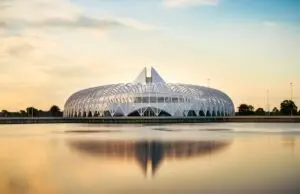
No discussion of Florida Poly’s future outlook is complete without acknowledging its physical home. The university’s iconic Innovation, Science, and Technology (IST) Building—designed by the world-renowned, late architect Dr. Santiago Calatrava—has won more than 20 global architectural awards and was named by Business Insider as one of the 16 most breathtaking buildings in the world.
Just as the futuristic white arches and kinetic louver roof of the IST Building project an image of forward-looking vision, Florida Polytechnic University itself stands as an architectural and academic monument to the future of American higher education. As it embarks on its fifth year holding the crown as the Southeast’s premier public college, Florida Poly is not merely participating in the future of technology; it is actively engineering it.

0 Comments