

LAKELAND, Fla. — In a testament to its unwavering commitment to academic rigor, institutional growth, and specialized STEM education, Florida Polytechnic University has once again captured the top spot in the U.S. News & World Report 2024–2025 Best Colleges rankings. For the fourth straight year, Florida Poly has been named the No. 1 public college in the Southeast, cementing its reputation as a powerhouse of technological and engineering education in the United States.
This latest accolade is not an isolated achievement. The university has simultaneously secured a prestigious Top 20 national ranking for its public engineering programs (specifically among institutions without a Ph.D.) for the second consecutive year, while also being named the No. 2 best value public college in the Southeast.
As higher education faces mounting scrutiny regarding return on investment, curriculum relevance, and institutional adaptability, Florida Poly’s trajectory offers a compelling case study in focused, strategic university administration. Driven by surging student enrollment, aggressive campus expansion, and robust academic programming, the Lakeland-based institution is rapidly evolving from a regional newcomer into a nationally recognized epicenter for science, technology, engineering, and mathematics (STEM).
Executive Overview: A Triumph of Focused STEM Education
To understand Florida Poly’s sustained dominance in the U.S. News rankings, one must examine the unique structural identity of the institution. As the only state university in Florida dedicated exclusively to STEM fields, Florida Poly was founded with a singular, uncompromised mission: to produce highly trained, job-ready technical talent equipped to meet the demands of the 21st-century global economy.
The university’s recent achievements span multiple dimensions of higher education excellence:
- Regional Dominance: Holding the No. 1 public college position in the Southeast for four consecutive years reflects consistent, high-level institutional performance in student retention, graduation rates, faculty resources, and peer assessment.
- National Engineering Recognition: Ranking within the Top 20 public undergraduate engineering programs nationally highlights the institution’s ability to compete with—and often outperform—much larger, legacy universities.
- Exceptional Value: Earning the No. 2 spot for best-value public colleges in the region demonstrates that high-tier STEM education can remain accessible and financially responsible for students and families.
- Exponential Growth: Surpassing previous milestones in enrollment, housing capacity, and physical infrastructure, the university is scaling its operations to meet surging market demand without sacrificing educational quality.
University leadership views these rankings as external validation of an internal philosophy that prioritizes applied research, cross-disciplinary collaboration, and deep integration with industry partners.
Detailed Chronology: The Milestones Fueling Florida Poly’s Ascent
Florida Poly’s rise up the academic league tables has occurred in lockstep with a period of intense, highly coordinated institutional expansion. Over the past 12 to 18 months, the university has crossed several critical thresholds in enrollment, academic development, and physical infrastructure.
Fall 2024: Record-Breaking Enrollment and Program Expansion
The momentum heading into the current academic year has been nothing short of historic. For the Fall 2024 semester, Florida Poly welcomed an incoming student body exceeding 1,770 students, representing a staggering 10% year-over-year increase. This growth is particularly noteworthy given the selective admissions criteria required to maintain the caliber of a top-tier STEM institution.
Simultaneously, the university has expanded its graduate offerings to meet the advanced technical needs of modern industry. Florida Poly officially launched two new Master of Science degree programs: one in electrical engineering and another in mechanical engineering. These advanced programs are designed to provide localized pathways for engineering graduates to deepen their expertise, feeding advanced R&D talent directly into Florida’s burgeoning high-tech corridors.
Infrastructure and Campus Development
An expanding student body requires a parallel expansion of physical assets. Over the past year, Florida Poly’s campus has transformed into a dynamic construction zone, marked by several milestone completions and groundbreakings:
- Expanded Student Housing: To accommodate the influx of incoming scholars, a brand-new third student residential building opened precisely on schedule for the start of the academic year. This modern facility injected an additional 430 beds into the campus housing inventory, helping to foster a vibrant, residential campus community.
- The Gary C. Wendt Engineering Building: Construction is advancing rapidly on this state-of-the-art, 40,000-square-foot facility. Slated for completion in spring 2025, the Wendt Engineering Building will house advanced laboratories, collaborative workspaces, and cutting-edge equipment designed to elevate both undergraduate and graduate research initiatives.
- The Student Achievement Center: Following a crucial initial funding allocation from the Florida Legislature, the first phase of development for the Student Achievement Center has officially commenced. This facility is envisioned as a central hub for student support services, career development, and leadership training.
Supporting Context & Metrics: Behind the U.S. News Methodology
The U.S. News & World Report Best Colleges rankings are among the most influential and closely watched metrics in global higher education. The methodology evaluates institutions across a comprehensive array of indicators, including graduation and retention rates, social mobility, faculty resources, financial resources per student, and expert opinion from academic leaders.
For a specialized, single-focus institution like Florida Poly, maintaining dominance in these categories requires careful balancing:
- Faculty-to-Student Ratio: By keeping class sizes manageable and ensuring direct access to world-class faculty, Florida Poly fosters an environment where undergraduate students routinely participate in high-level, publishable research—an opportunity often reserved for graduate students at larger universities.
- Employer Demand and Outcomes: ABET-accredited degrees combined with mandatory or highly encouraged internships ensure that Florida Poly graduates enter the workforce with practical experience. This directly influences metrics related to post-graduation employment rates and starting salaries.
- Affordability and ROI: The "Best Value" ranking takes into account an institution’s academic quality alongside the net cost of attendance for a student who receives the average level of need-based financial aid. Florida Poly’s high standing here proves that elite engineering education does not necessitate crippling student loan debt.
Official Statements: Leadership Perspectives on the Road Ahead
The leadership team at Florida Polytechnic University attributes these consecutive top-tier rankings to a shared institutional vision and the tireless dedication of the campus community.
Dr. Devin Stephenson, president of the university, emphasized the broader implications of the regional and national recognition:
"Maintaining such remarkable rankings at the regional and national levels demonstrates that students and academic leaders are recognizing Florida Poly as an excellent provider of high-quality STEM degrees. This recognition is a clear sign that our innovative educational approach is making a significant impact, and our strategic plans for sustained growth will drive us toward even greater success."
Echoing these sentiments, Dr. Brad Thiessen, interim provost and vice president of academic affairs, pointed to the direct link between academic rigor and institutional mission:
"These rankings underscore the exceptional quality of our academic programs and reaffirm Florida Poly’s standing as a leading STEM institution. As we continue to grow and fulfill our mission, we remain focused on expanding our high-demand academic degrees and fostering a vibrant learning environment for all our students."
Both leaders stressed that complacency is not an option. Even as celebrations over the 2024–2025 rankings take place, internal committees are already strategizing for the next phase of institutional evolution.
Future Outlook: Sustaining Momentum in a Competitive STEM Landscape
As Florida Polytechnic University looks toward the remainder of the decade, the horizon is characterized by both immense opportunity and distinct challenges. The demand for qualified STEM professionals—particularly in fields such as artificial intelligence, advanced manufacturing, aerospace engineering, cybersecurity, and renewable energy—has never been higher.
Florida Poly is uniquely positioned to capitalize on this macroeconomic demand. By anchoring its educational model in applied research and direct industry partnerships, the university acts as a powerful economic engine for the state of Florida. Rather than operating in an academic vacuum, Florida Poly’s faculty and students regularly collaborate with corporate partners to solve real-world problems, ensuring that the curriculum evolves in real-time alongside technological innovations.
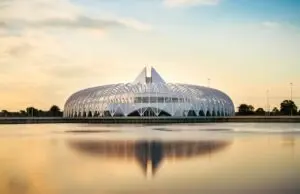
Furthermore, the physical beauty and architectural significance of the campus continue to serve as a powerful magnet for top-tier talent. The iconic Innovation, Science, and Technology (IST) Building—designed by world-renowned architect Dr. Santiago Calatrava—has garnered more than 20 global awards and was famously named one of the 16 most breathtaking buildings in the world by Business Insider. This architectural marvel is more than just a visual statement; it is a functional incubator for creativity, engineering genius, and collaborative learning.
Looking forward, the university’s strategic roadmap includes:
- Curriculum Adaptation: Continuous evaluation of undergraduate and graduate programs to integrate emerging technologies, such as machine learning applications in engineering and sustainable infrastructure design.
- Research Expansion: Increasing grant acquisitions and deepening partnerships with federal agencies and private sector leaders to bolster the institution’s applied research output.
- Community Integration: Deepening ties with the local and regional business communities in Central Florida to ensure regional economic resilience and abundant internship pipelines for students.
Conclusion
Florida Polytechnic University’s fourth consecutive year as the No. 1 public college in the Southeast is much more than a line item in a higher education magazine. It is a validation of a bold institutional experiment: creating a specialized, uncompromised public STEM university designed from the ground up for the modern technological age.
With record enrollment, expanding graduate programs, state-of-the-art facilities like the Gary C. Wendt Engineering Building, and a proven track record of producing career-ready graduates, Florida Poly is not merely resting on its laurels. It is actively engineering the future of higher education in Florida and across the nation.

0 Comments