

LAKELAND, Fla. — In an era where higher education faces unprecedented scrutiny regarding return on investment, institutional agility, and academic rigor, Florida Polytechnic University (Florida Poly) continues to cement its status as a powerhouse for science, technology, engineering, and math (STEM) education.
For the fourth consecutive year, U.S. News & World Report has named Florida Poly the No. 1 public college in the Southeast in its highly anticipated 2024–2025 Best Colleges rankings. This sustained dominance underscores the institution’s relentless commitment to academic excellence, student success, and targeted innovation.
Beyond its regional crown, Florida Poly has captured national attention, securing a position among the Top 20 public engineering programs without a Ph.D. in the United States for the second consecutive year. Furthermore, the university was designated as the No. 2 best value public college in the Southeast, proving that elite-tier STEM education can be both accessible and economically viable.
These latest accolades arrive on the heels of a transformative period for the Lakeland-based institution. Characterized by surging enrollment numbers, aggressive campus expansion, and the continuous refinement of its high-demand curriculum, Florida Poly is rapidly evolving from a bold regional experiment into an internationally recognized model for specialized public higher education.
Executive Overview: A Legacy of Sustained Excellence
The release of the 2024–2025 U.S. News & World Report rankings marks more than just a momentary triumph for Florida Poly; it represents a validation of a strategic long-term vision. Founded as the State University System of Florida’s 12th institution and its only campus dedicated exclusively to STEM education, Florida Poly has consistently punched above its weight class.
The university’s ability to defend its No. 1 ranking in the Southeast for four straight years speaks volumes about institutional consistency. In higher education, reaching the top is difficult, but maintaining that position requires continuous adaptation, faculty retention, student support, and alignment with modern industry needs.
Key Accolades at a Glance:
- No. 1 Public College in the Southeast: Fourth consecutive year (U.S. News & World Report).
- Top 20 Public Engineering Program (No Ph.D.): Second consecutive year nationally (U.S. News & World Report).
- No. 2 Best Value Public College in the Southeast: Highlighting affordability and career outcomes.
According to university leadership, these rankings reflect a broader cultural shift in how students, parents, and academic peers view specialized STEM institutions. Rather than spreading resources across a broad liberal arts curriculum, Florida Poly focuses its capital, intellectual property, and pedagogical strategies entirely on the technical disciplines that drive the modern global economy.
Detailed Chronology: Growth, Expansion, and Milestone Achievements
The path to the 2024–2025 U.S. News ranking is paved with a series of deliberate, high-impact milestones achieved over the past twelve months. From groundbreaking ceremonies to record-breaking demographic shifts, the university’s upward trajectory is visible across every metric of institutional health.
Fall 2024 Enrollment Surges
The academic year kicked off with a historic milestone: Florida Poly welcomed a record-breaking student body of over 1,770 students for the Fall 2024 semester. This represents a robust 10% year-over-year increase, signaling strong demand among high-achieving students seeking rigorous technical training. This growth is particularly noteworthy given tightening national demographics and shifting public perceptions regarding the value of a traditional four-year degree. Students are increasingly voting with their feet, flocking to institutions that offer clear pathways to high-paying, future-proof careers in engineering and computer science.
Curriculum Evolution: New Master’s Degrees
To meet the escalating demands of high-tech industries, Florida Poly expanded its graduate offerings ahead of the 2024–2025 academic year. The university launched two new Master of Science degrees:
- Electrical Engineering
- Mechanical Engineering
These programs are engineered to bridge the gap between theoretical research and practical industrial application, providing graduates with the advanced analytical tools required to lead R&D departments, aerospace firms, advanced manufacturing facilities, and technology corporations.
Capital Improvements and Infrastructure
Physical expansion has matched academic growth step-for-step. To accommodate the influx of incoming scholars, Florida Poly completed and opened its third student residential building precisely on schedule for the start of the academic year. The new facility injects an additional 430 beds into the campus housing inventory, easing student housing pressures and fostering a more vibrant, on-campus residential community.
Simultaneously, construction has accelerated on the state-of-the-art Gary C. Wendt Engineering Building. This 40,000-square-foot facility is slated for completion by spring 2025. It will serve as an epicenter for advanced engineering research, collaborative student projects, and cutting-edge laboratory work.
Furthermore, following a crucial initial funding allocation from the Florida Legislature, the university has officially broken ground on the first phase of the Student Achievement Center. This facility is designed to house comprehensive academic support services, career counseling, leadership development programs, and student organizations, ensuring holistic support for the campus community.
Supporting Context & Metrics: The Anatomy of a STEM Powerhouse
To fully grasp the significance of Florida Poly’s ascent, one must examine the unique structural framework that separates it from comprehensive universities.
As a dedicated STEM institution, Florida Poly operates under a distinct operational philosophy. Every academic program—from computer science and data analytics to electrical and mechanical engineering—is built around mandatory internships, senior capstone projects, and applied research initiatives. This hands-on pedagogy ensures that students do not graduate with abstract theoretical knowledge alone; they leave with demonstrable portfolios of completed engineering projects.
The Economic Engine of Central Florida
Beyond its academic footprint, Florida Poly functions as a critical economic catalyst for the state of Florida. Located along the high-tech corridor connecting Tampa and Orlando, the university serves as an intellectual and commercial bridge between academic research and private-sector innovation.
- Industry Partnerships: The university collaborates directly with regional and national corporations, providing them with a steady stream of highly trained engineering talent while solving complex technical challenges through applied research.
- ABET Accreditation: All of Florida Poly’s eligible engineering and computing programs hold prestigious ABET accreditation, assuring employers that graduates have met the highest international standards of technical education.
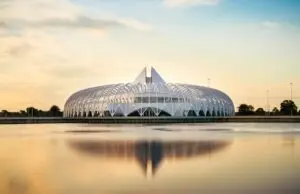
- Architectural Iconography: The university’s campus is anchored by the world-renowned Innovation, Science, and Technology (IST) Building. Designed by Spanish architect Dr. Santiago Calatrava, the structure has won more than 20 global architectural awards and was named by Business Insider as one of the 16 most breathtaking buildings in the world. While its aesthetic brilliance is undeniable, the building also serves as a functional, light-filled laboratory for the minds shaping the future of technology.
Official Statements: Leadership Perspectives
The announcement of the 2024–2025 rankings prompted reflections from university leadership regarding past achievements and future aspirations.
Dr. Devin Stephenson, president of Florida Polytechnic University, emphasized the broader implications of the rankings in a statement celebrating the institution’s streak:
"Maintaining such remarkable rankings at the regional and national levels demonstrates that students and academic leaders are recognizing Florida Poly as an excellent provider of high-quality STEM degrees. This recognition is a clear sign that our innovative educational approach is making a significant impact, and our strategic plans for sustained growth will drive us toward even greater success."
Echoing these sentiments, Dr. Brad Thiessen, interim provost and vice president of academic affairs, highlighted the internal academic standards driving the university’s external reputation:
"These rankings underscore the exceptional quality of our academic programs and reaffirm Florida Poly’s standing as a leading STEM institution. As we continue to grow and fulfill our mission, we remain focused on expanding our high-demand academic degrees and fostering a vibrant learning environment for all our students."
Both administrators point to a shared institutional culture defined by agility, student-centric instruction, and an uncompromising focus on workforce readiness.
Future Outlook: Sustaining Momentum in a Competitive Landscape
As Florida Polytechnic University looks toward the remainder of the decade, the challenge will be managing its rapid growth without sacrificing the personalized education model that fueled its initial success.
With the completion of the Gary C. Wendt Engineering Building in spring 2025 and the ongoing development of the Student Achievement Center, physical infrastructure will support the anticipated continued rise in enrollment. Furthermore, the newly minted graduate programs in electrical and mechanical engineering position the university to capture a larger share of the advanced technical training market.
In an increasingly automated and technology-driven global economy, the demand for specialized, adaptive STEM institutions has never been higher. By continuously refining its curriculum, forging deep industry partnerships, and maintaining top-tier educational quality at an affordable price point, Florida Polytechnic University has proven that it is not just participating in the future of higher education—it is engineering it.

0 Comments