

Executive Overview
As the Sunshine State hurtles toward a high-stakes Tuesday primary election, early voting metrics reveal a familiar yet shifting electoral dynamic across Florida’s 67 counties. With more than 1.8 million Floridians having already cast their ballots as of mid-August, the preliminary data highlights distinct strategic divides between the state’s two major political parties. Republicans have leveraged a robust ground game to secure a commanding lead in overall pre-Election Day turnout, driven primarily by dominant participation in in-person early voting. Conversely, Democrats have maintained their traditional firewall via vote-by-mail ballots, outpacing the GOP in returned postal votes by a notable margin.
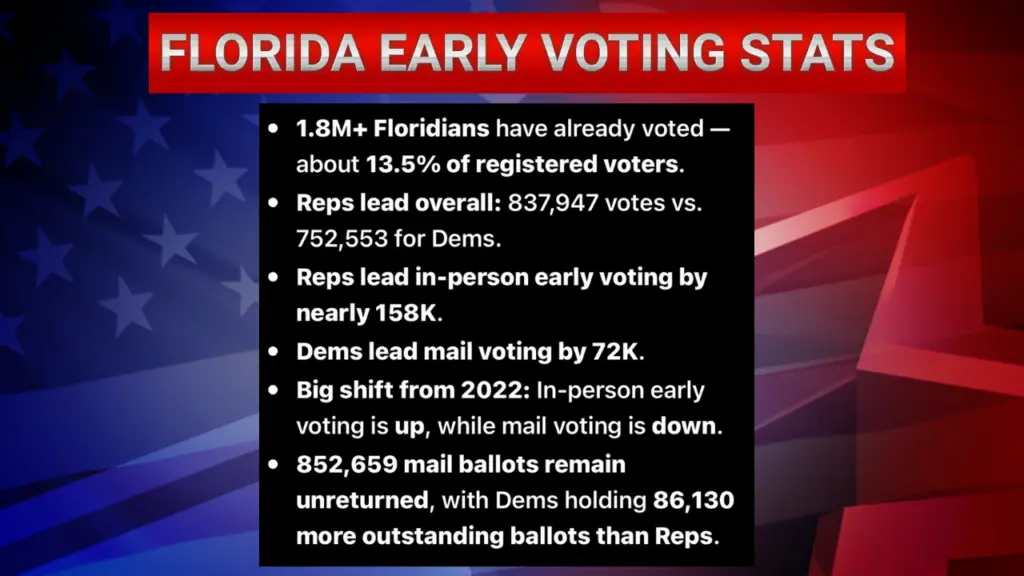
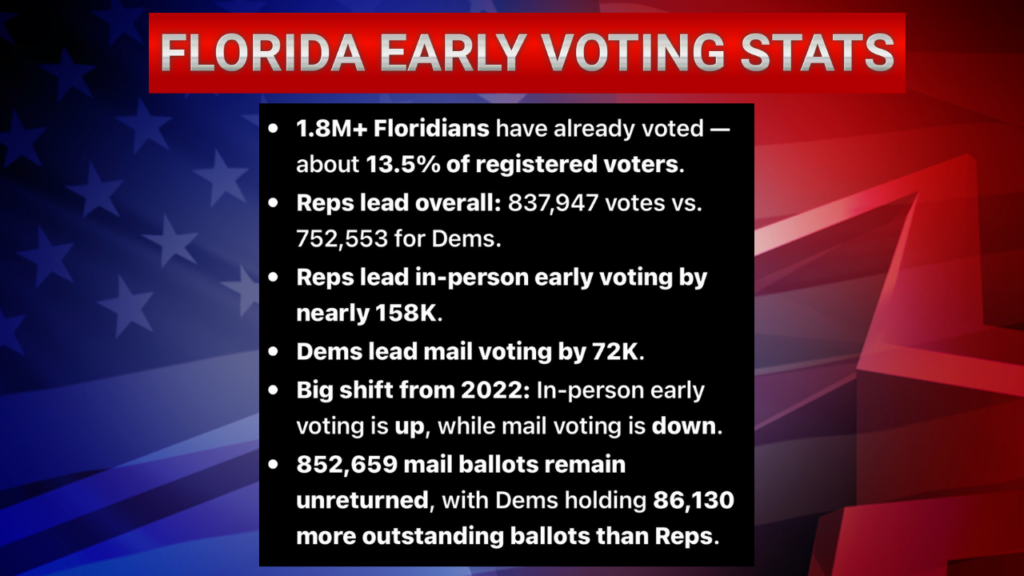
Statewide data compiled as of 11:00 a.m. on August 16 indicated that 1,816,739 vote-by-mail and early voting ballots had been officially tabulated. This total represents approximately 13.5% of Florida’s massive pool of registered voters. A granular breakdown of these early returns reveals a closely contested pre-Election Day landscape: registered Republicans have cast 837,947 ballots, closely followed by registered Democrats with 752,553 ballots. Meanwhile, voters registered with no party affiliation (NPA) or alternative third parties accounted for more than 226,000 of the total ballots submitted.
Despite the impressive pre-Election Day totals, political analysts and election supervisors emphasize that these figures represent only a fraction of the total electorate. Hundreds of thousands of mail-in ballots remain unreturned, and 11 of Florida’s most populous counties extended their early voting windows through Sunday, signaling that the pre-election tallies will climb higher before the final precincts open on Tuesday morning. Furthermore, because Florida operates under a closed-primary system, the structural dynamics of these early returns must be viewed through the lens of party-registration rules that restrict participation in partisan contests strictly to registered members of that respective organization.
Detailed Chronology of the Pre-Election Voting Period
The path to the August primary has been characterized by a steady, methodical accumulation of early votes, punctuated by targeted pushes from both political parties to mobilize their respective bases. Understanding the timeline of these returns provides critical insight into voter behavior and administrative preparations across Florida’s diverse electoral jurisdictions.
The Initial Phase and State-Update Benchmarks
The early voting period commenced weeks ahead of the primary, operating under statutory guidelines designed to provide maximum accessibility while ensuring rigorous chain-of-custody protocols for mail-in ballots. By mid-August, election offices across the state were reporting a steady stream of returned postal votes, even as in-person early voting sites began opening their doors to the public.
By the morning of August 16, the cumulative statewide tally crossed the 1.8 million threshold. At this critical juncture—frozen statistically at 11 a.m. on that Saturday—the data exposed an immediate partisan divergence. While the total number of ballots cast favored the GOP, the underlying mechanics showed a tale of two distinct voting methods. Republicans had successfully channeled their supporters into physical voting booths during the early voting window, whereas Democratic voters favored the convenience and security of postal voting, a trend that has accelerated significantly over past election cycles.
Extending the Window: The Final Weekend Push
Recognizing the high stakes of the primary contests—ranging from competitive congressional nominations to crucial municipal and county offices—election officials in 11 heavily populated counties took the proactive step of extending in-person early voting through Sunday evening. This late-stage expansion directly affected some of the largest voter pools in the state.
The counties that chose to keep their early voting sites open through the final weekend included:
- Broward County
- Duval County
- Hillsborough County
- Leon County
- Manatee County
- Miami-Dade County
- Orange County
- Osceola County
- Palm Beach County
- Pinellas County
- Sarasota County
This geographical footprint encompasses millions of eligible voters, spanning major urban centers in South Florida, the Tampa Bay region, Central Florida, and the state capital. The decision by supervisors of elections in these counties to utilize the full extent of their administrative authority ensured that working-class families and last-minute deciders had ample opportunity to cast their ballots before the statutory pre-Election Day cutoff, injecting additional volume into the final turnout statistics.
Supporting Context & Metrics: Breaking Down the Numbers
A deeper examination of the statistical data illuminates the strategic strengths and vulnerabilities of each political faction as they head toward the primary finish line. The metrics underscore how contrasting mobilization strategies have shaped the pre-Election Day electorate.
In-Person Early Voting: The Republican Stronghold
The foundation of the Republican pre-Election Day advantage rests squarely on in-person voting. State records show that a total of 420,102 registered Republicans utilized early voting sites across Florida. In contrast, 262,309 registered Democrats cast their ballots in person during the same timeframe.
This translates to a substantial GOP advantage of nearly 158,000 votes in the physical voting booths. Additionally, voters not affiliated with either major party, along with members of minor third parties, made their presence felt at early voting sites: 49,351 NPA voters and 7,026 minor-party registrants completed their ballots in person. Political strategists note that this aggressive in-person turnout among Republicans reflects a concerted effort by party leadership to encourage traditional Election Day voters to bank their votes early, thereby mitigating the risk of inclement weather, personal emergencies, or administrative delays on Tuesday.
Vote-by-Mail: The Democratic Firewall
While Republicans dominated the physical polling locations, Democrats retained their historical edge in vote-by-mail participation. State data confirmed that 490,244 Democratic vote-by-mail ballots had been successfully completed, returned, and logged by election supervisors as of the August 16 update.
By comparison, registered Republicans had returned 417,845 mail ballots. This gave Democrats a net advantage of more than 72,000 votes in the mail-in category. Furthermore, non-party-affiliation voters submitted 151,792 mail ballots, while minor-party registrants contributed another 18,070 returned postal votes. The Democratic reliance on mail-in ballots reflects a multi-cycle organizational strategy focused on secure, long-term ballot chasing, though it also leaves them vulnerable if mail-in returns lag behind projected models.
The Outstanding Mail Ballot Universe
Perhaps one of the most critical metrics for election observers heading into Tuesday is the sheer volume of unreturned postal ballots. As of the August 16 update, 852,659 vote-by-mail ballots remained unreturned across the state.
This massive pool of outstanding paper ballots represents a potential reserve of votes that could dramatically influence close primary contests if dropped off at secure drop-boxes or election offices before the 7:00 p.m. Tuesday deadline. The partisan breakdown of these unreturned ballots is as follows:

- Registered Democrats: 352,314 outstanding mail ballots
- Registered Republicans: 266,184 outstanding mail ballots
- No Party Affiliation (NPA): 209,803 outstanding mail ballots
- Other/Minor Parties: 24,358 outstanding mail ballots
With Democrats holding a larger share of these outstanding postal votes, party coordinators engaged in frantic "cure" and "get-out-the-vote" operations over the final 48 hours to ensure that these ballots were properly signed, sealed, and delivered to county supervisors.
Official Guidelines, Rules, and Structural Realities
To fully interpret the early voting statistics, one must understand the unique legal and structural framework governing Florida elections. Most notably, Florida is classified as a closed-primary state.
The Impact of Closed Primaries
Under Florida election law, registered voters may generally participate only in the primary elections of the specific political party with which they are officially registered. This statutory requirement creates a profound structural barrier for voters registered with no party affiliation (NPAs) or third parties, effectively locking them out of partisan primary contests where the nominees for governor, cabinet positions, the state legislature, and Congress are decided.
However, NPAs and minor-party voters are far from disenfranchised during the primary cycle. They retain full legal rights to participate in:
- Nonpartisan Contests: Any nonpartisan races appearing on their specific ballot, such as judicial elections, school board seats, and various local referendums.
- Universal Primary Contests: Under a well-known provision of the Florida Constitution, if all candidates running for a specific office belong to the same political party and no opposition has qualified for the general election (including write-in candidates), the primary becomes a "universal primary" open to all registered voters of that district, regardless of party affiliation. In these rare instances, the winner of the primary effectively secures the seat.
Understanding the Limitations of Early Metrics
Election supervisors and political scientists frequently issue cautionary notes regarding the interpretation of early voting and mail-in data. Pre-Election Day numbers should never be viewed as definitive predictors of final election outcomes or total turnout.
The partisan composition of the electorate can shift dramatically on Election Day itself. Historically, many conservative-leaning and moderate voters who prefer traditional voting methods wait until Tuesday to cast their ballots at their assigned neighborhood precincts. Consequently, an early lead in postal or in-person voting does not guarantee victory; it merely establishes a baseline of banked votes that campaigns must either protect or overcome when the physical polls open at sunrise on Tuesday.
Future Outlook: What to Watch on Election Night
As the pre-Election Day window closes and attention shifts squarely to Tuesday’s primary showdown, political observers are monitoring several key indicators that will determine the ultimate winners and losers across Florida.
Key Factors for Election Night
- Election Day Turnout Surges: Will traditional Election Day voters show up in numbers sufficient to offset the massive early-vote tallies compiled by Republicans? Analysts will be tracking precinct-level data closely as returns begin flowing in shortly after 7:00 p.m. local time.
- Cure Rates and Late Mail Ballots: With hundreds of thousands of mail ballots requested and not yet logged as of the mid-August update, the final tally will depend heavily on how many of those remaining postal votes were successfully cured (in cases of signature discrepancies) and processed by county election workers before the strict legal deadline.
- Impact of Local Extended Voting: Will the voters in the 11 counties that extended early voting through Sunday provide a decisive block in hotly contested regional and statewide primaries? The localized impact of these extra voting hours in population centers like Miami-Dade, Broward, Hillsborough, and Orange counties could prove pivotal in tight races.
- NPA Participation in Nonpartisan Contests: With over 226,000 non-aligned voters having already cast ballots through early voting and mail-in methods, their collective influence on nonpartisan local races and universal primaries will be a major storyline to watch as results are certified.
As precincts across Florida prepare to close their doors and tabulate the final votes, the stage is set for a dramatic conclusion to a primary season defined by aggressive early mobilization, strategic postal voting, and the enduring complexity of the state’s electoral machinery.

0 Comments