

Executive Overview
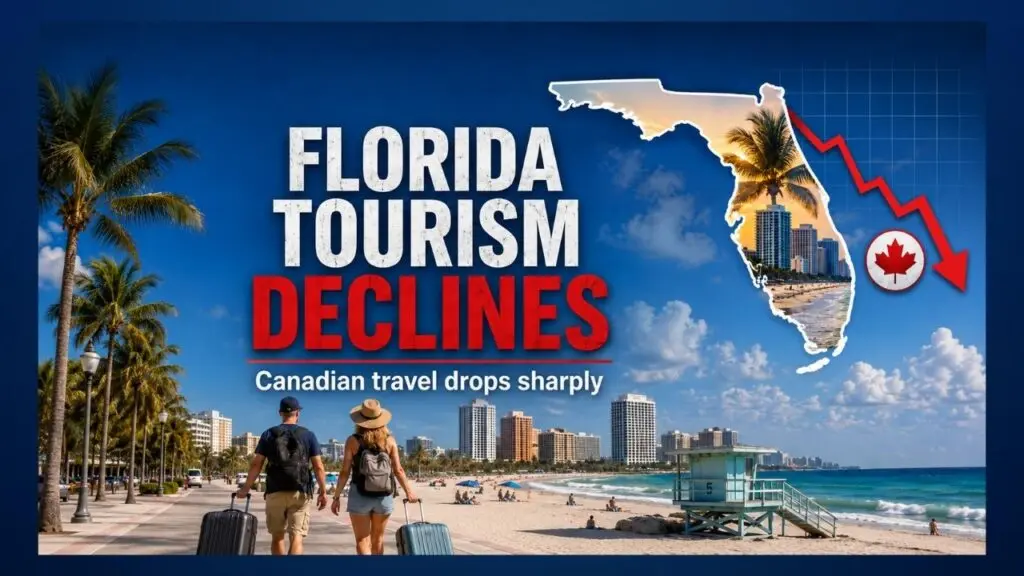
Florida’s powerhouse tourism industry is facing an unfamiliar landscape. Following years of post-pandemic record-breaking growth—culminating in an all-time high of 143.3 million visitors in 2025—the Sunshine State is experiencing a noticeable cooling trend. According to newly released data from Visit Florida, the state’s official tourism marketing agency, Florida welcomed 73.5 million visitors during the first half of 2026. This figure represents a 1.4% decline compared to the 74.5 million travelers who visited during the same period last year.
This contraction marks the second consecutive quarter of declining tourism numbers for the state. While domestic and overseas markets have shown resilience with minor adjustments, the most striking aspect of the downturn is a sharp, prolonged drop in Canadian visitation. Economic headwinds, persistent inflation, and rising geopolitical and trade tensions between Washington and Ottawa have converged to reshape travel patterns.
Despite these immediate challenges, state economists and industry leaders emphasize that Florida’s overarching tourism infrastructure remains robust, sitting well above pre-pandemic benchmarks. However, warning signs are flashing across financial sectors. State revenue forecasters point to stretched consumer credit balances and a mismatch between inflation and wage growth as potential dampening factors. In response, tourism executives are aggressively pivoting marketing strategies, looking to diversify attractions, highlight historical milestones, and support rural main streets across the state.
Detailed Chronology & Quarterly Breakdown
A granular look at the data provided by Visit Florida and regional reports—such as those highlighted by Fox 35 Orlando—reveals how the slowdown has materialized across the first half of 2026.
The Second-Quarter Slump
From April through June 2026, Florida welcomed an estimated 34.01 million visitors. This represents a modest 0.7% decrease compared to the second quarter of 2025. While a sub-one-percent drop might appear negligible at a glance, it compounds the downward momentum established earlier in the year, cementing a rare back-to-back quarterly contraction for a state accustomed to uninterrupted expansion.
First-Half Totals: By the Numbers
Aggregating the first six months of the year, the state’s total visitation tally stands at 73.5 million—down 1.4% from the roughly 74.5 million recorded during the first half of 2025.
The breakdown across visitor segments highlights where the declines are concentrated:
- Domestic Travelers: Domestic visitors continue to form the bedrock of Florida’s tourism economy, accounting for the vast majority of all arrivals. In the second quarter of 2026, domestic visitation ticked down slightly to 31.08 million, compared to 31.22 million during the same period in 2025. For the entire six-month stretch, domestic travel reached 67.33 million, down from 68.2 million year-over-year.
- Overseas Visitors: International travel from overseas markets displayed mixed momentum. During the second quarter, overseas visitation fell 3.7% to approximately 2.21 million visitors. However, strong performance in the early months of the year kept cumulative overseas travel for the first half of 2026 up by 2.2% compared to the first half of 2025.
- Canadian Travelers: The steepest and most concerning slide occurred within the Canadian market. Second-quarter Canadian visitation dropped to approximately 721,000—a 4.2% decline from the previous year. Looking at the first six months combined, Canadian travel plummeted by 13.9%, falling to approximately 1.68 million visitors.
To put the Canadian decline into historical perspective, current numbers remain depressed relative to pre-pandemic baselines. In the second quarter of 2019, Florida welcomed roughly 848,000 Canadians, with 2.29 million arriving during the first half of that year. The gap between pre-pandemic norms and 2026 reality underscores a structural shift in how northern neighbors are allocating their vacation time and discretionary dollars.

Supporting Context & Metrics: Economic and Political Pressures
To understand why Canadian visitation is lagging so severely, industry analysts are looking beyond simple seasonal fluctuations. A comprehensive July report from Statistics Canada pointed to a broader, more systemic change in travel habits, explicitly noting that early 2026 data indicates "a persistent shift away from the United States by Canadian residents in their travel preferences."
The Geopolitical Factor
This behavioral shift has coincided with a notable cooling of diplomatic and economic relations between the United States and Canada. Tensions have mounted over U.S. trade policies, ongoing trade disputes, and controversial rhetoric from President Donald Trump, who has repeatedly referred to Canada as the "51st state" in public remarks. Furthermore, Canadian Prime Minister Mark Carney has publicly criticized recent U.S. trade proposals, emphasizing that bilateral agreements are under strain. In a recent statement addressing the shifting landscape, Carney remarked, "We recognize that sometimes, its signature is written in pencil."
However, analysts caution against oversimplifying the crisis. While political friction and rhetorical barbs undoubtedly influence consumer sentiment, economic realities play a massive role. Inflation, unfavorable exchange rates, and tighter household finances across Canada are forcing families to reassess discretionary spending. Furthermore, data does not yet establish a precise mathematical formula separating political animus from pocketbook economics.
Broad Economic Warning Signs in Florida
The economic pressures are not isolated to international visitors. On August 14, Florida’s Revenue Estimating Conference issued an update signaling that state economists are keeping a wary eye on broader macroeconomic indicators.
Key risk factors identified by state economists include:
- Wage Lag: Inflation has consistently outpaced wage growth over the past year, squeezing middle-class purchasing power.
- Credit Reliance: Consumers are increasingly depending on credit cards and personal loans to maintain their spending habits, a trend economists warn is unsustainable over the long term.
- Cooling Sectors: Federal projections point toward slower growth trajectories not just in tourism, but also in critical complementary sectors like construction and real estate.
Despite these warning lights, Florida’s tourism baseline remains elevated. The state’s historic performance in 2025—which saw a record-shattering 143.3 million visitors—followed a post-pandemic trend where annual totals routinely cleared the previous 2019 benchmark of 131 million. The current 2026 data represents a cooling from record highs rather than an outright collapse, but it serves as an early warning for an industry that generates billions in taxable revenue.
Official Statements and Industry Response
Tourism is the lifeblood of Florida’s economy, supporting hundreds of thousands of jobs across hotels, restaurants, theme parks, rental car agencies, and local small businesses. Recognizing the potential threat of a prolonged slowdown, state agencies and industry leaders are aggressively adapting their promotional playbooks.
Diversifying Beyond Traditional Hubs
Visit Florida is executing a multi-pronged strategy designed to stimulate domestic engagement and entice travelers off the beaten path. Rather than relying solely on the state’s legendary theme park capitals and coastal beach resorts, the agency is directing marketing muscle toward historical sites and rural communities.

This strategy heavily incorporates the upcoming national semiquincentennial (the United States’ 250th anniversary), positioning Florida as a rich repository of early American history. By shining a spotlight on lesser-known destinations, Visit Florida aims to inject capital into local economies that rarely see the windfall generated by major metropolitan hubs.
In an August 12 interview with reporters, Visit Florida President and CEO Bryan Griffin articulated the philosophy behind this localized push:
"Tourism and travel make such a big difference for something like a main street, a restaurant, a lodging or an attraction around the state."
The Broader Recovery Narrative
The current dip stands in stark contrast to the explosive rebound Florida experienced in the wake of the COVID-19 pandemic. When global travel ground to a halt in 2020, Florida’s tourism economy suffered historic losses. However, aggressive reopening strategies and an influx of domestic road-trippers spurred a rapid recovery. By 2022, statewide visitation had eclipsed 2019 pre-pandemic records, kicking off a golden era of growth that lasted through 2025.
By contrast, the Canadian market’s recovery has been sluggish and erratic. Statistics Canada has noted that the current 11-month stretch of year-over-year declines in Canadian travel to the U.S. represents the deepest and longest downturn outside of the pandemic era.
Future Outlook: What Lies Ahead for Florida Tourism?
As the state transitions from the bustling summer months into the critical autumn planning period, industry stakeholders are intensely focused on the upcoming winter tourism season. Traditionally, winter marks the arrival of "snowbirds"—hundreds of thousands of Canadians who migrate south to escape harsh northern winters, renting properties and spending months supporting local commerce.
Key Questions for the Winter Season
- Will Canadians Return? The million-dollar question for Florida hoteliers and property managers is whether the persistent drop in Canadian visitation will reverse as winter approaches, or if economic pressures and anti-U.S. sentiment will prompt travelers to explore domestic options or alternative warm-weather destinations like Mexico and the Caribbean.
- Can Domestic Vigor Hold? With consumer credit tightening and inflation biting into disposable income, domestic travelers may begin trimming short-trip getaways and weekend vacations.
- Will Marketing Initiatives Offset Losses? Visit Florida’s pivot toward rural tourism and historical milestones will be put to the test as the agency attempts to capture a new demographic of heritage-focused travelers.
Conclusion
Florida’s tourism sector is by no means in crisis, but the numbers for the first half of 2026 serve as a clear reminder that no market is immune to macroeconomic and geopolitical shifts. While the state continues to enjoy the fruits of a historic post-pandemic boom, the convergence of Canadian trade tensions, consumer financial strain, and cooling quarterly metrics suggests that maintaining record-breaking visitor numbers will require proactive stewardship, strategic marketing, and vigilant economic forecasting in the months and years ahead.

0 Comments