
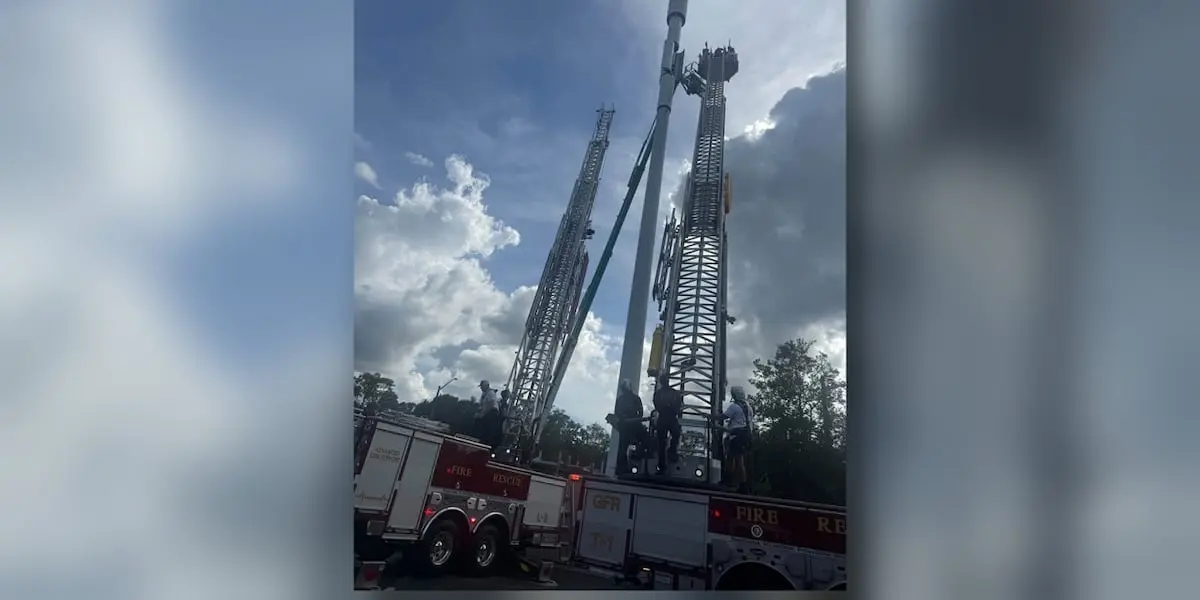

GAINESVILLE, Fla. — A high-stakes emergency operation unfolded in North-Central Florida on Tuesday afternoon as municipal rescue crews successfully extracted a team of utility technicians stranded nearly ten stories in the air on a telecommunications tower.
The incident, which occurred along the busy commercial corridor of Northwest 34th Boulevard, drew a rapid, multi-agency response from Gainesville Fire Rescue (GFR) and local emergency medical services. While the rescue concluded with no reported injuries, it has re-ignited critical discussions surrounding industrial safety protocols, the physical demands placed on telecommunications infrastructure workers, and the specialized technical training required of modern municipal first responders.
Executive Overview
On the afternoon of September 8, 2026, a routine maintenance and upgrade operation on a cellular tower in Gainesville, Florida, turned into a precarious waiting game for a crew of utility climbers. Positioned approximately 100 feet above the ground, the workers found themselves unable to descend safely, prompting an emergency call that mobilized the region’s premier high-angle rescue assets.
Gainesville Fire Rescue personnel arrived on the scene at Northwest 34th Boulevard to find the workers suspended on the tower’s upper superstructure. Utilizing a specialized aerial ladder apparatus, rescue technicians established a secure extraction path, systematically transferring the workers from the tower’s metal framework to the safety of the fire department’s aerial platform.
The successful resolution of the incident without casualties or physical trauma highlights the precision of local emergency response protocols. However, the event also underscores a broader systemic challenge within the telecommunications sector: the inherent risks of tower climbing, an occupation consistently ranked among the most hazardous in the United States. As local municipalities continue to expand their digital infrastructure footprint to accommodate 5G and next-generation wireless technologies, the reliance on high-angle rescue capabilities is poised to grow, demanding continuous investment in municipal training and equipment.
Detailed Chronology
The events of September 8, 2026, unfolded rapidly, requiring precise synchronization between the stranded utility crew, dispatchers, and responding emergency units.
+-----------------------------------------------------------------------------+
|                           INCIDENT TIMELINE                                 |
+-----------------------------------------------------------------------------+
|  16:30 | Emergency dispatch receives 911 call reporting stranded workers.   |
|  16:38 | GFR First Responders arrive; establish command and isolate area.   |
|  16:45 | Technical Rescue Team assesses tower stability and wind hazards.   |
|  17:00 | Aerial platform apparatus positioned; ladder extension begins.      |
|  17:15 | Rescuers make physical contact with workers at 100-foot mark.       |
|  17:30 | Safe transfer complete; workers lowered to ground level.            |
|  17:45 | Medical evaluations conclude; scene cleared by incident command.   |
+-----------------------------------------------------------------------------+
The Emergency Call and Initial Dispatch
At approximately 4:30 p.m. EDT, the Alachua County Combined Communications Center received a priority 911 call indicating that multiple utility technicians were trapped near the summit of a monopole cellular tower located off Northwest 34th Boulevard.
The initial dispatch sent a standard structural response, but the nature of the call quickly triggered the activation of Gainesville Fire Rescue’s specialized technical rescue protocols. Responding units included heavy rescue engines, command vehicles, and Tower 2—a highly specialized aerial platform vehicle designed for high-reach operations.
On-Scene Assessment and Environmental Factors
Upon arriving at the scene at 4:38 p.m., GFR incident commanders established a localized perimeter to secure the drop zone beneath the tower. First responders observed the utility workers positioned at approximately the 100-foot mark.
Initial assessments focused on several critical variables:
- Structural Integrity: Evaluating whether the tower had suffered any mechanical or structural failures that could jeopardize the rescue platform or the climbers.
- Environmental Hazards: Assessing wind speeds, localized thermal updrafts, and the proximity of high-voltage overhead power lines running parallel to Northwest 34th Boulevard.
- Worker Condition: Establishing verbal communication to verify the physical and psychological state of the stranded climbers, ensuring none were experiencing immediate medical crises such as heat exhaustion or suspension trauma.
The Extraction Operation
With wind conditions determined to be within safe operational limits, GFR personnel positioned Tower 2’s aerial apparatus. The vehicle’s hydraulic outriggers were deployed to stabilize the chassis on the uneven terrain adjacent to the utility easement.
The aerial ladder, equipped with a spacious platform bucket at its tip, was slowly extended toward the tower’s crown. A designated rescue technician in the platform bucket managed the approach to avoid contact with the delicate cellular antennas and array hardware.
Upon reaching the workers, the rescue technician secured each climber using auxiliary safety harnesses linked directly to the aerial platform’s anchor points. One by one, the technicians transitioned from the vertical climbing peg system of the cell tower into the GFR platform. By 5:30 p.m., all stranded personnel had been successfully lowered to ground level.
Post-Incident Evaluation
Once on the ground, the workers were immediately evaluated by Alachua County emergency medical technicians. Because the extraction was executed swiftly, the workers had not spent an extended period suspended statically in their personal fall-arrest harnesses—a condition that can lead to orthostatic intolerance (suspension trauma), which can be fatal within minutes if left unaddressed. Following a comprehensive medical screening, all workers were cleared on-scene with zero injuries reported.
Supporting Context & Metrics
To fully understand the significance of this rescue, it is necessary to examine both the technical demands of high-angle rescues and the broader safety landscape of the telecommunications tower industry.
The Physics and Training of High-Angle Rescue
High-angle rescue is defined by the National Fire Protection Association (NFPA) under standards NFPA 1006 (Standard for Technical Rescuer Professional Qualifications) and NFPA 1670 (Standard on Operations and Training for Technical Search and Rescue Incidents). It involves environments where the slope is equal to or greater than 60 degrees, requiring rescuers to rely entirely on ropes, rigging systems, and aerial mechanical devices for safety and mobility.
| Metric | Detail / Value |
|---|---|
| Operational Height | ~100 Feet (approx. 30.5 meters) |
| NFPA Standard Governed | NFPA 1006 & NFPA 1670 |
| Primary Rescue Apparatus | Aerial Platform Truck (Tower 2) |
| Critical Risk Factor | Suspension Trauma / Orthostatic Intolerance |
| Environmental Thresholds | Wind speeds exceeding 35 mph typically halt aerial operations |
Tower Climbing: One of America’s Most Dangerous Professions
The telecommunications industry relies on a network of roughly 300,000 cell towers across the United States. Maintenance of these structures is notoriously hazardous. According to data from the Occupational Safety and Health Administration (OSHA), the tower climbing industry experiences a disproportionately high fatality rate compared to other construction-related sectors.
Common causes of tower climbing incidents include:
- Fall Protection Failures: Improper use or failure of personal fall arrest systems (PFAS).
- Structural Overload: Failure of hoisting equipment, gin poles, or temporary rigging.
- Environmental Exposure: Extreme heat, sudden lightning strikes, or high-velocity winds.
- Equipment Malfunction: Mechanical failure of climb assist systems or descent control devices, which can leave workers stranded without a safe means of self-rescue.
In this specific incident, the rapid deployment of Gainesville Fire Rescue’s aerial apparatus bypassed the need for a complex rope-based pick-off rescue, which would have required rescuers to climb the tower manually and rappel down with the victims. The availability of a 100-foot aerial platform in the municipal fleet significantly reduced the duration of the event and minimized the physical toll on the stranded crew.
Official Statements
Following the successful conclusion of the operation, representatives from the responding agencies and industry safety advocates emphasized the importance of training, preparedness, and compliance with federal safety mandates.
Gainesville Fire Rescue
A spokesperson for Gainesville Fire Rescue praised the coordination of the responding crews:
"This incident demonstrates the absolute necessity of our continuous training in technical and high-angle rescue. When our crews arrive at a scene like Northwest 34th Boulevard, they aren’t improvising; they are executing highly rehearsed protocols. Tower 2 performed flawlessly, and our personnel worked quickly to ensure that these workers were brought down safely before environmental factors or physical exhaustion could complicate the situation. We are incredibly pleased that this ended with zero injuries."
Industry Safety and OSHA Compliance Advocates
While the specific utility company employing the workers has not publicly disclosed the exact cause of the equipment or physical failure that left the crew stranded, occupational safety experts point out that federal regulations require employers to have a dedicated, workable rescue plan in place for every climb.
Under OSHA Title 29 CFR 1926.502, employers must provide for "prompt rescue of employees in the event of a fall or shall assure that employees are able to rescue themselves."
National Association of Tower Erectors (NATE) representatives frequently emphasize that while municipal fire departments are a vital safety net, third-party contractors must maintain rigorous self-rescue training.
"Every tower climb must be treated with the utmost respect for gravity," noted an industry safety consultant. "Municipal departments like Gainesville Fire Rescue do an outstanding job, but the industry’s goal must always be self-sufficiency through robust training, double-redundant descent systems, and meticulous pre-climb hazard assessments."
Future Outlook
As the demand for high-speed data transmission, 5G expansion, and emerging 6G development continues to accelerate, the density of cellular towers and small-cell installations in urban and suburban environments will rise. This infrastructure boom carries direct implications for both the workforce and municipal emergency services.
Technological Shifts in Infrastructure Maintenance
To mitigate the risks associated with manual tower climbing, the telecommunications industry is increasingly turning to technological alternatives:
- Unmanned Aerial Vehicles (UAVs): Drones are now routinely used for structural inspections, thermal imaging, and line-of-sight analysis, drastically reducing the number of climbs required for diagnostic purposes.
- Robotic Climbing Systems: Experimental automated crawlers are being developed to ascend tower shafts to perform basic maintenance, paint application, and structural integrity scans.
- Enhanced Climb-Assist Technology: Modern towers are increasingly integrated with motorized climb-assist pulleys that reduce physical fatigue, a primary precursor to climber errors and medical emergencies.
Municipal Emergency Preparedness
For municipalities like Gainesville—home to a major research institution, the University of Florida, and a rapidly expanding regional population—maintaining a highly trained technical rescue team is no longer optional.
Local governments must continue to allocate capital for the acquisition and maintenance of high-reach aerial apparatus and advanced training certifications. The successful rescue on Northwest 34th Boulevard stands as a powerful proof of concept for these municipal investments, proving that when high-altitude emergencies arise, the readiness of local first responders remains the ultimate line of defense.

0 Comments