

Executive Overview
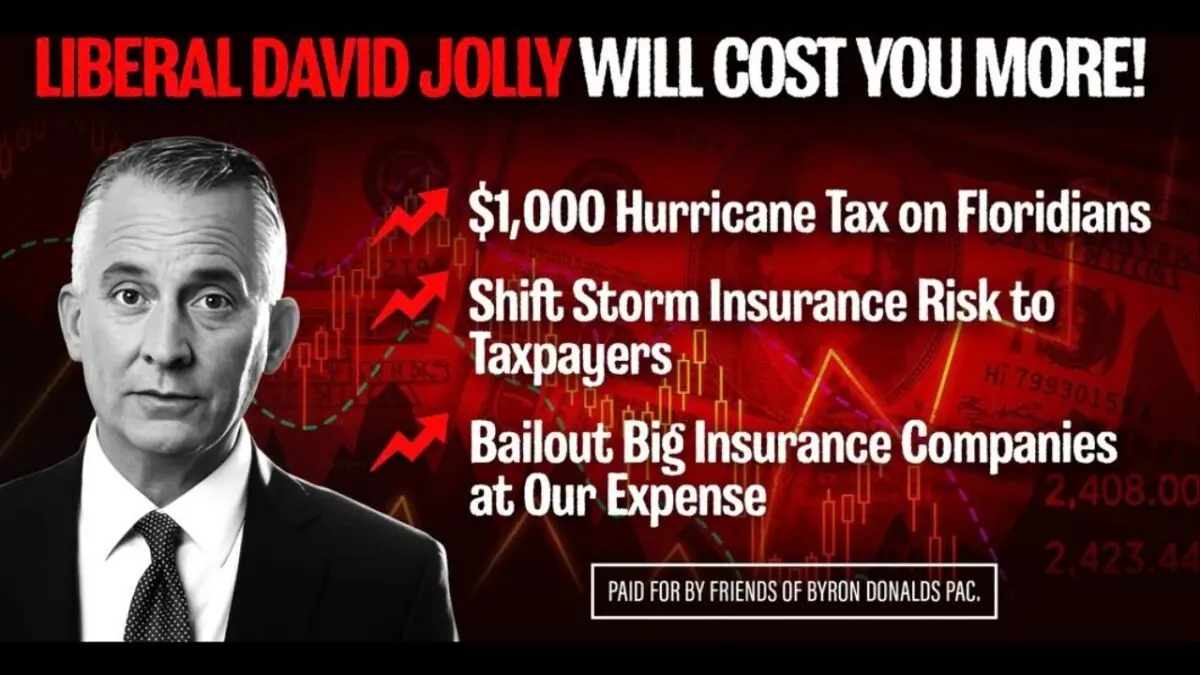
As the race for the Florida gubernatorial seat intensifies, property insurance—long the Achilles’ heel of the state’s economy—has emerged as the central battleground for candidates. Republican candidate Byron Donalds recently launched a sharp political broadside against his Democratic opponent, David Jolly, targeting Jolly’s newly unveiled homeowners insurance reform platform. In his campaign materials, Donalds claims that Jolly’s proposal would impose a debilitating, recurring $1,000 "hurricane tax" on working Florida families every single year.
However, a rigorous fact-checking analysis reveals a stark disconnect between political rhetoric and policy reality. Jolly’s published platform contains no mandate for a $1,000 annual fee, tax, or homeowner assessment. Instead, the figure traces back to an entirely separate, academic economic study. That study modeled hypothetical worst-case financial scenarios associated with drastically expanding Citizens Property Insurance Corp.—the state’s insurer of last resort—to encompass statewide residential wind coverage. The study never evaluated Jolly’s specific blueprint.
This investigative report examines the architecture of Jolly’s proposal, deconstructs the origin of Donalds’ $1,000 attack ad, analyzes Florida’s existing legal frameworks regarding post-disaster emergency assessments, and explores what homeowners can realistically expect as the legislative debate unfolds.
Detailed Chronology: The Evolution of Florida’s Insurance Debate
The Mounting Insurance Crisis
For years, Florida homeowners have grappled with an escalating property insurance crisis characterized by skyrocketing premiums, the withdrawal or insolvency of major private insurers, and heavy reliance on Citizens Property Insurance Corp. As private markets retreated from catastrophe-prone coastal and inland regions, the state’s risk exposure concentrated dangerously within government-backed entities.
Jolly’s Policy Rollout
Seeking to capitalize on voter frustration over soaring housing costs, Democratic candidate David Jolly released a comprehensive structural reform proposal designed to decouple routine homeowners insurance from catastrophic wind and hurricane risk. Under his model, private insurers would continue to write standard policies—covering fire, theft, and liability—but would be entirely relieved of the volatile, high-cost burden of hurricane windstorm coverage.
Instead, Jolly proposed the creation of a centralized, state-backed catastrophe fund specifically designed to shoulder hurricane and wind risks. According to his campaign, this fund would be systematically capitalized before issuing coverage, relying on a robust combination of startup reserves, private reinsurance markets, and alternative revenue streams such as targeted insurance company taxes, a modest fee on high-end real estate transactions, and a reallocation of existing tourist-tax revenues.

The Political Counteroffensive
Recognizing the vulnerability of any state-backed financial mechanism, Republican contender Byron Donalds seized upon the plan, framing it as a recipe for bureaucratic expansion and hidden fiscal burdens. Donalds’ campaign released targeted television and digital attack ads claiming the proposal would create an annual $1,000 "hurricane tax" on Florida households.
The claim immediately ignited a fierce public debate over the validity of the $1,000 figure, forcing political analysts, policy watchdogs, and voters to parse the precise mechanics of state-backed insurance funding, legislative oversight, and historical emergency assessment statutes.
Supporting Context & Metrics: Where Did the $1,000 Figure Come From?
To understand how a policy debate over catastrophe funds morphed into a $1,000 tax claim, one must examine the source of the data.
Tracing the Numbers
The $1,000 annual figure does not appear anywhere in David Jolly’s published white papers or legislative outlines. Rather, the metric originates from a separate macroeconomic and actuarial study that explored the theoretical consequences of an aggressive, state-wide expansion of Citizens Property Insurance. That study modeled what might happen if the state government assumed primary residential wind coverage across all 67 counties without adequate private reinsurance buffers.
Crucially, the study’s authors did not analyze Jolly’s specific architecture, which explicitly mandates prior capitalization and reinsurance acquisition. Consequently, applying the study’s worst-case financial models directly to Jolly’s proposal represents a significant statistical leap.
Florida’s Existing Assessment Mechanics
While Jolly’s campaign maintains that no annual homeowner assessments are written into his plan, the debate underscores a hard truth about Florida insurance law: state-backed programs inherently carry statutory mechanisms to handle catastrophic shortfalls.

To evaluate whether Floridians could face future levies under any state-backed system, one must look at existing statutes:
- The Florida Hurricane Catastrophe Fund (Cat Fund): Established under Florida Statute 215.555, the Cat Fund acts as a state-administered reinsurance mechanism for private insurers. Under current law, if the fund exhausts its liquid reserves following a catastrophic hurricane season, the State Board of Administration possesses the statutory authority to direct the Office of Insurance Regulation to impose emergency assessments.
- Broad-Based Premium Surcharges: These emergency assessments do not always apply solely to homeowners insurance. They can extend across a wide array of property and casualty insurance lines—including commercial property and private passenger automobile policies. Certain lines, such as workers’ compensation and medical malpractice, are legally excluded, but the broad scope means millions of Florida consumers pay the levy.
- Citizens Property Insurance Surcharges: Citizens operates under a two-tiered assessment framework. If the insurer suffers a major operational deficit, its policyholders face an immediate policy surcharge of up to 15%. If that proves insufficient to cover storm claims, an emergency assessment of up to 10% annually can be levied against all assessable property and casualty insurance premiums statewide, impacting customers of private insurance companies as well.
Hypothetical Impact Scenario
Consider a typical Florida household paying a combined $8,000 annually for homeowners, automobile, and other assessable property-and-casualty policies. If a severe hurricane season depleted state reserves and triggered a maximum emergency assessment, that household could theoretically face hundreds of dollars in additional surcharges tacked onto their routine bills. The final cost would fluctuate based on the statutory percentage levied by regulators and the baseline premiums paid by the policyholder.
Official Statements and Campaign Positions
The war of words between the Donalds and Jolly camps highlights fundamentally divergent philosophies on how to manage Florida’s catastrophe-prone housing market.
The Jolly Campaign Response
David Jolly’s policy team has pushed back aggressively against the "hurricane tax" label, issuing detailed clarifications regarding the structural differences between his proposed fund and traditional government bailouts.
"Our proposal does not contain, nor does it rely upon, any annual $1,000 homeowner assessment," a campaign spokesperson stated. "The entire objective of shifting wind risk to a dedicated, reinsured state fund is to relieve private insurance companies of unsustainable catastrophe exposure, thereby lowering base premiums for consumers. The fund will be fully capitalized through pre-funded reserves, reinsurance contracts, and non-homeowner revenue streams—such as real estate transaction fees and tourist taxes—before it ever assumes a single policy."
Furthermore, Jolly’s camp emphasizes that because the program does not yet exist in statutory form, the ultimate architecture remains subject to the Florida Legislature, which would be tasked with drafting the implementing bills and establishing the exact financial safeguards.

The Donalds Campaign Response
Conversely, the Byron Donalds campaign stands by its characterization, arguing that any centralized, government-run fund will inevitably rely on taxpayer backing or emergency assessments when major hurricanes inevitably strike the peninsula.
"You cannot simply wave a magic wand and remove billions of dollars of hurricane risk without exposing the public treasury or policyholders to ultimate liability," representatives for Donalds argued in campaign releases. "Whether it is labeled a fee, a tax, or an emergency assessment, government-backed insurance schemes always end up sticking the bill to Florida families when the storms hit. David Jolly’s plan is a massive government expansion that opens the door wide to hidden costs."
Future Outlook: What Floridians Must Know Moving Forward
As the gubernatorial race proceeds toward election day, voters and policyholders navigating the state’s complex insurance market should keep three critical takeaways in mind:
- Separating Fact from Political Modeling: The $1,000 figure cited by Byron Donalds is derived from a separate macroeconomic stress test examining a theoretical expansion of Citizens Property Insurance, not from an explicit line-item in David Jolly’s proposal.
- The Reality of State-Backed Risk: While Jolly’s plan relies on pre-funding and private reinsurance rather than automatic homeowner levies, Florida’s legislative history proves that state-backed insurance entities possess statutory authority to levy emergency assessments when catastrophic losses outpace reserves.
- The Role of the Legislature: Because neither candidate’s ideal system can be enacted unilaterally, the ultimate financial exposure for taxpayers and policyholders will depend heavily on the legislative framework crafted by the Florida Legislature. Factors such as initial capital reserves, reinsurance attachment points, frequency of major landfalling hurricanes, and finalized statutory financing mechanisms will ultimately determine the true cost of property insurance reform in the Sunshine State.
Ultimately, while the political rhetoric will likely remain heated, Florida property owners are left weighing competing visions for market stability—one favoring private-market decompression with government-backed reinsurance adjustments, and the other warning against the fiscal perils of centralized state intervention.

0 Comments