
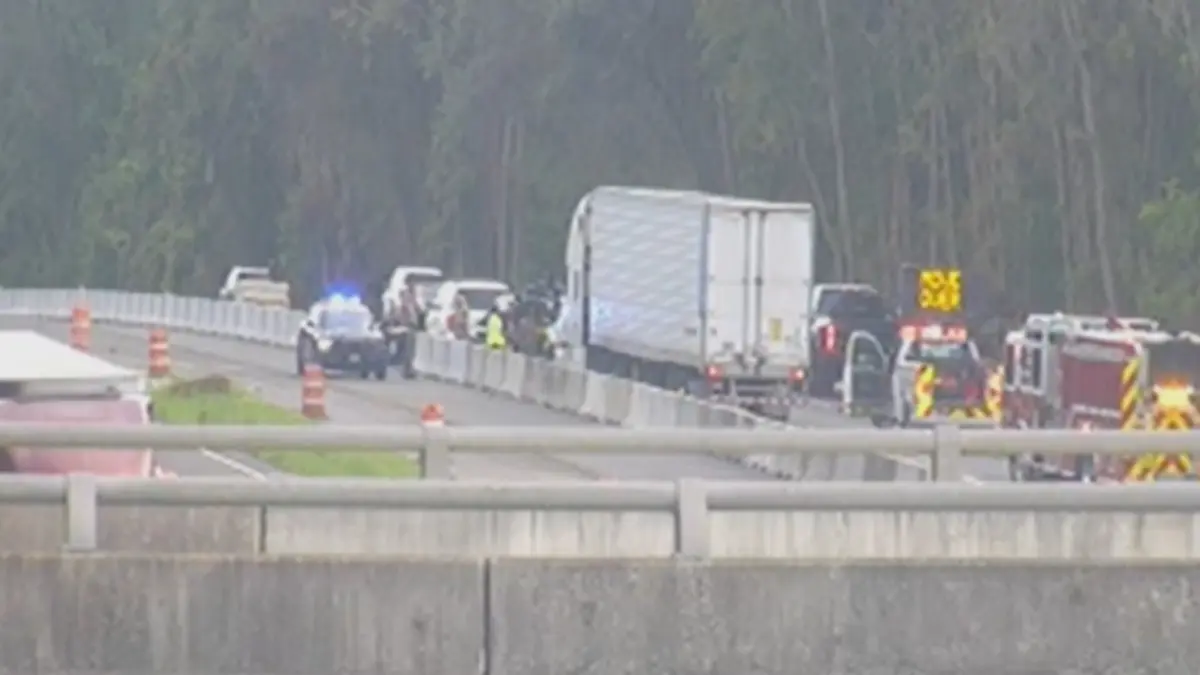

OCALA, Fla. — Normal traffic patterns have been fully restored along a critical stretch of Interstate 75 in Marion County following a multi-hour vehicular accident that paralyzed southbound transit during the Tuesday evening rush hour.
The incident, which occurred near mile marker 348 in the vicinity of Southwest 66th Street, triggered an immediate and intensive emergency response from local and state transportation authorities. While the lanes have since been cleared and reopened to the motoring public, the event underscores the profound vulnerability of Florida’s primary interstate arteries to sudden disruptions, raising fresh questions regarding rapid-response protocols, regional infrastructure capacity, and emergency communication efficiency.
Executive Overview
At approximately 6:15 p.m., an Instant Pixel News (IPN) alert flashed across mobile devices and dispatch screens across Central Florida, warning motorists of a severe traffic bottleneck on Interstate 75 southbound. The Florida Department of Transportation (FDOT) quickly confirmed that a crash had occurred, necessitating the emergency closure of two major southbound lanes.
The resulting traffic cascade created severe gridlock that stretched for miles, trapping thousands of commuters, commercial freight haulers, and long-distance travelers in a standstill for hours. Emergency crews, including Florida Highway Patrol (FHP) troopers, local fire-rescue personnel, and FDOT incident management teams, rushed to the scene to secure the area, treat potential injuries, and clear wreckage from the active lanes.
By late evening, heavy-duty towing operations and roadway clearing crews had successfully removed the disabled vehicles and debris from the asphalt. FDOT officials announced the full reopening of the southbound corridor, allowing traffic to resume its normal flow. Nevertheless, the incident serves as a stark reminder of the delicate balance governing the state’s transportation network—where a single localized accident can ripple outward, paralyzing economic activity and disrupting regional mobility for hours.
Detailed Chronology of Events
The Incident and Initial Impact (Approx. 6:00 p.m. – 6:15 p.m.)
The sequence of events began just prior to 6:15 p.m., as the evening commute was reaching its peak volume. While the exact mechanics of the collision remain under active review by law enforcement, multiple vehicles became involved in a crash on the southbound lanes of I-75, just north of mile marker 348 and in close proximity to the Southwest 66th Street overpass.
The impact forced vehicles across multiple lanes, creating an immediate hazard and obstructing the flow of traffic. Almost instantaneously, vehicles traveling at highway speeds were forced to brake abruptly. Within minutes, a dense queue of vehicles began to form, stretching backward past previous interchanges and catching thousands of unsuspecting motorists in the sudden slowdown.
Emergency Deployment and Lane Closures (6:15 p.m. – 7:30 p.m.)
Recognizing the severity of the obstruction, the Florida Department of Transportation’s SunGuide transportation management system registered a significant drop in average speeds, triggering automated alerts. Emergency dispatchers routed Florida Highway Patrol troopers, Marion County Fire Rescue units, and FDOT Road Ranger service patrols to the scene.
To ensure the safety of first responders and facilitate the extraction of any injured parties, authorities made the decision to close two southbound lanes. This reduction of available capacity from three or more lanes down to a single narrow passage immediately throttled throughput. Traffic dropped from standard highway velocities to a virtual crawl, with vehicles moving at mere fractions of the speed limit.
During this window, the IPN alert was officially disseminated, broadcasting the urgent advisory to local residents, media outlets, and navigation applications. Commuters attempting to utilize I-75 to bypass the city or return to suburban residences found themselves trapped in a stationary sea of brake lights.
Mitigation, Recovery, and Clearance (7:30 p.m. – 9:00 p.m.)
As twilight settled over Marion County, specialized recovery teams worked under the glare of emergency vehicle strobes and portable floodlights. Debris—including shattered automotive glass, shredded rubber, and vehicle fluids—was swept and treated with absorbent materials to prevent secondary hazards such as fuel-slick skids or engine fires.
Heavy-duty towing apparatuses arrived on-site to hoist and remove the severely damaged vehicles from the travel lanes and onto flatbed carriers. Once the physical wreckage was cleared from the asphalt, FDOT engineers and safety inspectors conducted a rapid visual assessment of the roadway surface to ensure no structural compromise had occurred during the collision or subsequent fluid spills.
Normalization of Traffic Flow (9:00 p.m. Onward)
Following the completion of cleanup operations and safety checks, law enforcement and transportation officials authorized the reopening of the closed southbound lanes. The cones and safety flares were retracted, and traffic control personnel signaled the resumption of normal transit.
Vehicles that had been bottled up for hours slowly accelerated past the site of the crash. By mid-to-late evening, electronic traffic sensors confirmed that congestion had fully dissipated. Traffic at mile marker 348 was flowing smoothly, bringing a temporary close to an intensely stressful evening for Central Florida commuters.
Supporting Context & Metrics: The Anatomy of I-75 Bottlenecks
To fully understand the magnitude of the delays experienced near Southwest 66th Street, one must examine the unique infrastructural and demographic pressures facing Interstate 75 through Marion County and the greater Ocala area.
Traffic Volume and Freight Dependence
Interstate 75 functions as the principal economic spine of the Florida peninsula, carrying hundreds of thousands of vehicles daily. A substantial percentage of this traffic is composed of heavy commercial freight vehicles—semi-trucks and logistics carriers—moving goods between the ports of South Florida and the distribution hubs of the American Southeast and Midwest.
When a multi-lane blockage occurs on this corridor, the impact is fundamentally different from a standard urban arterial shutdown. Commercial trucks require significantly longer stopping distances, broader turning radii, and larger recovery footprints. Furthermore, the sheer physical size of commercial fleets exacerbates lane capacity losses. The closure of just two lanes on a major interstate corridor instantly strips away upwards of 50% to 66% of the roadway’s structural throughput capacity, creating an exponential buildup of vehicles that far outpaces the rate of natural dissipation.
The Ocala Metropolitan Bottleneck
Ocala and Marion County have experienced unprecedented population growth and commercial expansion over the past decade. As residential developments push outward and warehousing facilities multiply along the I-75 corridor, baseline traffic volumes have steadily climbed.
Mile marker 348, situated near Southwest 66th Street, represents a critical juncture where commuter traffic from Ocala’s expanding western and southern suburbs intersects with long-distance interstate travelers. The corridor’s design, while compliant with historical engineering standards, frequently operates near or at maximum capacity during peak travel windows (7:00 a.m. – 9:00 a.m. and 4:30 p.m. – 6:30 p.m.). Consequently, any unscheduled incident—be it a mechanical breakdown, a minor fender-bender, or a severe multi-vehicle collision—inevitably triggers systemic gridlock.
The Economic and Environmental Toll
While the immediate physical consequences of the crash were managed by emergency personnel, incidents of this scale generate hidden costs across the regional economy:
- Productivity Losses: Commercial freight haulers and local service providers suffered hours of delay, missing delivery windows and disrupting supply chain schedules.
- Fuel Consumption and Emissions: Thousands of idling vehicles burned thousands of gallons of unnecessary fuel, releasing elevated levels of carbon dioxide and particulate matter into the local airshed.
- Emergency Response Impediments: The severe backlog of civilian vehicles can occasionally impede secondary emergency responders attempting to access the scene or navigate parallel evacuation and service routes.
Official Statements and Ongoing Investigation
At the time of this publication, the Florida Highway Patrol—the lead investigative agency tasked with determining the definitive cause of the crash—has not yet released a comprehensive official report. Requests for detailed information regarding the number of vehicles involved, the identities of those injured, and the specific sequence of events that precipitated the collision remained pending.
Law enforcement spokespersons typically withhold detailed narratives until preliminary crash reconstruction analyses are finalized and next-of-kin notifications (if applicable) are completed. Investigators must evaluate multiple evidentiary streams, including:
- Eyewitness Accounts: Testimonies provided by motorists who observed the moments leading up to the impact.
- Physical Evidence: Skid marks, vehicle resting positions, point-of-impact debris patterns, and mechanical integrity assessments of the involved automobiles.
- Digital and Video Telemetry: Footage captured by dashcams, nearby commercial surveillance systems, or FDOT traffic monitoring cameras.
Transportation officials continue to emphasize that safety remains their paramount objective. In the wake of this incident, agencies are reviewing their response metrics to identify potential areas for shaving critical minutes off future clearance operations.
Future Outlook: Enhancing Resilience on Florida’s Interstates
As Central Florida continues to absorb rapid residential and commercial growth, municipal planners, state legislators, and transportation engineers face mounting pressure to modernize legacy infrastructure like Interstate 75. Incidents such as the Southwest 66th Street crash highlight several strategic imperatives for the future:
1. Expansion of Intelligent Transportation Systems (ITS)
The deployment of advanced sensors, automated incident detection software, and dynamic message signs has revolutionized how FDOT manages traffic anomalies. Expanding the footprint of these technologies along rural and semi-urban stretches of I-75 will allow transportation management centers to detect slowdowns within seconds rather than minutes, accelerating the dispatch of Road Rangers and emergency assets.
2. Infrastructure Upgrades and Lane Capacity
Long-term regional planning discussions increasingly focus on structural enhancements, including the potential widening of bottlenecked segments, the optimization of interchange merging lanes, and the creation of dedicated freight or managed lanes. By separating heavy commercial traffic from lighter passenger vehicles, planners hope to mitigate the cascading effects of multi-vehicle collisions.
3. Public Communication and Real-Time Routing
The rapid dissemination of alerts via platforms like IPN, social media, and dynamic cellular emergency broadcasting plays a vital role in consumer behavior modification. Encouraging motorists to alter their routes well in advance of a bottleneck—by utilizing designated alternate corridors such as U.S. 441 or State Road 200—can significantly reduce the density of vehicles accumulating at the immediate disaster zone.
Conclusion
While the southbound lanes of Interstate 75 near mile marker 348 are once again clear and vehicular traffic moves without impediment, the memory of Tuesday evening’s gridlock remains fresh for the hundreds of drivers who found themselves stranded. As authorities complete their investigation into the crash near Southwest 66th Street, the event stands as a compelling testament to the vital importance of robust infrastructure, coordinated emergency response, and continuous proactive planning in keeping Florida’s economic arteries open and secure.

0 Comments