

Executive Overview
On Wednesday, September 23, 2026, millions of Moroccan citizens headed to the polls to elect a new parliament. The legislative election took place at a critical juncture for the North African kingdom. On paper, Morocco represents one of the region’s most striking economic success stories: a hub of industrial manufacturing, a premier global tourist destination, and the co-host of the upcoming 2030 FIFA World Cup. Yet, beneath this glossy exterior of macroeconomic stability and grand infrastructure projects lies a deep and simmering domestic crisis.
The 2026 elections were defined by a stark disconnect between a thriving state-led economy and a deeply disillusioned population, particularly its youth. Despite massive state expenditures, everyday Moroccans continue to grapple with systemic issues: stubbornly high youth unemployment, an underfunded healthcare system, struggling public schools, and a rising cost of living.
At stake are the 395 seats of the House of Representatives. Under Morocco’s constitutional framework, revised in 2011, King Mohammed VI must select the Prime Minister from the political party that wins the plurality of these seats. Because the country’s proportional representation system makes a single-party majority virtually impossible, the victorious party will be tasked with negotiating a complex governing coalition.
Dubbed by domestic analysts as the "World Cup government," the incoming administration will oversee the distribution of billions of dollars in public and private investments aimed at preparing the country’s infrastructure for 2030. However, this administration will also inherit the formidable challenge of restoring faith in a political system that many citizens—especially those under thirty—increasingly view as unresponsive, technocratic, and disconnected from their daily struggles.
Detailed Chronology
The path to the 2026 legislative elections has been marked by economic pressure, social unrest, and shifting political alliances. Understanding the current electoral landscape requires tracing the key developments of the last five years.
[2021 Election] ──> [2022-2025 inflation & Drought] ──> [Late 2025 Youth Protests] ──> [Early 2026 Ceuta Crisis] ──> [Sept 2026 Election]The 2021 Realignment and the Technocratic Promise
In September 2021, Moroccan voters delivered a historic defeat to the moderate Islamist Justice and Development Party (PJD), which had led the government for a decade. In its place, a triumvirate of liberal and centrist parties took the reins: the National Rally of Independents (RNI), led by billionaire businessman Aziz Akhannouch; the Authenticity and Modernity Party (PAM); and the conservative Istiqlal (Independence) Party.
Promising a pragmatic, business-friendly approach to governance, the Akhannouch coalition vowed to implement the "New Development Model"—a blueprint championed by the Palace to double Morocco’s per capita GDP by 2035 and establish a comprehensive social safety net.
2022–2025: Economic Headwinds and the Growth of Inequality
While the coalition successfully attracted foreign direct investment in aeronautics, automotive manufacturing, and green hydrogen, the benefits of this growth did not trickle down. A series of severe, consecutive droughts devastated Morocco’s agricultural sector, which employs nearly 40% of the country’s workforce.

Simultaneously, global supply chain disruptions and domestic inflation sent the prices of fuel, cooking oil, and basic food staples soaring. Although the government introduced subsidies and launched the Assistance Sociale Directe (Direct Social Assistance) program to support vulnerable families, many middle- and lower-class households found their purchasing power severely eroded.
Late 2025: The Youth-Led Protests
By the autumn of 2025, frustrations boiled over. Led primarily by Gen Z Moroccans who had grown up in the shadow of the Arab Spring and the COVID-19 pandemic, spontaneous, decentralized protests erupted in major urban centers like Casablanca, Rabat, and Tangier.
Unlike previous political movements, these demonstrations were largely organized via social media platforms like TikTok and Instagram, bypassing traditional trade unions and opposition parties. The protesters demanded immediate labor market reforms, an end to corruption, and a massive reinvestment in public services, particularly healthcare and education.
Early 2026: The Ceuta Border Crisis
The depth of youth desperation was laid bare in early 2026 when thousands of young Moroccans, along with sub-Saharan migrants, converged on the northern border town of Fnideq. In a coordinated effort organized online, crowds attempted to scale the border fences to enter Ceuta, a Spanish enclave bordering Morocco.
The images of young citizens risking their lives to leave the country sent shockwaves through the political establishment. It served as a stark reminder that despite Morocco’s growing international prestige, a significant portion of its youth saw no future for themselves within its borders.
September 2026: The Campaign Trail
As the official campaign window opened in September 2026, the ruling coalition parties sought to re-engage an increasingly detached electorate.
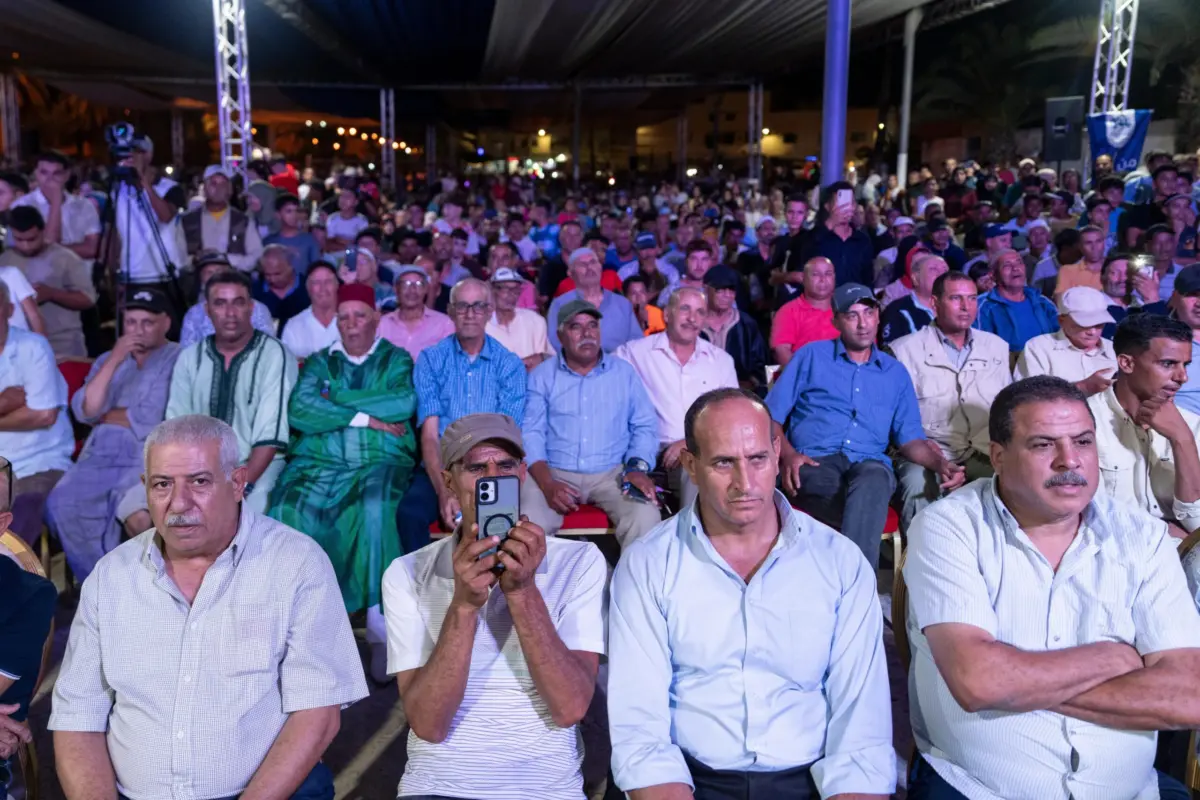
- September 16, 2026 (Tangier): The Authenticity and Modernity Party (PAM) held a major rally in the northern port city of Tangier. Fatima Ezzahra El Mansouri, the Minister of Housing, Mayor of Marrakech, and a key coordinator of PAM, addressed a crowded arena. She emphasized the party’s commitment to urban renewal, social housing, and bridging the gap between rural provinces and booming metropolitan areas.
- September 20, 2026 (Benslimane): PAM shifted its focus to the Casablanca-Settat region, holding a massive rally in Benslimane. The event featured Faouzi Lekjaa, the highly influential President of the Royal Moroccan Football Federation (FRMF) and a member of PAM’s political bureau. Lekjaa used his immense popularity as the architect of Morocco’s football successes—including the national team’s historic 2022 World Cup run—to pitch the 2030 World Cup not just as a sporting event, but as a historic engine for national development, job creation, and infrastructural modernization.
Supporting Context & Metrics
The 2026 election took place against a backdrop of complex demographic and economic data that highlights the deep divide within modern Moroccan society.
The Voter Registration Deficit
Despite a growing national population, now estimated at over 37 million, the number of registered voters has actually shrunk.

| Electoral Year | Registered Voters | Percentage Change |
|---|---|---|
| 2021 | ~17.5 million | — |
| 2026 | ~15.8 million | -9.7% |
This nearly 10% drop in voter registration is highly unusual for a developing nation with a young demographic profile. Political analysts attribute this decline to a deliberate decision by eligible young voters to opt out of the system entirely. Feeling that the parliament lacks the power to enact real change relative to the Palace, many have chosen political apathy over participation.
The Macro-Micro Economic Paradox
The central tension of the 2026 election lies in the disconnect between macroeconomic success and microeconomic struggle.
┌────────────────────────────────────────────────────────┐
│               THE MOROCCAN ECONOMIC DIVIDE             │
├────────────────────────────┬───────────────────────────┤
│    MACROECONOMIC HIGHLIGHTS │    MICROECONOMIC REALITIES │
├────────────────────────────┼───────────────────────────┤
│ • Co-hosting 2030 World Cup│ • 30%+ Youth Unemployment │
│ • Tangier Med Port Expansion│ • Severe Agricultural Drop│
│ • Green Hydrogen Leader    │ • High Inflation on Food  │
│ • High-Speed Rail Network  │ • Underfunded Hospitals   │
└────────────────────────────┴───────────────────────────┘- World Cup Investment Portfolio: The "World Cup Government" will manage an estimated $5 billion to $10 billion in infrastructure projects. This includes the construction of the grand Grand Stade de Casablanca in Benslimane (designed to seat 115,000 spectators), expansion of the high-speed rail (TGV) network to Marrakech and Agadir, and major upgrades to airports, highways, and telecommunications.
- The Unemployment Crisis: Despite these grand projects, the national unemployment rate hovers around 13%, but that figure skyrockets to over 30% among urban youth and university graduates. The modern, export-oriented sectors (automotive, aerospace) are highly technocratic and capital-intensive, meaning they do not generate enough low- and mid-skilled jobs to absorb the roughly 300,000 young people entering the labor market each year.
Official Statements and Political Rhetoric
The political discourse surrounding the election highlights the deep ideological divisions regarding the path forward for the country.
The Coalition: Development, Prestige, and Continuity
Leaders of the ruling coalition have framed the election as a choice between continued progress and economic instability. At the Benslimane rally, Faouzi Lekjaa argued that the upcoming years are crucial for cementing Morocco’s status on the world stage:
"The 2030 World Cup is not merely a tournament of ninety-minute football matches. It is a national project of transformation. The roads we build, the hospitals we upgrade, and the stadiums we construct will serve generations of Moroccans long after the final whistle is blown. We need a stable, competent government to steer this ship."
Similarly, Fatima Ezzahra El Mansouri defended the government’s social record, pointing to the rollout of universal health insurance (AMO) and direct cash transfers:
"We have laid the groundwork for a true welfare state. For the first time in our history, millions of impoverished families are receiving direct financial support from the state. We do not claim to have solved every problem, but we have built the foundation. Now, we must build upon it."
The Boycott Movements: Systemic Skepticism
Conversely, opposition groups and dissident movements have dismissed the election as a performative exercise designed to legitimize an authoritarian status quo.

The far-left political party, The Democratic Path (Annahj Addimoqrati), officially boycotted the election, releasing a statement that read:
"This election lacks the minimum conditions of democracy. The parliament remains a body with limited power, while the true decisions governing our economy, our resources, and our foreign policy are made behind closed doors by the royal cabinet and the technocratic elite. Voting only serves to provide a democratic facade to a system that refuses to reform."
A similar sentiment was echoed by Al-Adl Wal Ihsane (Justice and Charity), a popular but officially banned Islamist association. Though barred from formal political participation, the group exerts significant influence in working-class neighborhoods and university campuses. In a public communique, they stated:
"The drop in voter registration is a clear vote of no confidence from the Moroccan people. The youth have realized that the ballot box is an illusion. Until there is a genuine separation of powers and a constitution that reflects the will of the people, participation in this system is an exercise in futility."
The Diaspora Disenfranchisement
A major point of contention remains the voting rights of the Marocains Résidant à l’Étranger (MREs)—the Moroccan diaspora, which numbers over five million and contributes billions of dollars annually in remittances. Under current laws, MREs cannot vote via mail or at local consulates. Instead, they must physically travel to Morocco to cast a ballot or appoint a proxy.
Diaspora advocacy groups have called this system outdated and exclusionary, arguing that it effectively disenfranchises a highly educated, economically vital segment of the population that could inject new ideas into the domestic political landscape.
Future Outlook
As the ballots are counted and negotiations to form a new government begin, the incoming administration faces a highly complex set of challenges.
Coalition Dynamics and the Prime Minister’s Mandate
Because no single party will secure an absolute majority in the 395-seat parliament, coalition-building will begin immediately. If PAM or the RNI emerges as the largest party, they will likely seek to reconstitute the current centrist coalition, perhaps bringing in smaller regional or leftist parties to secure a stable majority.

The incoming Prime Minister will have to balance the policy priorities of diverse coalition partners while maintaining a close alignment with the strategic directives of King Mohammed VI, who retains ultimate authority over the military, foreign policy, and religious affairs.
Managing the "World Cup" Economy
The primary economic challenge of the next five years will be ensuring that the massive financial outlays for the 2030 World Cup do not lead to a debt crisis or worsen domestic inflation. The government must strike a delicate balance:
- Public vs. Private Funding: Encouraging private sector participation and foreign direct investment to offset the burden on the state treasury.
- Inclusive Infrastructure: Ensuring that infrastructure development is not confined to the wealthy axes of Casablanca-Rabat-Tangier, but also benefits marginalized regions in the Atlas Mountains, the south, and rural provinces.
Navigating the Social Contract
Ultimately, the success of the next government will not be measured by the architectural beauty of its new stadiums, but by its ability to rewrite the social contract with its youngest citizens. If the new administration fails to lower youth unemployment, improve the quality of public education, and curb the rising cost of living, the disillusionment that characterized the 2026 campaign could easily manifest as renewed social unrest.
The 2026 election has demonstrated that while Morocco’s grand development plans have earned it international acclaim, its internal stability depends on its ability to turn macroeconomic growth into tangible opportunities for its people. The "World Cup Government" faces a daunting task: it must build the infrastructure of tomorrow while addressing the urgent, everyday crises of today.

0 Comments