
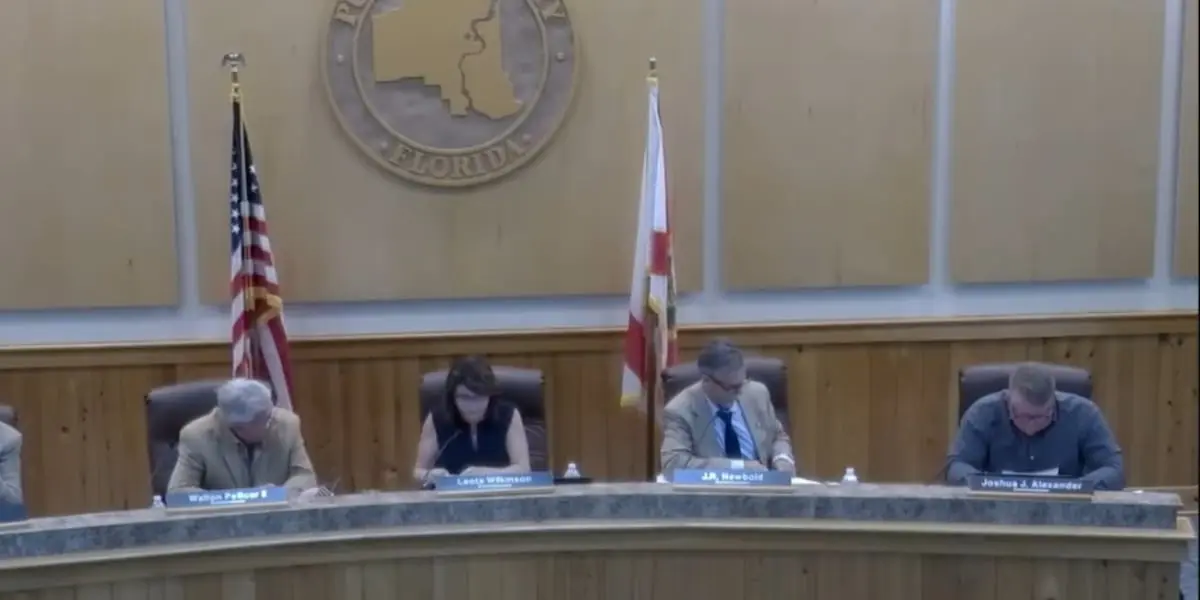

PALATKA, Fla. — In a decisive and unanimous vote on Tuesday night, the Putnam County Board of County Commissioners advanced a temporary moratorium halting the development of medium and large-scale data center projects throughout the region. The legislative action, which successfully cleared its second and final reading, establishes a strict administrative pause designed to give local planners, environmental scientists, and county officials adequate time to formulate a comprehensive regulatory framework for an industry that has largely bypassed traditional municipal zoning until now.
The emergency ordinance, which took effect immediately upon passage, sets a hard expiration date of September 2027. During this window, county agencies are barred from accepting, processing, or approving site plans, building permits, or zoning variances for any commercial computing facilities meeting the newly minted county definitions for "medium" and "large-scale" digital infrastructure.
While proponents of data center development tout the promise of high-tech job creation and increased municipal tax revenues, Putnam County leaders have opted for a precautionary approach. The primary drivers behind the moratorium center on the staggering water and electrical footprints associated with modern server farms, the strain such facilities place on regional transmission lines, and the long-term compatibility of heavy industrial computing footprints with the rural character of Northeast Florida.
Executive Overview
The rapid proliferation of artificial intelligence (AI), cloud computing, and enterprise data storage has transformed rural and semi-rural counties across the United States into prime targets for tech developers. Seeking vast expanses of relatively inexpensive land, proximity to major fiber-optic trunks, and access to cooling resources, developers have increasingly turned their sights toward counties like Putnam.
However, local governments are discovering that existing zoning codes—often drafted decades before the advent of hyperscale computing—are wholly inadequate for addressing the unique demands of these facilities. Data centers are not traditional warehouses; they are continuous, 24/7 operations that consume immense amounts of electricity and millions of gallons of water daily for cooling systems.
By enacting the September 2026 moratorium, the Putnam County Commission has established a vital regulatory "time-out." The core objectives of this legislative pause include:
- Codifying Definitions: Establishing clear legal and architectural parameters for what constitutes small, medium, and large-scale data centers based on square footage, power draw, and water consumption.
- Infrastructure Impact Analysis: Conducting exhaustive engineering studies to evaluate how the introduction of high-load industrial computing will affect the local power grid managed by regional utility cooperatives and investor-owned utilities.
- Environmental Stewardship: Assessing the potential strain on local aquifers, particularly the Floridan Aquifer, and drafting strict guidelines regarding wastewater discharge, thermal pollution, and noise abatement.
- Community Alignment: Ensuring that future economic development aligns with the long-term vision of Putnam County residents, safeguarding property values and the natural landscape from premature, high-impact industrialization.
Detailed Chronology of the Legislative Action
The path to Tuesday night’s unanimous vote was neither rushed nor casual; it represents the culmination of months of behind-the-scenes discussions among county planners, zoning administrators, and commissioners growing increasingly anxious over speculative land acquisitions.
Spring 2026: The Initial Inquiries
The conversation surrounding commercial computing facilities in Putnam County began quietly in early 2026. Real estate brokers and anonymous corporate representatives—often operating under shell companies or limited liability corporations (LLCs)—began making preliminary inquiries regarding large tracts of agricultural and industrial-zoned land near Palatka and unincorporated areas flanking major transportation corridors.
While no formal applications were submitted, county planning staff noted an unusual uptick in requests for zoning verification letters concerning parcel sizes exceeding 100 acres. These parcels shared common traits: access to high-voltage transmission lines and proximity to major water sources. Realizing that the county’s Land Development Code contained no specific references to "data centers," "server farms," or "cryptocurrency mining operations," the planning department initiated an internal review of how peer counties in Florida were handling similar pressures.
Summer 2026: Drafting the Definitions and Emergency Measures
By mid-summer, the Board of County Commissioners directed the county attorney’s office and the Department of Planning and Development to draft a protective ordinance. The primary challenge facing the drafting committee was terminology. Without precise definitions, any attempt to restrict data centers could leave the county vulnerable to legal challenges or unintended restrictions on standard office buildings and telecommunications infrastructure.
Through a series of public workshops, planning staff formulated a tiered classification system:
- Small-Scale Facilities: Edge computing nodes or localized server rooms operating under a designated threshold of square footage and power consumption, generally integrated into existing commercial or office spaces.
- Medium-Scale Facilities: Standalone facilities occupying between 20,000 and 100,000 square feet, drawing substantial electrical loads (measured in megawatts) and requiring dedicated mechanical cooling infrastructure.
- Large-Scale / Hyperscale Facilities: Massive industrial installations exceeding 100,000 square feet, consuming tens or hundreds of megawatts of continuous power—equivalent to the electrical demand of tens of thousands of residential homes—and necessitating industrial-grade water management systems.
September 8, 2026: The Unanimous Vote
The legislative process culminated on Tuesday night, September 8, 2026. During a densely attended regular meeting of the Putnam County Board of County Commissioners, the second and final reading of the moratorium ordinance was brought to the floor.
Unlike many contentious zoning debates that divide local leadership, the vote on the data center ban was swift, resolute, and unanimous. Commissioners voiced a shared consensus that while Putnam County remains open for responsible economic development, the risks of rushing into a high-stakes, resource-intensive industry without adequate safeguards were simply too high. With the stroke of a pen, the moratorium went into effect, freezing medium and large-scale proposals through September 2027.
Supporting Context & Metrics: The Resource Footprint of Modern Computing
To understand the urgency behind Putnam County’s legislative pause, one must examine the staggering operational realities of modern data centers. The digital economy is physical; it requires tangible resources on an industrial scale.
The Power Paradigm
Data centers are electrical vacuum cleaners. A medium-scale facility can easily require 20 to 50 megawatts (MW) of continuous power, while hyperscale facilities regularly demand upwards of 100 to 500 MW. To put this in perspective:
- 1 megawatt of power can supply roughly 800 average American homes under normal conditions.
- A 100 MW data center consumes as much electricity as a small city.
In Putnam County, where the electrical grid relies on a mix of regional power providers, introducing multiple medium or large-scale computing centers could outpace current generation and transmission capacities. This raises legitimate fears among residents and local leaders regarding potential grid instability, reliability issues, and the passing of costly transmission upgrade expenses onto residential ratepayers.
Water Consumption and Cooling Realities
Servers generate immense amounts of heat. To prevent hardware failure, these facilities require continuous cooling. While some modern facilities utilize closed-loop air cooling or advanced liquid immersion technologies, the vast majority of large-scale server farms rely on evaporative cooling towers that consume millions of gallons of water every day.
- Daily Usage: A typical hyperscale data center can consume between 1 million and 5 million gallons of water per day—roughly equivalent to the water consumption profile of a community of 10,000 to 50,000 residents.
- Aquifer Impact: Putnam County sits atop the Floridan Aquifer, one of the most productive and vital freshwater systems in the United States. Local environmental groups have repeatedly warned that unchecked industrial water extraction could depress aquifer levels, reduce spring flows, and impact agricultural irrigation rights.
Land Use and Noise Pollution
Beyond utilities, data centers present unique physical footprints. They require secure, sprawling footprints surrounded by high-security fencing, emergency backup diesel generators, and heavy-duty HVAC cooling yards.
Furthermore, these cooling yards and backup generators produce a constant, low-frequency hum—a persistent acoustic drone that can travel significant distances across flat terrain. In rural Putnam County, where the preservation of peace, quiet, and scenic vistas is central to the quality of life, the introduction of continuous industrial noise represents a profound lifestyle disruption for neighboring landowners.
Official Statements and Local Perspectives
The unanimous vote by the Putnam County Commission reflects a growing wave of municipal caution sweeping across the American Southeast. Local leaders are no longer willing to accept economic development promises at face value without rigorous vetting of long-term costs.
While formal statements from corporate tech representatives have been sparse—largely due to the speculative and confidential nature of early-stage land scouting—local stakeholders, community advocates, and county commissioners have been vocal about the necessity of the moratorium.
"We are not slamming the door on technology, nor are we opposed to progress," noted one county official during the legislative session. "What we are doing is putting up a caution sign. Before we allow our water resources to be drawn down and our electrical grid to be maxed out by facilities that primarily benefit out-of-state corporate entities while leaving local residents to foot the infrastructure bill, we need to know the rules of the road."
Agricultural and conservation advocates in Putnam County have similarly praised the commission’s foresight. For generations, the local economy has leaned on agriculture, silviculture, and eco-tourism tied to the St. Johns River basin. Introducing heavy industrial computing complexes without strict zoning controls threatened to fundamentally alter the economic and ecological balance of the region.
County planning directors have confirmed that the interregnum created by the moratorium will be utilized to commission independent hydrological and electrical studies. These reports will form the factual backbone of the permanent zoning regulations expected to be debated and adopted before the September 2027 expiration date.
Future Outlook: What Lies Ahead for Putnam County
The enactment of the data center moratorium is not the end of the conversation; rather, it is the opening chapter of a complex regulatory and economic planning process. Over the next twelve months, Putnam County faces a series of critical milestones:
1. The Regulatory Draft Phase (Fall 2026 – Winter 2027)
County planning staff, advised by legal and engineering consultants, will draft a comprehensive set of amendments to the Land Development Code. These amendments will likely establish:
- Dedicated Technology Districts: Restricting heavy data center development to specific industrial zones equipped with the requisite heavy-duty infrastructure, far away from residential neighborhoods and sensitive environmental ecosystems.
- Mandatory Resource Offsets: Requiring developers to prove that their proposed water usage will not negatively impact local aquifers, potentially mandating investments in reclaimed water infrastructure or closed-loop cooling systems.
- Energy Independence Clauses: Requiring tech firms to secure or generate their own renewable energy sources (such as dedicated solar arrays) rather than draining the local grid capacity designated for residential and small-business growth.
2. Public Hearings and Community Feedback (Spring 2027)
As draft regulations take shape, the Putnam County Commission will host a series of public hearings. These sessions will provide residents, environmental organizations, and industry stakeholders an opportunity to weigh in on the proposed permanent codes. The primary challenge for commissioners will be striking a delicate balance: crafting regulations robust enough to protect county resources without rendering Putnam County entirely uncompetitive for future, sustainable technology investments.
3. Expiration and Implementation (September 2027)
By or before September 2027, the temporary moratorium will sunset, replaced by a permanent, modernized chapter of the county code specifically governing digital infrastructure. Whether Putnam County emerges as a welcoming hub for environmentally responsible, green-energy-powered computing facilities or maintains a defensive posture keeping large-scale tech at bay will depend entirely on the rigor of the studies conducted during this designated pause.
For now, Putnam County has seized control of its own narrative. In an era where the digital gold rush threatens to overrun municipal infrastructure across the nation, Palatka and Putnam County have drawn a clear line in the sand: growth must be sustainable, resources must be protected, and the community’s future will be planned on local terms.

0 Comments