

Executive Overview
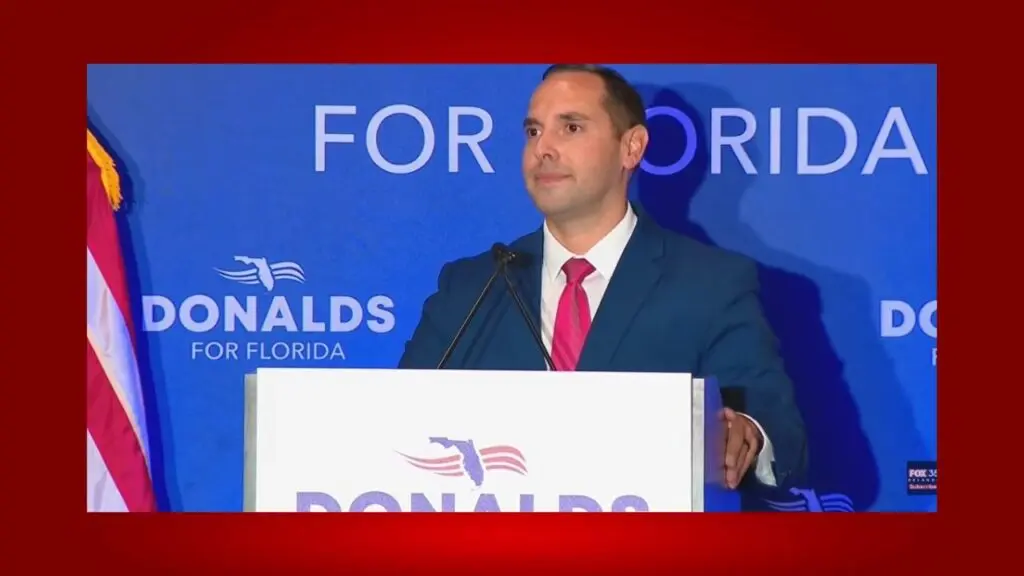
In a high-stakes move that cements the strategic architecture of his general election campaign, Republican gubernatorial nominee Byron Donalds has officially tapped Florida State Senator Bryan Ávila of Hialeah as his running mate. Announced before an enthusiastic crowd at the historic Freedom Tower at Miami Dade College in downtown Miami, the ticket unites two prominent conservative figures with deep roots in the state’s legislative trenches.
By choosing Ávila—a seasoned South Florida lawmaker, an officer in the Florida Army National Guard, and the son of Cuban exiles—Donalds has signaled an aggressive, unapologetic push to secure the vital Hispanic electorate while consolidating conservative gains in the increasingly pivotal Miami-Dade County.
This formidable pairing arrives at a transformative political crossroads for the Sunshine State. With term limits closing the chapter on Governor Ron DeSantis’s tenure, Florida has firmly established itself as a laboratory for conservative governance, economic expansion, and aggressive policy reform. Donalds, a U.S. Congressman representing Naples who secured a decisive victory in last week’s Republican gubernatorial primary, now faces a formidable Democratic ticket comprising former U.S. Representative David Jolly and former U.S. Representative Gwen Graham.
The Donalds-Ávila campaign is explicitly branding itself as a coalition built upon unwavering conservative principles, economic upward mobility, educational freedom, and a direct counterweight to the progressive platform championed by their Democratic opponents. Beyond the rhetoric, the selection of Ávila is a calculated play on demographics and geography. By anchoring his campaign with a leading voice from Hialeah—the beating heart of the Cuban American diaspora—Donalds is doubling down on the historic realignment that has turned Miami-Dade County from a perennial Democratic stronghold into a reliable bellwether for the GOP.
Detailed Chronology: From Primary Triumph to the Freedom Tower Announcement
The genesis of the Donalds-Ávila ticket represents the culmination of months of behind-the-scenes coalition-building, intense primary maneuvering, and strategic positioning.
Following a grueling Republican primary battle that tested the candidates on issues ranging from economic development to state infrastructure, Donalds emerged as the standard-bearer for the Florida GOP. Bolstered by an endorsement from President Donald Trump, Donalds moved swiftly to unify the party. Even during the primary cycle, the campaign’s forward-looking strategy was evident. In May, Donalds and Ávila appeared alongside local leaders in Hialeah to officially launch the "Latinos for Byron" coalition, a grassroots initiative explicitly designed to cement ties with Hispanic business owners, community leaders, and working-class families.
The formal rollout of the ticket at the Freedom Tower carried profound symbolic weight. Known widely as the "Ellis Island of the South," the Freedom Tower served as the Cuban Assistance Center in the 1960s, processing hundreds of thousands of refugees fleeing Fidel Castro’s communist regime. By standing before this monument to liberty, Donalds and Ávila deliberately invoked the generational sacrifices of immigrant families, framing their gubernatorial bid not merely as an election campaign, but as a continuation of the American dream.
"Bryan Ávila is the son of Cuban exiles who fled communism so their children could live in freedom," Donalds proclaimed to the cheering Miami audience. "We didn’t inherit political names. We didn’t inherit the political birthright, but what we inherited was the responsibility to fight for the state that gave our families everything."
Ávila’s path to the ticket has been forged through more than a decade of dedicated public service. First elected to the Florida House of Representatives in 2014, Ávila served concurrently with Donalds for a portion of their tenure in Tallahassee before Donalds transitioned to federal service in Washington, D.C., following his election to Congress in 2020. In 2022, Ávila successfully transitioned to the Florida Senate, where he quickly emerged as a legislative powerhouse, steering several high-profile and culturally significant bills through the upper chamber.

With the ticket now officially solidified, the Donalds-Ávila campaign transitions from primary consolidation to the rigorous demands of the general election, setting up a clash of visions for Florida’s future.
Supporting Context & Metrics: Demographics, Legislative Records, and Policy Focus
To fully understand the strategic calculus behind the Donalds-Ávila ticket, one must examine the shifting demographic and political tectonic plates of Florida, particularly within Miami-Dade County. For decades, South Florida was viewed by political pundits as an impenetrable Democratic fortress, anchored by high voter turnout in urban centers and strong support among diverse minority communities. However, over the past three election cycles, a dramatic ideological migration has occurred. Hispanic voters—particularly Cuban, Venezuelan, and Nicaraguan Americans—have increasingly aligned with the Republican Party, driven by concerns over economic inflation, traditional family values, and a vehement rejection of democratic socialism.
By pairing Byron Donalds—an African American conservative leader from Southwest Florida—with Bryan Ávila—a Hispanic lawmaker whose life story epitomizes the immigrant experience—the GOP ticket projects a diverse, multi-ethnic face of modern conservatism. This demographic synthesis is designed to neutralize identity politics while appealing directly to the economic aspirations of Florida’s working and middle classes.
Legislative Accomplishments and Scrutiny
Both men bring substantial legislative credentials to the executive ticket, though their records have naturally attracted both praise and criticism from across the political spectrum.
Ávila’s tenure in the Florida Legislature has been marked by active involvement in major policy debates. During the rollout, Donalds specifically highlighted Ávila’s pivotal role in sponsoring landmark legislation in 2022 that restricted certain classroom instruction involving race and gender identity—a cornerstone of the conservative educational reform movement in Florida. While celebrated by school-choice advocates and parents demanding greater transparency in public education, provisions of the law have faced sustained legal challenges in federal court from civil rights organizations and advocacy groups.
Furthermore, the campaign strategically addressed an issue that flared up during the Republican gubernatorial primary: the regulation of data centers. During the primary contest, Donalds faced scrutiny from rival campaigns regarding his perceived proximity to interests tied to large-scale technological developments and digital infrastructure projects. By foregrounding Ávila’s legislative work on data-center regulation, the Donalds campaign is proactively signaling a commitment to robust state oversight. This policy focus aims to balance technological modernization and economic growth with community preservation, environmental stewardship, and consumer protection—defusing a potential vulnerability ahead of the general election.
Official Statements and Political Reactions
The announcement of the Donalds-Ávila ticket sent immediate ripples through Florida’s political ecosystem, drawing sharp contrasts between the Republican vision for the state and the platform offered by the Democratic opposition.
Speaking to supporters and media personnel following the Freedom Tower event, Ávila expressed deep gratitude for the opportunity to serve alongside Donalds, framing the nomination as a tribute to the resilience of his parents and the opportunities afforded by the state of Florida.
"Growing up in Hialeah, surrounded by families who traded everything they had for the promise of liberty, taught me that freedom is never guaranteed—it must be defended every single day," Ávila stated. "Under the leadership of Governor DeSantis, Florida has become the beacon of economic freedom, individual liberty, and common-sense governance in America. Byron Donalds understands the stakes. Together, we will ensure that Florida remains a place where businesses thrive, parents have a voice in their children’s education, and the American dream remains alive and well for every generation."

National and state Republican figures quickly rallied behind the ticket. Endorsements poured in from conservative leaders praising the dynamic pairing of Donalds’ fiscal conservatism and federal legislative experience with Ávila’s deep institutional knowledge of state government and municipal concerns.
Conversely, the Democratic camp lost no time in mounting a vigorous critique of the newly minted GOP ticket. Democratic gubernatorial nominee David Jolly and his running mate, Gwen Graham, released joint statements condemning the ticket’s alignment with hardline conservative policies. Jolly argued that the Donalds-Ávila platform represents an extreme departure from the pragmatic governance required to address Florida’s mounting infrastructure, housing affordability, and property insurance crises.
"Florida families are currently facing unprecedented cost-of-living pressures, runaway property insurance rates, and a housing market that has priced working people out of their own communities," Jolly remarked. "Instead of offering real solutions to these kitchen-table issues, the Donalds-Ávila ticket doubles down on divisive cultural battles and policies that favor special interests over everyday Floridians."
Political analysts note that the fierce rhetorical battle lines drawn in the immediate wake of the announcement preview a bruising, high-turnout general election cycle where both sides will fight aggressively for the political center.
Future Outlook: The Road to November and the Battle for South Florida
As the political calendar advances toward the November general election, all eyes turn inexorably toward the sprawling, diverse battleground of South Florida. Miami-Dade County, Broward County, and Palm Beach County will serve as the primary arenas where the gubernatorial contest is ultimately won or lost.
For the Donalds-Ávila campaign, the mathematical roadmap is clear. To secure the governor’s mansion, the ticket must not only replicate the robust margins that Republicans achieved in Miami-Dade during the 2022 midterms, but also expand their footprint among independent voters and suburban households. Ávila’s local footprint in Hialeah and his extensive network within the South Florida business and civic communities provide the campaign with an invaluable on-the-ground apparatus.
At the same time, the campaign must navigate potential vulnerabilities. The controversies surrounding past education legislation, coupled with Democratic attacks on economic security, property insurance reform, and healthcare access, will demand a disciplined and agile messaging strategy from Donalds and Ávila. They must successfully pivot from primary-stage red meat to broad-based general election appeals centered on economic stewardship, public safety, and administrative competence.
For David Jolly and Gwen Graham, the path forward relies on mobilizing progressive urban bases while peeling away moderate suburban voters who may feel fatigued by partisan polarization. The Democratic strategy will undoubtedly seek to tie the Donalds-Ávila ticket to controversial national debates while keeping the focus squarely on Florida’s acute domestic challenges, particularly property insurance costs and environmental resilience in the face of climate change.
Ultimately, the choice of Bryan Ávila as running mate underscores Byron Donalds’ strategic ambition: to build a durable, multi-ethnic conservative coalition capable of keeping the Florida executive office firmly in Republican hands. As the campaigns gear up for the grueling months of campaigning, debates, and television ad blitzes ahead, the Sunshine State stands at a historic crossroads. The outcome in November will not only determine the state’s leadership for the next four years, but will also reverberate across the national political landscape as a bellwether for the future direction of American conservatism.

0 Comments