

Executive Overview
In an era defined by high-frequency trading algorithms, micro-second market execution, and speculative retail frenzies fueled by social media, the departure of Warren E. Buffett from the helm of Berkshire Hathaway Inc. marks the definitive end of an epoch. Following his transition out of the Chief Executive Officer role, Buffett has formally retired as Chairman of Berkshire Hathaway. This departure closes a multi-decade chapter of capital allocation that transformed a failing New England textile mill into a colossal, multi-industry conglomerate valued near the trillion-dollar mark.
For more than half a century, Buffett championed a methodology that was deceptively simple yet notoriously difficult to execute: identify fundamentally sound businesses, acquire them when market dislocations depress their intrinsic value, and hold them indefinitely. This "value investing" framework consistently outperformed the broader S&P 500 index over rolling decades, defying Wall Street skeptics who periodically declared his patient approach obsolete during market bubbles.
Buffett’s retirement leaves a profound vacuum at the intersection of global finance and public culture. Operating from Omaha, Nebraska—far from the traditional financial hubs of New York or London—he built not just a portfolio, but a secular ministry of corporate governance and personal ethics. As the global financial ecosystem grapples with systemic volatility, passive indexation, and the rise of generative artificial intelligence, Buffett’s departure forces a critical reckoning: Can the discipline of patient, value-driven capital allocation survive without its most iconic practitioner?
Detailed Chronology
[1965] Buffett acquires control of Berkshire Hathaway (textile mill)
  │
[1991] Salomon Brothers crisis; Buffett steps in as Chairman to restore integrity
  │
[2023] Death of longtime vice-chairman and partner Charlie Munger
  │
[Recent] Buffett steps down as Chief Executive Officer (CEO) of Berkshire Hathaway
  │
[Present] Warren Buffett formally retires as Chairman of the Board
The Foundations of the Berkshire Empire
The trajectory of Berkshire Hathaway began in 1965 when Buffett, operating his early investment partnerships, took control of a declining textile manufacturing company. Recognizing the structural decline of domestic textile production, Buffett pivoted, using the firm’s cash flows to acquire insurance operations—most notably National Indemnity Company and later GEICO. This strategic pivot unlocked the power of "insurance float"—premiums collected before claims are paid—which Buffett deployed as low-cost leverage to acquire undervalued, cash-generating businesses.
The Crucible of Salomon Brothers (1991)
While Buffett’s wealth accumulated rapidly, his national reputation as the ethical compass of American business was forged in the fire of the 1991 Salomon Brothers scandal. When a rogue trader violated U.S. Treasury bidding rules, threatening the investment bank with systemic collapse and federal prosecution, Buffett stepped in as interim chairman.
His subsequent testimony before Congress became a landmark text in corporate ethics. He famously warned employees that while he could tolerate financial losses, he would not tolerate a single shred of reputational damage. This intervention preserved Salomon Brothers and solidified Buffett’s unique status as a trusted arbiter of corporate integrity.
The Transition Phase
The modern era of Berkshire Hathaway has been characterized by a carefully orchestrated, multi-year succession plan designed to reassure global markets of the conglomerate’s continuity.
- The Loss of a Partner (2023): In late 2023, Charlie Munger, Berkshire’s brilliant and acerbic Vice Chairman, passed away at age 99. Munger had served as Buffett’s primary intellectual sounding board, famously nudging him away from buying "cigar-butt" companies (mediocre businesses at very cheap prices) toward buying "wonderful businesses at fair prices."
- The CEO Transition: Following Munger’s passing, Buffett initiated the first formal phase of his retirement by relinquishing the Chief Executive Officer title, elevating longtime lieutenant Greg Abel to oversee Berkshire’s non-insurance operations.
- The Final Step: The formal relinquishment of his Chairman seat completes this historic transition, leaving the next generation of leadership to navigate a highly complex macroeconomic environment.
Supporting Context & Metrics
The Mechanics of Outperformance
The core of the Buffett investment thesis rests on the concept of a "moat"—a structural, sustainable competitive advantage that protects a business’s market share and pricing power from competitors. This philosophy guided Berkshire’s massive, multi-decade positions in companies like Coca-Cola, American Express, and Apple.
| Metric / Concept | Value Investing (Buffett Era) | Speculative Trading (Modern Era) |
|---|---|---|
| Primary Metric | Intrinsic Value & Free Cash Flow | Price Momentum & Volatility |
| Holding Period | Years to Decades ("Our favorite holding period is forever") | Minutes to Weeks |
| Core Asset Target | Businesses with high return on equity and durable "moats" | Pre-revenue tech, cryptocurrencies, and meme stocks |
| Leverage Source | Low-cost insurance float | Margin debt and complex derivative options |
The "Woodstock for Capitalists"
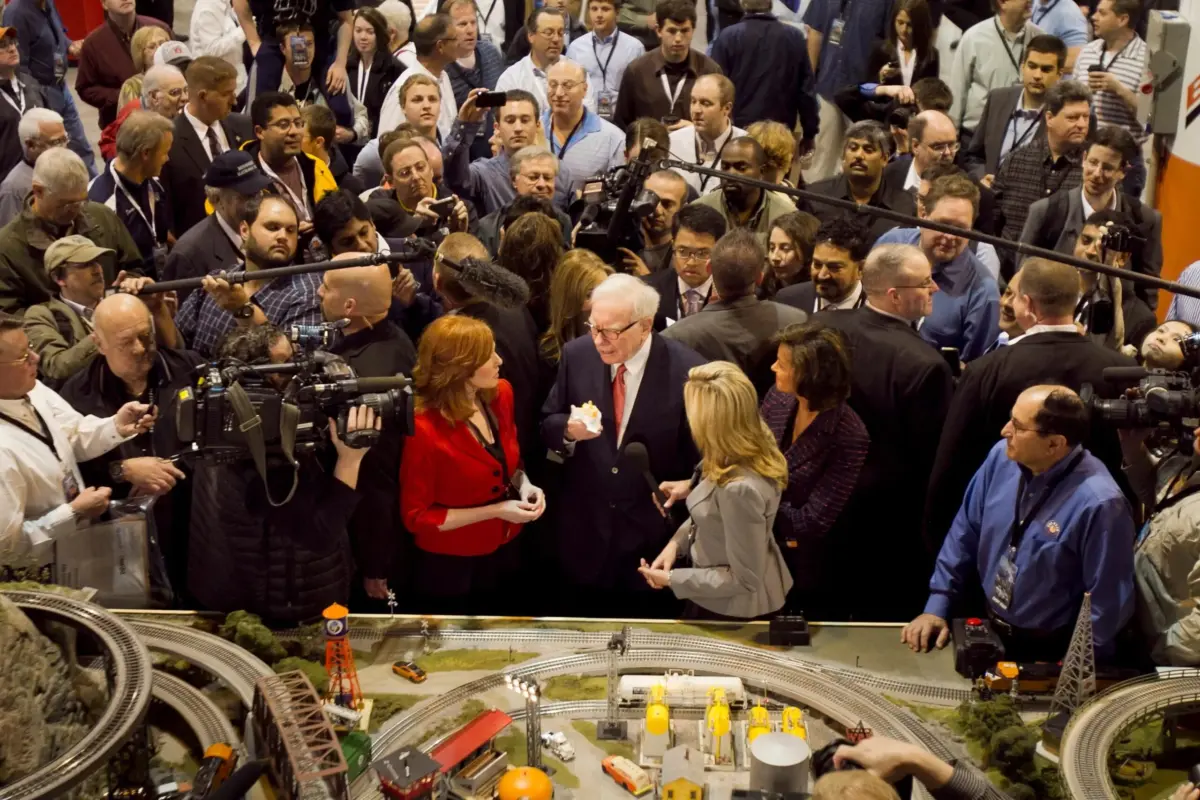
The physical manifestation of Berkshire’s cultural power was its annual shareholder meeting in Omaha. What began as a modest gathering in a cafeteria grew into a global pilgrimage, drawing upwards of 40,000 shareholders to an indoor arena on the first Saturday of May.
The meetings were a unique blend of corporate governance, financial education, and carnival. Shareholders spent millions of dollars purchasing products from Berkshire-owned subsidiaries—ranging from See’s Candies to Justin Boots—exhibited on the convention floor.
For nearly six hours, Buffett and Munger sat on stage, drinking Cherry Coke, eating peanut brittle, and answering unscripted questions from shareholders, journalists, and analysts.
[40,000+ Attendees] ──► [6 Hours of Q&A] ──► [$Millions in Subsidiary Sales]The Battle Against Modern Market Fads
Throughout his career, Buffett stood as a vocal contrarian against Wall Street’s hottest trends:
- The Dot-Com Bubble (Late 1990s): Buffett was widely derided as "out of touch" for refusing to invest in unprofitable internet startups. Within two years, the dot-com crash vindicated his caution as Berkshire’s capital remained intact while tech portfolios evaporated.
- Gold and Non-Productive Assets: Buffett remained a lifelong skeptic of gold and cryptocurrencies. He argued that gold was a static asset that produced nothing, famously writing that it "has two significant shortcomings, being neither of much use nor procreative." He maintained that productive assets—like farmland or businesses—would always out-deliver static commodities.
- The AI Deepfake Threat: In a bitter irony, Buffett’s unmatched reputation for honesty made him a primary target for modern financial scammers. In his final years at the company, Berkshire had to issue public warnings regarding sophisticated, AI-generated deepfake videos showing a synthetic Buffett endorsing highly speculative investments and political candidates.
Official Statements and Enduring Wisdom
The intellectual legacy of Warren Buffett is preserved through his annual letters to Berkshire Hathaway shareholders, which became required reading for university endowment managers, sovereign wealth funds, and retail investors alike.
                               ┌────────────────────────┐
                               │    Buffett's Rules     │
                               └───────────┬────────────┘
                                           │
                    ┌──────────────────────┴──────────────────────┐
                    ▼                                             ▼
        ┌───────────────────────┐                     ┌───────────────────────┐
        │       Rule #1         │                     │       Rule #2         │
        │  Never lose money.    │                     │ Never forget Rule #1. │
        └───────────────────────┘                     └───────────────────────┘
The Golden Rules of Capital Allocation
Buffett’s investment philosophy was often distilled into memorable, homespun aphorisms that masked deep analytical rigor:
- On Risk Management: "You only find out who is swimming naked when the tide goes out." This warning repeatedly proved true during credit crunches and market downturns, when over-leveraged funds collapsed while Berkshire sat on massive cash reserves.
- On Market Psychology: "Be fearful when others are greedy, and greedy when others are fearful." This principle guided Berkshire’s massive capital deployments during the 2008 financial crisis, when the firm provided emergency liquidity to Goldman Sachs, General Electric, and Dow Chemical on highly lucrative terms.
- On Personal Association: "Who you associate with is just enormously important. Don’t expect that you’ll make every decision right on that. But you are going to have your life progress in the general direction of the people you work with, that you admire, that become your friends."
Academic Perspectives on the Buffett Phenomenon
Scholars of finance emphasize that Buffett’s appeal extended far beyond his balance sheet. Todd Finkle, a retired professor and author of Warren Buffett: Investor and Entrepreneur, noted that Buffett’s educational sessions with students prioritized character over finance:
"He didn’t say anything about money when speaking to young people. The first topic that he would always bring up is that the most important thing you’ll do in your life is to pick who to marry. Not a day goes by where what I’ve learned about Warren doesn’t affect me positively, both personally and financially."
Bob Miles, who has taught a specialized university course on Buffett’s management style for nearly two decades, echoed this sentiment:
"People associate him with successful investing, but I look at him more and more as kind of a guide toward how to live a successful life, whatever your talents happen to be."
David Musto, a professor of finance at the University of Pennsylvania’s Wharton School, emphasized the institutional demand for Buffett’s insights:
"Trips for students to Berkshire’s annual meetings were always a hot ticket. I don’t know of any time that it wasn’t popular. It certainly helps to have people in the middle, thinking about the value of a stock, particularly when traders are jumping into meme stocks and obscure cryptocurrencies."
Future Outlook
The Succession Plan: Greg Abel and the Next Generation
The primary challenge facing Berkshire Hathaway in the post-Buffett era is the preservation of its unique corporate culture. Greg Abel, who has been designated to oversee all operations, faces the daunting task of managing a decentralized conglomerate with over 360,000 employees across diverse sectors including energy, insurance, rail transport, manufacturing, and retail.
                          ┌────────────────────────┐
                          │   Berkshire Board of   │
                          │       Directors        │
                          └───────────┬────────────┘
                                      │
         ┌────────────────────────────┴────────────────────────────┐
         ▼                                                         ▼
┌──────────────────────────────────┐              ┌──────────────────────────────────┐
│        Operating Lead            │              │         Investment Leads         │
│  Greg Abel (CEO & Chairman)      │              │   Todd Combs & Ted Weschler      │
│  • Manages operating companies   │              │   • Manage equity portfolios     │
│  • Preserves capital allocation  │              │   • Deploy excess cash reserves  │
└──────────────────────────────────┘              └──────────────────────────────────┘
While Abel possesses deep operational expertise—particularly in the energy sector—he does not command the same cult-like devotion or public platform as Buffett. Portfolio managers Todd Combs and Ted Weschler, who have managed portions of Berkshire’s equity portfolio for years, will assume full responsibility for the stock selection process, under the oversight of the board.
Can Value Investing Survive the Digital Age?
The broader question hanging over the financial sector is whether value investing can remain a dominant force. Modern markets are increasingly dominated by:
- Passive Index Funds: Trillions of dollars flow automatically into stocks based on market capitalization, regardless of underlying valuations.
- Algorithmic and High-Frequency Trading: Quantitative models exploit micro-inefficiencies, reducing the market’s reliance on human fundamental analysis.
- Retail Speculation Platforms: Online forums like Reddit’s WallStreetBets have democratized trading but also introduced unprecedented volatility, turning stocks into high-stakes speculative vehicles.
Without Buffett’s active voice, there is a risk that the market’s connection to intrinsic value will fray further. However, proponents of the value school argue that the departure of the "Oracle of Omaha" will eventually prove the durability of his system.
When market excesses inevitably correct, the companies that generate real cash flows, maintain low debt, and possess durable competitive advantages will endure. In this sense, Warren Buffett’s ultimate legacy is not just the multi-billion-dollar conglomerate he built, but the enduring blueprint he left behind for navigating the volatile waters of global capitalism.

0 Comments