

Executive Overview
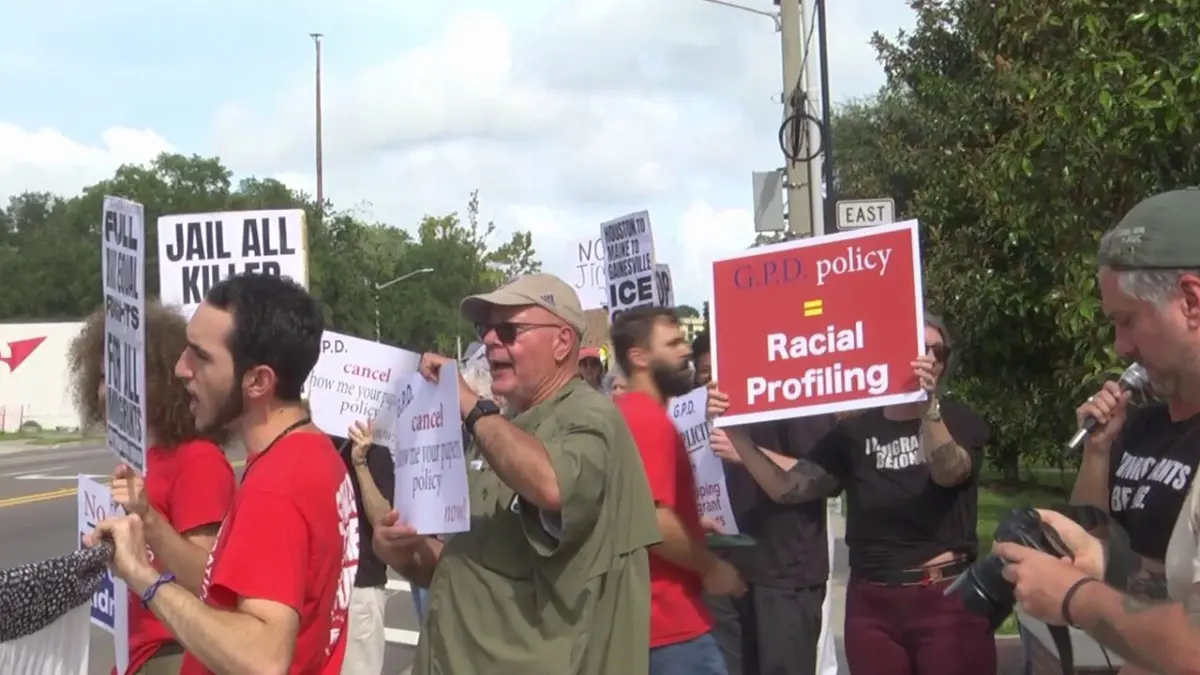
In the late summer of 2026, the municipal landscape of Gainesville, Florida, became the latest battleground in a nationwide conflict over immigration enforcement, state mandates, and community policing. Following the quiet enactment of a new internal directive by the Gainesville Police Department (GPD), local advocacy groups, civil rights defenders, and residents mobilized in protest outside the department’s headquarters.
The controversy centers on a newly issued GPD general order titled “State Board of Immigration Enforcement.” Under this directive, municipal police officers are formally required to document and report any contact with individuals they suspect of being "unauthorized aliens." These reports are compiled via a standardized state form and forwarded directly to the Florida Department of Law Enforcement (FDLE).
While GPD administrators maintain that the policy is a mandatory compliance measure dictated by state-level authorities, critics argue it transforms local police officers into de facto federal immigration agents. The policy has reignited fears of systemic racial profiling, eroded trust between immigrant communities and local law enforcement, and highlighted a growing divide between progressive municipalities and Florida’s state government.
This investigative report examines the chronology of the directive, the socio-political climate in Alachua County, the operational mechanics of the new reporting mandate, and the broader legal and humanitarian implications of localizing immigration enforcement.
Detailed Chronology
The implementation of the GPD’s new immigration reporting policy did not occur in a vacuum. Instead, it represents the culmination of a multi-month push by state authorities to standardize local police cooperation with federal immigration agencies.
[Summer 2026] State Immigration Enforcement Council lobbies local agencies
       │
[Aug 28, 2026] GPD formally issues "State Board of Immigration Enforcement" Order
       │
[Late Aug 2026] Community discovery of the directive sparks public outrage
       │
[Sep 3, 2026] ICE detains a local Gainesville High School student-athlete
       │
[Sep 2026] GINI-led protests erupt outside GPD Headquarters
The Summer of State-Level Pressure
Throughout the summer of 2026, Florida’s State Immigration Enforcement Council actively engaged with municipal police departments and county sheriffs across the state. The council’s primary objective was to encourage, and in some cases pressure, local jurisdictions to adopt strict reporting mechanisms regarding undocumented immigrants.
While several rural and historically conservative counties quickly fell into alignment, mid-sized municipal departments—particularly those in university towns like Gainesville—exhibited initial hesitation, citing concerns over community trust and resource allocation.
August 28, 2026: The Issuance of the General Order
On August 28, 2026, the Gainesville Police Department formally issued the general order titled “State Board of Immigration Enforcement.” The directive bypassed public city commission debates, catching local immigrant advocacy groups off guard. The order established a protocol requiring patrol officers to assess the legal status of individuals during routine stops, traffic violations, or service calls if "reasonable suspicion" existed regarding their immigration status.
September 3, 2026: A Catalyst in the Community
Tensions escalated sharply on September 3, 2026, when news broke that a beloved student-athlete from Gainesville High School had been detained by U.S. Immigration and Customs Enforcement (ICE).
Although the student was subsequently approved for bond and permitted to return home, the incident sent shockwaves through the local school system and minority neighborhoods. For many residents, the detention served as a concrete example of the perceived threat posed by increased coordination between local entities and federal immigration enforcement.
The Mobilization of GINI and Public Protest
In direct response to the August 28 general order and the subsequent ICE detention, the Gainesville Immigrant Neighbor Inclusion (GINI) Initiative organized a series of demonstrations. Protesters gathered outside the GPD headquarters on Main Street, carrying signs, chanting slogans, and demanding the immediate rescission of the general order.
The demonstrations drew a diverse coalition of University of Florida students, faith leaders, immigration attorneys, and local families, illustrating the deep community polarization surrounding the issue.
Supporting Context & Metrics
To understand the friction in Gainesville, one must analyze the legal and demographic framework of Florida’s evolving immigration policies, as well as the operational divergence between neighboring municipalities.
The Mechanism of the "State Board of Immigration Enforcement" Order
The newly implemented general order mandates a specific operational pipeline:
- The Encounter: An officer interacts with an individual during standard policing duties (e.g., a traffic stop, a code violation, or as a witness/victim of a crime).
- The Suspicion: If the officer develops a suspicion that the individual is undocumented—based on criteria that critics argue are highly subjective—the officer is instructed to investigate further.
- The Documentation: The officer must complete a dedicated state-issued form detailing the individual’s personal information, location of encounter, and the basis for the suspicion of unauthorized status.
- The Transmission: The completed documentation is routed to the Florida Department of Law Enforcement (FDLE), which then coordinates with federal immigration authorities, including ICE.
Regional Divergence in Policy Adoption
The State Immigration Enforcement Council’s push has met with uneven success across North Central Florida. A comparison of municipal police departments reveals a fractured landscape:
| Jurisdiction | Population (Approx.) | Adopted Immigration Reporting Policy? | Primary Authority/Sponsor |
|---|---|---|---|
| Gainesville PD | 145,000 | Yes (Effective Aug 28, 2026) | State Mandate / GPD Command |
| Ocala PD | 64,000 | No | Local Autonomy / Municipal Discretion |
| Lake City PD | 12,000 | No | Local Autonomy / Municipal Discretion |
This divergence highlights that despite state-level pressure, local police chiefs still retain a degree of administrative discretion. Departments in Ocala and Lake City have, thus far, resisted adopting similar explicit mandates, choosing instead to focus resources on traditional municipal crime prevention and maintaining community relations.
The Progressive-Conservative Fault Line
Gainesville, as the home of the University of Florida, exists as a progressive-leaning enclave within Alachua County, often contrasting with the deeply conservative state leadership in Tallahassee. This ideological divide has repeatedly manifested in battles over local governance, home rule, and civil liberties.
Advocates point out that policies like the GPD general order effectively override local municipal efforts to foster inclusive communities, forcing local tax dollars to fund state-aligned immigration enforcement agendas.
Official Statements and Perspectives
The debate over the GPD general order features sharply contrasting viewpoints from law enforcement officials, state coordinators, and community activists.
The Gainesville Police Department’s Position
GPD leadership has framed the policy not as a voluntary initiative, but as an unavoidable administrative compliance requirement imposed by the state of Florida. In communication with local media outlets, a GPD spokesperson emphasized that the department is bound by state regulations:
"The directive we have implemented originates from state-level requirements. Our officers are being instructed to comply with state frameworks by utilizing the designated forms to report suspected unauthorized status to the Florida Department of Law Enforcement. We remain committed to keeping our community safe while adhering to the legal mandates handed down to us by the state."
The Grassroots Resistance: GINI and Community Voices
Conversely, representatives from the Gainesville Immigrant Neighbor Inclusion (GINI) Initiative argue that the policy is a catastrophic step backward for public safety. Activists assert that when undocumented residents fear that any contact with local police could lead to deportation, they cease reporting crimes, domestic abuse, or serving as witnesses in criminal investigations.
During the protests outside GPD headquarters, community members expressed their anger and fear. One local resident spoke passionately to reporters about the human cost of such policies:
"There is no such thing as an illegal alien; we are all human beings trying to live our lives, support our families, and contribute to this city. The entire community should be up in arms about what is happening here. There is absolutely no reason for our local police, funded by our local tax dollars, to act as an arm of ICE."
Legal and Civil Rights Concerns
Civil rights attorneys monitoring the situation in Gainesville have raised concerns regarding the constitutional validity of the directive. Under federal law, immigration enforcement is primarily the domain of the federal government.
Lawyers argue that instructing municipal officers to determine "suspected unauthorized status" inevitably leads to violations of the Fourth Amendment (unreasonable search and seizure) and the Fourteenth Amendment (equal protection), as officers may rely on accent, English proficiency, or ethnicity to form their suspicions.
Future Outlook
As the GPD general order takes effect, the city of Gainesville faces a period of heightened legal, social, and political instability. Several key developments are anticipated in the coming months:
1. Impending Legal Challenges
Civil rights organizations, including the American Civil Liberties Union (ACLU) of Florida and regional immigrant defense coalitions, are reportedly preparing lawsuits to challenge the constitutionality of the state-mandated reporting forms. These lawsuits are expected to argue that the state of Florida is overstepping its constitutional boundaries by enacting local immigration enforcement mandates that preempt federal authority.
2. Erosion of Public Safety Metrics
Sociologists and criminologists warn that the implementation of the policy will likely yield a measurable drop in crime reporting within immigrant-dense neighborhoods in Gainesville. Law enforcement experts will be watching closely to see if domestic violence reporting, wage theft complaints, and neighborhood cooperation with detectives decline as a direct consequence of the new reporting mandate.
3. Municipal and Legislative Clashes
The Gainesville City Commission, which has historically supported immigrant integration initiatives, may seek legislative or budgetary workarounds to limit the scope of the GPD’s cooperation with the FDLE. However, any local attempts to circumvent state immigration laws could trigger punitive measures from the Florida Legislature, including the withholding of state funds or the removal of local elected officials.
The unfolding situation in Gainesville serves as a microcosm of a national debate: whether municipal police departments should serve strictly as local peacekeepers or be integrated into the broader, highly politicized apparatus of state and federal border enforcement. As protests continue and legal battles loom, the residents of Gainesville find themselves at the center of an unresolved struggle over identity, safety, and the rule of law.

0 Comments