

Executive Overview
TALLAHASSEE, Fla. — In college football, perception is frequently treated as reality, and in Tallahassee this week, the atmosphere is heavy with scrutiny. As the Florida State Seminoles prepare for one of the most daunting environments in modern athletics—a high-stakes road matchup against the No. 10-ranked Alabama Crimson Tide—the program finds itself navigating a tempest of external speculation, lackluster early-season results, and intense self-reflection.
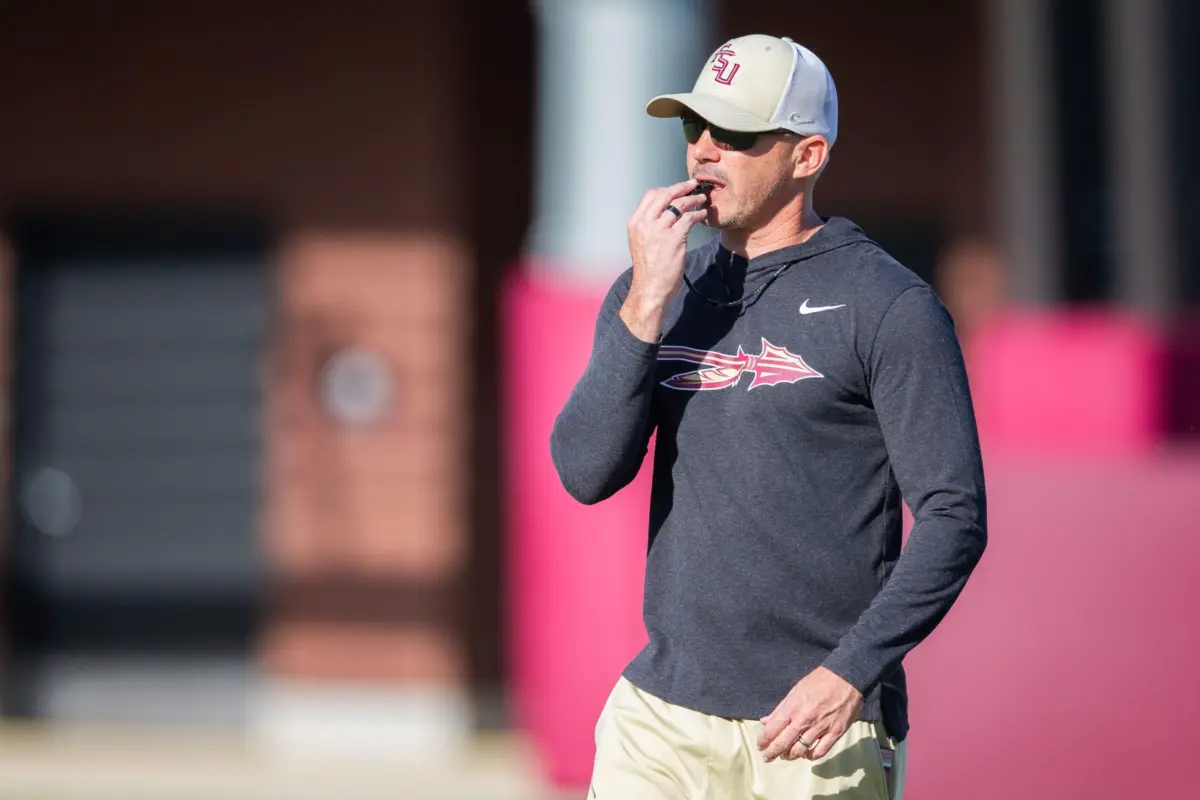
Head coach Mike Norvell met with the media on Wednesday for his final press briefing ahead of Saturday’s kickoff. Appearing composed yet resolute, Norvell addressed everything from viral social media rumors to the glaring tactical deficiencies that have plagued the Seminoles through the opening stretch of the season. Joining him at the podium was rover Ashlynd Barker, a defensive standout whose recent play has been a bright spot despite the team’s broader struggles.
For Florida State, this week represents far more than just a standard game-week preparation. It serves as a referendum on the trajectory of a program attempting to steady its footing. With a demanding schedule ahead, questions swirling regarding coaching efficacy, and fans parsing every digital footprint for signs of an impending departure, Norvell and his players face the ultimate test of resilience. This report provides an in-depth look at Wednesday’s press conference, analyzes the underlying defensive metrics, examines the players’ accountability, and outlines the monumental challenge awaiting the Seminoles in Tuscaloosa.
Detailed Chronology: Wednesday’s Media Availability
The mid-week press conference is typically a routine affair characterized by boilerplate coach-speak and injury updates. However, the unique intersection of Florida State’s current on-field struggles and the relentless speed of digital media turned Wednesday’s session into an interrogation of both physical execution and psychological fortitude.
Addressing the Digital Noise: Moving Trucks and Social Media Speculation
The most surreal moment of the afternoon arrived when a reporter broached a topic that had been circulating wildly across X (formerly Twitter) and various message boards: viral photographs appearing to show moving trucks parked outside Norvell’s residence. In the modern era of collegiate athletics, where coaching seats grow hotter by the week and rumors can materialize from a single out-of-context snapshot, digital scrutiny has become an inescapable tax of leadership.
Norvell, visibly bewildered by the question, made it clear that he operates in a self-imposed bubble far removed from the digital noise.
"I don’t look a whole lot online," Norvell told reporters. "For me, all of our focus is on the team and that’s where I live."
By entirely dismissing the online chatter, Norvell sought to project stability to his locker room. Yet, the very existence of such rumors underscores the volatile nature of expectations in Tallahassee. When a historic program stumbles out of the gate, fans and analysts alike search for tea leaves in the most mundane of places—turning a routine household occurrence into fodder for a coaching search.
Confronting the Record: Owning the Disappointment
Moving past the social media distractions, Norvell pivoted directly to the core issue: the on-field product. Florida State’s results have fallen short of the elevated standards established in the program’s rich history, and the head coach refused to offer excuses or deflect blame.
"There have been disappointing results and I’ve never sat here and tried to make an excuse, not once since I’ve been here," Norvell stated candidly. "Our results have not been as good as what we want them to be. But I believe in the process. I believe in the work. I believe in the players I get to coach."
This unwavering commitment to his foundational philosophy—the "process"—has been a hallmark of Norvell’s tenure. However, as the losses mount and execution falters, rhetoric about trusting the process inevitably faces skepticism from a fanbase demanding immediate tangible progress.
Supporting Context & Metrics: Diagnosing the Third-Down Deficit
While motivational messaging plays an important role in team culture, football games are ultimately won and lost in the margins of schematics and execution. For Florida State, those margins have been alarmingly thin on third-down defense through the first two games of the season.
The Disconnect Between Practice and Game Day
Norvell identified third-down defense as one of the most profoundly frustrating aspects of the team’s early-season performance. The issue, according to the head coach, is not a lack of conceptual understanding or poor preparation during weekly practice sessions. Rather, it is a debilitating breakdown in translation when the lights come on.
"This is the practice clip. This is the game clip. Like, why is this one different?" Norvell asked rhetorically, capturing the exact sentiment of defensive coordinators across the country who watch flawless weeknight execution unravel on Saturday afternoons.
When pressed on whether this falls on the coaching staff or the players, Norvell demonstrated accountability.
"Is that coaching? Yes. Because obviously it wasn’t executed. We’re responsible for all of it."
The Players’ Perspective: Deflecting the Shield to the Field
While Norvell shouldered the ultimate responsibility as head coach, rover Ashlynd Barker offered a sharply contrasting perspective, firmly placing the burden of execution back onto the players’ shoulders. In an era where players frequently look for schematic excuses or blame play-calling, Barker’s transparency was refreshing.
"It’s not the play call or the coaches. It’s simply on us," Barker declared. "We just got to be better."
This divergence in perspective highlights a classic dynamic in football: coaches analyze the why behind a structural failure (scheme, communication, preparation), while players ultimately bear the burden of the what (missed tackles, blown coverages, losing one-on-one battles). For Florida State to reverse its fortunes on third down, that player-led accountability must manifest in immediate structural discipline on the field.
Official Statements & Standout Performances
Amid the broader team struggles, individual resilience continues to emerge. Few stories embody this better than that of Ashlynd Barker, whose performance against SMU serves as a testament to toughness.
Playing Through Pain: Barker’s Miraculous Interception
During the previous matchup against SMU, Barker made one of the game’s defining defensive plays by intercepting quarterback Kevin Jennings. What made the play remarkable was not just the athletic tracking of the ball, but the physical impediment through which it was achieved: Barker was playing with a hard cast on his hand.
In football, a hand cast severely limits grip strength, making routine catches difficult, let alone securing a game-changing interception in high-velocity traffic. Barker revealed that his feat was the culmination of lighthearted locker room banter throughout the week.
"The whole week out of practice, everybody was joking with me about being able to catch it, and I was able to catch a pick," Barker smiled, reflecting on the moment. "So it’s crazy that I was able to do it."
Barker’s ability to overcome a physical handicap to make a pivotal play provides a vital emotional spark for a defense searching for playmakers. His willingness to play through injury and produce in critical moments sets a high standard for his teammates.
Scouting the Crimson Tide: Containing Keelon Russell
Barker’s leadership will be tested immediately as he and the Florida State defense prepare to contain Alabama’s dynamic offensive attack, spearheaded by quarterback Keelon Russell.
Evaluating the Crimson Tide’s signal-caller, Barker pinpointed the precise element that makes Russell such a nightmarish assignment for opposing defensive coordinators: mobility.
"He’s probably the biggest change in the offense because he can get out the pocket more and make plays with his legs," Barker noted.
In modern college football, a dual-threat quarterback who can extend plays outside the pocket transforms an offensive playbook. Traditional pass-rushing lanes that are effective against pocket passers often break down against athletes like Russell, forcing defensive backs like Barker to maintain blanket coverage for extended periods—a daunting task for any secondary, let alone one trying to tighten its third-down efficiency.
Future Outlook: The Road Ahead in Tuscaloosa
As Florida State boards the flight to Tuscaloosa, the narrative surrounding the program is at a critical juncture. Facing the No. 10-ranked team in the country on the road is never an easy assignment, but doing so while carrying the weight of early-season inconsistencies and swirling external rumors magnifies the challenge exponentially.
The Stakes of Saturday’s Showdown
A victory against Alabama would instantly alter the entire complexion of Florida State’s season. It would serve as a powerful validation of Norvell’s "process," silence the online critics questioning the stability of the program, and inject a massive dose of confidence into a locker room striving to find its identity. Conversely, a decisive defeat would only intensify the pressure, fueling the digital narrative of a program in transition and deepening the concerns regarding tactical execution on both sides of the ball.
What to Watch For
As the Seminoles take the field on Saturday afternoon, analysts and fans will be closely monitoring several key indicators:
- Third-Down Discipline: Can Florida State bridge the gap between their crisp practice clips and game-day execution? Fixing their third-down defensive woes is non-negotiable against an elite offensive scheme.
- Containment of Keelon Russell: Will the Seminoles’ front seven be able to maintain disciplined pass-rushing lanes and prevent Russell from breaking the pocket and picking up drive-sustaining yardage with his legs?
- Mental Fortitude: How will the team respond to early adversity? In hostile environments like Bryant-Denny Stadium, body language and emotional control dictate whether a team can stay within striking distance or let the game spiral out of control.
Ultimately, Mike Norvell and his squad have chosen to tune out the digital static, ignore the moving truck rumors, and focus entirely on the green grass of the gridiron. Whether that internal focus translates into execution under the bright lights of Tuscaloosa remains the defining question of Florida State’s season.

0 Comments