

Executive Overview
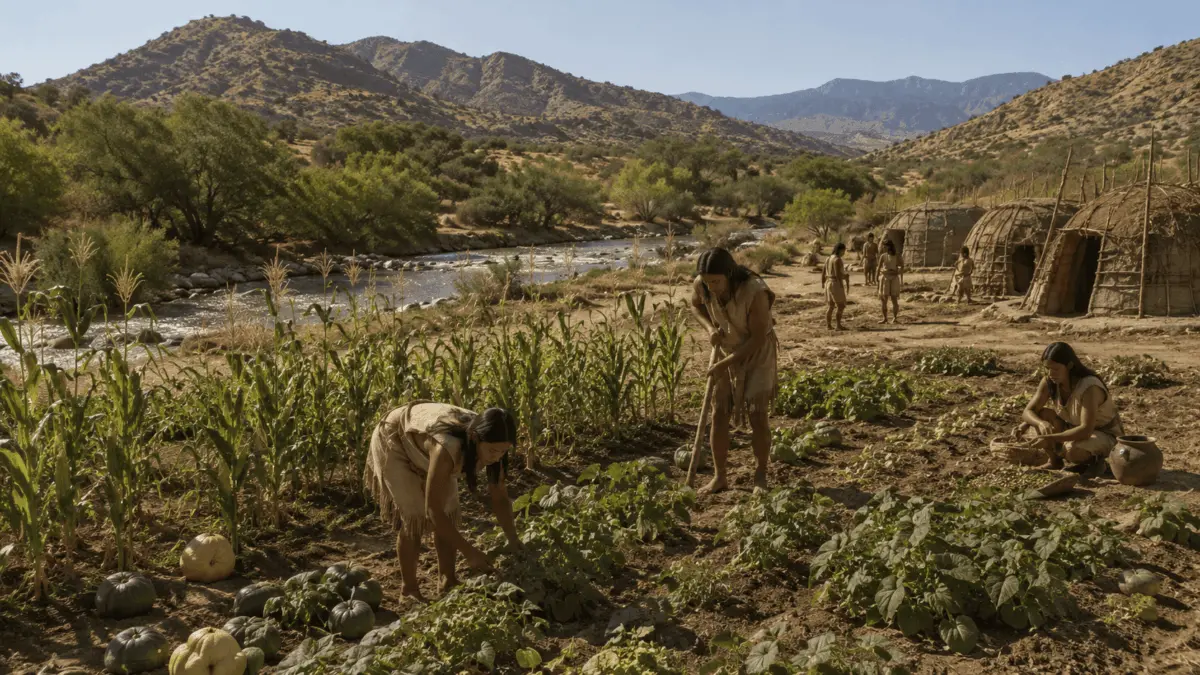
Long before the first European sails appeared on the horizon of the North American continent, complex, highly productive agricultural societies were already thriving across the landscape. Contrary to early, Eurocentric myths depicting North America as a pristine wilderness populated solely by nomadic hunter-gatherers, archaeological and historical evidence reveals a continent actively managed, shaped, and cultivated by Indigenous peoples for millennia.
From the sophisticated, arid-land irrigation canals of the American Southwest to the ingenious companion-planting systems of the Eastern Woodlands, Native American agriculture laid the foundational bedrock for food security, trade, and community structure in the Western Hemisphere.
In this special installment of the American Agriculture History Minute, host Mark Oppold explores the profound depth of pre-Columbian farming. This feature corrects persistent historical misconceptions, highlights the remarkable ecological adaptability of early Indigenous farmers, and re-evaluates the true origins of North American agriculture. By examining how ancient communities harnessed water resources, bred resilient crop varieties, and synchronized their cultivation cycles with local ecosystems, modern agronomists and historians alike gain a vital perspective on sustainable land stewardship. The story of American agriculture does not begin with European colonization; rather, European practices entered an ancient, highly evolved continuum of Indigenous land management.
Detailed Chronology: The Evolution of Pre-Columbian Farming
To understand the trajectory of agriculture in North America, one must look far back into antiquity. The development of farming across the continent was neither sudden nor uniform; it was a gradual, highly localized process of innovation, experimentation, and adaptation that stretched across thousands of years.
The Archaic Roots and Early Southwestern Agriculture (c. 2100 B.C. – 1000 B.C.)
For generations, popular history misattributed the origins of Southwestern agriculture to distant Mesoamerican empires such as the Aztecs or Incas. However, modern archaeological science has decisively corrected this narrative. The ancient farmers who first coaxed crops from the arid soils of present-day Arizona and New Mexico were distinct Indigenous cultures native to the region.
Archaeological excavations—particularly within the Tucson Basin of southern Arizona—have pushed the timeline of early Southwestern farming back to approximately 2100 B.C. During this Early Agricultural Period, communities began shifting from a strictly mobile foraging lifestyle to semi-permanent and permanent settlements anchored by cultivated fields.
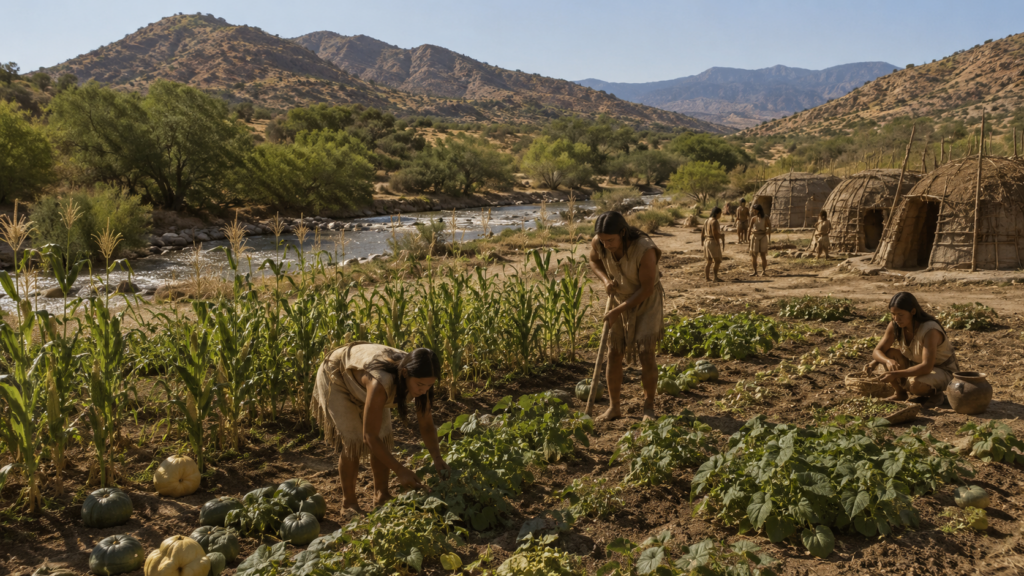
By 1000 B.C., these early innovators had mastered rudimentary yet highly effective water-management practices. Confronted with scarce rainfall and unforgiving desert temperatures, they engineered early irrigation systems, diverting seasonal runoff and river flows to nourish foundational crops like maize (corn), beans, and squash.
The Rise of Specialized Regional Traditions (c. 1st Millennium A.D. – 1400s)
As centuries progressed, these foundational farming techniques evolved into sophisticated regional agricultural economies. Archaeologists categorize these developments into distinct cultural traditions that dominated the American Southwest and beyond:
- The Hohokam Culture: Flourishing primarily in the desert of southern Arizona along the Gila and Salt River basins, the Hohokam built one of the most extensive and complex prehistoric irrigation canal systems in the Americas. Some of these canals stretched for miles, distributing precious river water to thousands of acres of arid farmland.
- The Mogollon Culture: Centered in the mountainous regions of eastern Arizona, western New Mexico, and parts of northern Mexico, the Mogollon adapted their farming techniques to rugged terrain, utilizing pit-house villages and terraced hillsides to capture rainfall and prevent soil erosion.
- The Ancestral Puebloans (Anasazi): Operating across the Four Corners region, these communities mastered dry-farming techniques, runoff agriculture, and ingenious water-catchment systems. They grew drought-resistant varieties of crops on mesa tops and canyon floors, storing surplus harvests in stone granaries to buffer against multi-year droughts.
The Eastern Woodlands and the "Three Sisters" (c. 1000 A.D. – European Contact)
Simultaneously, agricultural innovation was flourishing east of the Mississippi River. Indigenous societies in the Eastern Woodlands developed the revolutionary companion-planting system famously known as the "Three Sisters": maize, climbing beans, and winter squash.
- Maize provided a sturdy vertical stalk that served as a natural trellis for the beans.
- Beans naturally fixed nitrogen into the soil, acting as a biological fertilizer that nourished the heavy-feeding corn.
- Squash grew broad, prickly leaves that blanketed the ground, suppressing weed growth and retaining vital soil moisture while deterring agricultural pests.
This ecological synergy maximized yields, preserved soil health, and provided a nutritionally complete diet rich in complex carbohydrates, essential amino acids, and vitamins.
Supporting Context & Metrics: Ecological Mastery and Crop Diversity
The scope and sophistication of Native American agriculture are best understood through the sheer volume of plant domestication and landscape modification achieved prior to 1492.
The Global Agricultural Gift
It is estimated that roughly 60% of the world’s current food supply—by weight and economic value—is derived from crops originally domesticated by the Indigenous peoples of the Americas. Beyond maize, beans, and squash, Native American farmers successfully cultivated and bred:
- Potatoes and sweet potatoes
- Tomatoes and peppers
- Sunflowers and pumpkins
- Cacao, vanilla, and various types of squash and gourds
- Long-staple cotton and specialized varieties of tobacco
Water Management and Engineering Marvels
The scale of pre-Columbian engineering challenges the modern imagination. In the arid Southwest, where annual rainfall often dropped below ten inches, Hohokam farmers moved millions of cubic yards of earth using simple stone and wooden tools to construct hundreds of miles of gravity-fed canals. These networks achieved precise gradients—sometimes dropping only a few feet per mile—to ensure steady water flow without eroding the canal walls or silting up the fields.
Controlled Burns and Forest Gardening
Agriculture in pre-Columbian North America was not restricted to fenced-in fields. Indigenous communities practiced broad landscape management, most notably through controlled, low-intensity burns. These fires cleared underbrush, rejuvenated soil nutrients, encouraged the growth of berry-producing shrubs favored by game animals, and created open park-like forests that facilitated both hunting and travel. Far from being passive inhabitants of a wild landscape, Native Americans actively curated their environments into vast, highly productive food webs.
Official Statements & Historical Perspectives
The re-evaluation of Indigenous agricultural history has garnered significant attention from academic institutions, federal land-management agencies, and cultural historians.
In recent briefs released by the National Park Service, researchers emphasize the necessity of reframing ancient Southwestern history:
"The historical record requires continuous correction. The early agriculturalists of Arizona and New Mexico were not offshoots of the Inca or Aztec empires, but brilliant, independent Indigenous innovators—including the ancestors of the Hohokam, Mogollon, and Pueblo peoples—who pioneered desert farming techniques that continue to astonish modern hydrologists."
Agricultural historians note that European colonists, upon arriving in the New World, would likely have faced starvation without the agricultural safety net provided by Indigenous nations. Mark Oppold, in The American Agriculture History Minute, highlights this critical junction:
"When European settlers brought their livestock, plows, and Old World seeds across the Atlantic, they did not step into an empty, untamed wilderness. They entered an ancient, meticulously managed agricultural landscape. European farming traditions did not invent American agriculture; they simply became the next chapter in a millennia-old story of human resilience and adaptation."
Modern agronomists are increasingly looking backward to move forward, studying ancient Indigenous techniques to address contemporary agricultural crises such as water scarcity, soil depletion, and climate change.
Future Outlook: Integrating Ancient Wisdom into Modern Agronomy
As the global agricultural sector faces unprecedented challenges in the 21st century—including intensifying droughts, declining aquifer levels, and the degradation of arable topsoil—the agricultural heritage of Native Americans offers a profound blueprint for the future.
Climate-Smart and Regenerative Agriculture
Modern regenerative agriculture champions principles that Indigenous farmers mastered centuries ago:
- Polyculture over Monoculture: Moving away from vast, single-crop fields toward integrated companion planting (inspired by the Three Sisters) reduces synthetic fertilizer dependency and naturally deters pests.
- Water Conservation: Dry-farming techniques and ancient water-harvesting geometries used in the American Southwest are being re-evaluated by modern researchers seeking to produce crops in regions facing severe water restrictions.
- Soil Health Restoration: Avoiding deep-till practices that destroy soil microbiology, early Indigenous farmers relied on minimal-disturbance methods that preserved soil structure and organic carbon content.
Educational and Cultural Preservation
Efforts are currently underway across North America to restore traditional Indigenous seeds (often preserved for centuries by tribal seed-keepers) to native lands. Programs pairing modern agricultural scientists with tribal elders are fostering a collaborative approach to food sovereignty, climate resilience, and cultural education.
Ultimately, recognizing the depth and sophistication of Native American agriculture shifts our national historical narrative. It honors the generational knowledge of the peoples who first tended the soil of the North American continent, transforming our understanding of farming from a colonial enterprise into a shared, millennia-old human heritage.

0 Comments