
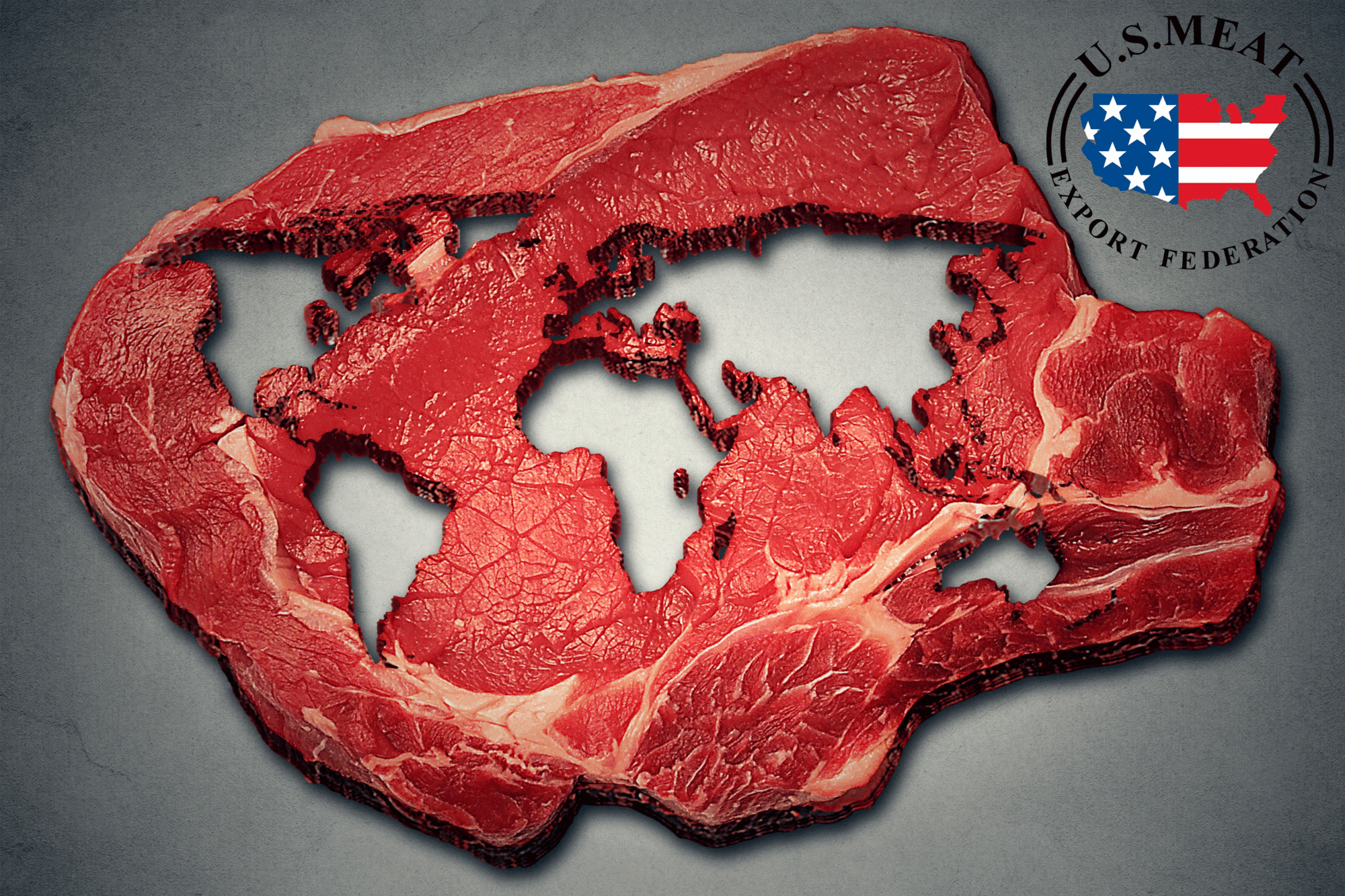

GLOBAL TRADE ANALYSIS — The landscape of American agricultural exports experienced a notable divergence in August, as robust international demand propelled U.S. beef sales to strong year-over-year gains, while the pork sector encountered a localized contraction. According to trade data released by the United States Department of Agriculture (USDA) and meticulously compiled by the U.S. Meat Export Federation (USMEF), the month of August underscored both the resilience of American meat producers and the complex, shifting macroeconomic factors shaping international protein markets.
While beef found renewed momentum on the back of surging consumer demand in East Asia and emerging markets, pork exports faced a downward correction, primarily influenced by shifting production capacities within key North American trading partners. As the industry looks toward the closing quarters of the year, stakeholders continue to navigate logistical hurdles, evolving phytosanitary requirements, and the constant balancing act of global market diversification.
Executive Overview
The August trade report paints a multifaceted picture of the U.S. red meat industry’s footprint on the global stage:
- U.S. Beef Resilience: August beef exports achieved a total volume exceeding 86,000 metric tons, registering a 4% increase compared to the corresponding period in the previous year. More impressively, the total export value climbed by 13%, reaching nearly $786 million. This valuation jump highlights a strong global preference for high-quality grain-fed American beef, even amid inflationary pressures in several importing economies.
- Pork Sector Contraction: Conversely, U.S. pork exports experienced a downturn in August. Total volume slipped to just over 222,000 metric tons—a 6% decline year-over-year. The financial impact was similarly pronounced, with total export value dropping 12% to $606 million. This contraction was largely concentrated in shipments to Mexico, where domestic pork production has notably rebounded, altering traditional import requirements.
- Strategic Market Shifts: Despite headwinds in specific regions, both sectors continue to reap the rewards of proactive market diversification. While Taiwan, South Korea, and the Middle East bolstered beef numbers, regions such as Central America, the Caribbean, and Colombia provided vital cushions for the pork industry, mitigating the losses experienced in core primary markets.
Detailed Chronology and Trade Performance Breakdown
The August Beef Trajectory: Recovery and Expansion
The positive trajectory of August beef exports was not an isolated anomaly, but rather the continuation of a strategic recovery phase observed throughout the year’s third quarter. Totaling over 86,000 metric tons, the volume growth demonstrates that international buyers remain willing to secure premium American beef cuts despite tighter domestic cattle supplies and elevated price points in the United States.
The 13% leap in export value—surpassing the $786 million threshold—indicates that foreign consumers are continuing to absorb higher unit costs. Industry analysts point out that this value-to-volume ratio is a healthy indicator for domestic cattle producers, as it proves that international markets are willing to pay a premium for the marbling, safety standards, and consistency associated with U.S. beef.
A closer examination of the August data reveals that the growth was broad-based rather than reliant on a single destination. While traditional heavyweights in Asia reasserted their purchasing power, emerging and secondary markets across the Middle East and South America punched above their weight classes, collectively contributing to the sector’s net positive balance sheet.
The Pork Sector’s August Correction
The U.S. pork industry’s performance in August tells a story of localized market saturation and domestic recovery abroad. Total export volume settling at 222,000 metric tons and a valuation of $606 million represented a clear deceleration from the heights achieved in previous cycles.
The primary driver behind this contraction was a significant slowdown in shipments to Mexico. For years, Mexico has served as the bedrock of U.S. pork export volume, absorbing massive quantities of hams and other primal cuts. However, a robust recovery within Mexico’s domestic swine production sector has altered this dynamic. Mexican producers have successfully scaled up operations to meet a larger share of local consumer demand, directly reducing their reliance on imported American product.
Compounding this shift was a temporary softening of demand in a few secondary Asian markets, which collectively created the 6% volume and 12% value retreat witnessed in the August data set.
Supporting Context and Metrics: The First Eight Months in Review
To fully understand the weight of the August figures, industry stakeholders must analyze the broader cumulative data spanning the first eight months of the year.
Beef: The China Factor and Non-China Growth
On a cumulative basis for the year-to-date, total U.S. beef export volume remains roughly 7% below the levels recorded during the same period in the previous year. At first glance, this metric might suggest a struggling sector; however, industry experts emphasize that this deficit is almost entirely attributable to a single variable: restricted market access and structural trade friction within mainland China.
Technical trade barriers, regulatory hurdles, and stringent border inspections have continued to impede the free flow of U.S. beef into the Chinese mainland, keeping volumes well below historical peaks.
However, when analysts strip away the China data to evaluate the rest of the global portfolio, a remarkably different, highly encouraging picture emerges. Excluding China, the total value of U.S. beef exports is currently running 6% ahead of the previous year. This impressive divergence underscores the immense strategic value of robust performance in alternative markets like Taiwan, South Korea, Japan, and Southeast Asia, effectively insulating the U.S. cattle industry from localized regulatory shocks.
Pork: The Power of Geographical Diversification
While the Mexican market correction impacted August pork figures, the cumulative year-to-date data reveals a resilient industry aggressively leaning into geographic diversification.
Pork shipments to Central America, Colombia, and the Caribbean have posted consistent, upward trends. By cultivating robust commercial relationships in these emerging Caribbean Basin and South American markets, U.S. pork exporters have successfully diversified their risk portfolio. This strategic distribution ensures that a downturn in any single primary market—such as the recent contraction in Mexico—does not threaten the long-term viability and growth trajectory of American pork producers and processors.
Official Statements and Industry Insights
In the wake of the USDA report release, leadership from the U.S. Meat Export Federation (USMEF) provided critical context regarding the forces shaping international trade channels.
USMEF President and CEO Dan Halstrom highlighted the standout performers that shaped the August outcomes, offering a nuanced perspective on regional trade realities.
"Taiwan has been an absolute standout market for U.S. beef throughout the year, consistently demonstrating high per-capita demand for high-quality American cuts," stated Dan Halstrom, President and CEO of USMEF. "Simultaneously, our exports to South Korea are tracking precisely along the lines of the stronger second-half performance our industry anticipated and planned for."
Addressing the persistent challenges in East Asia, Halstrom offered candid commentary regarding the world’s second-largest economy:
"While beef exports to China have shown modest improvements compared to the depressed levels of a year ago, ongoing technical trade barriers continue to create a ceiling on our growth potential in that vital market. Resolving these non-tariff measures remains a key priority for expanding our footprint there sustainably."
Turning his attention to the pork sector, Halstrom emphasized that the August dip, while noticeable, is part of a standard economic cycle rather than a structural failure of U.S. competitiveness.
"The softening in pork numbers is primarily tied to Mexico, where domestic production has experienced a very strong, localized recovery," Halstrom explained. "When a primary partner increases its own domestic supply, a trade adjustment is natural. However, the remarkable growth we are seeing in Central America, Colombia, and the Caribbean proves that our market diversification strategy is working precisely as intended, providing stability and alternative revenue streams for American pork producers."
Future Outlook: Navigating the Global Protein Marketplace
As the red meat export industry pivots toward the final quarter of the year, stakeholders are mapping out strategies to capitalize on emerging trends while mitigating ongoing macroeconomic and geopolitical risks.
1. Strengthening Asian Markets Through Promotional Investments
The rebound in South Korea and the sustained high demand in Taiwan validate the continuous promotional investments made by checkoff-funded organizations like USMEF. Moving forward, maintaining consumer preference in these high-value Asian markets will require aggressive culinary education, food service partnerships, and targeted retail marketing. As South Korea’s economy stabilizes and consumer confidence rebounds, U.S. beef exporters are well-positioned to capture an even larger share of the prime and choice cut segments.
2. Overcoming Regulatory and Technical Barriers
For the beef sector to close the gap on its year-to-date volume deficit, unlocking greater access to mainland China remains an indispensable objective. Agricultural trade negotiators, in collaboration with industry leaders, will need to engage in persistent dialogue with foreign regulatory bodies to streamline inspection processes and harmonize sanitary standards. Until those technical barriers are systematically dismantled, the non-China markets will continue to bear the heavy lifting for export valuation.
3. Adapting to Shifts in North American Trade
The structural shift observed in Mexico’s pork sector serves as a sharp reminder that export markets are dynamic and subject to domestic policy changes abroad. To offset the plateauing of demand in Mexico, U.S. pork exporters are expected to double down on expansion efforts in Latin America and Southeast Asia. Emerging economies with rising middle-class populations represent prime targets for affordable, high-quality protein imports. Logistics optimization, trade agreements, and cold-chain infrastructure investments in these secondary regions will be vital components of the industry’s playbook for the upcoming year.
Summary
The August export report serves as a microcosm of modern agricultural trade: a delicate balance of regional headwinds, localized production shifts, and aggressive market diversification. While U.S. beef shines brightly through Asian and Middle Eastern demand, and pork recalibrates in the face of shifting North American dynamics, the overarching narrative remains one of adaptability. Backed by world-class quality and proactive global marketing, American meat exporters remain uniquely equipped to navigate the complexities of the international marketplace in the months and years ahead.

0 Comments