
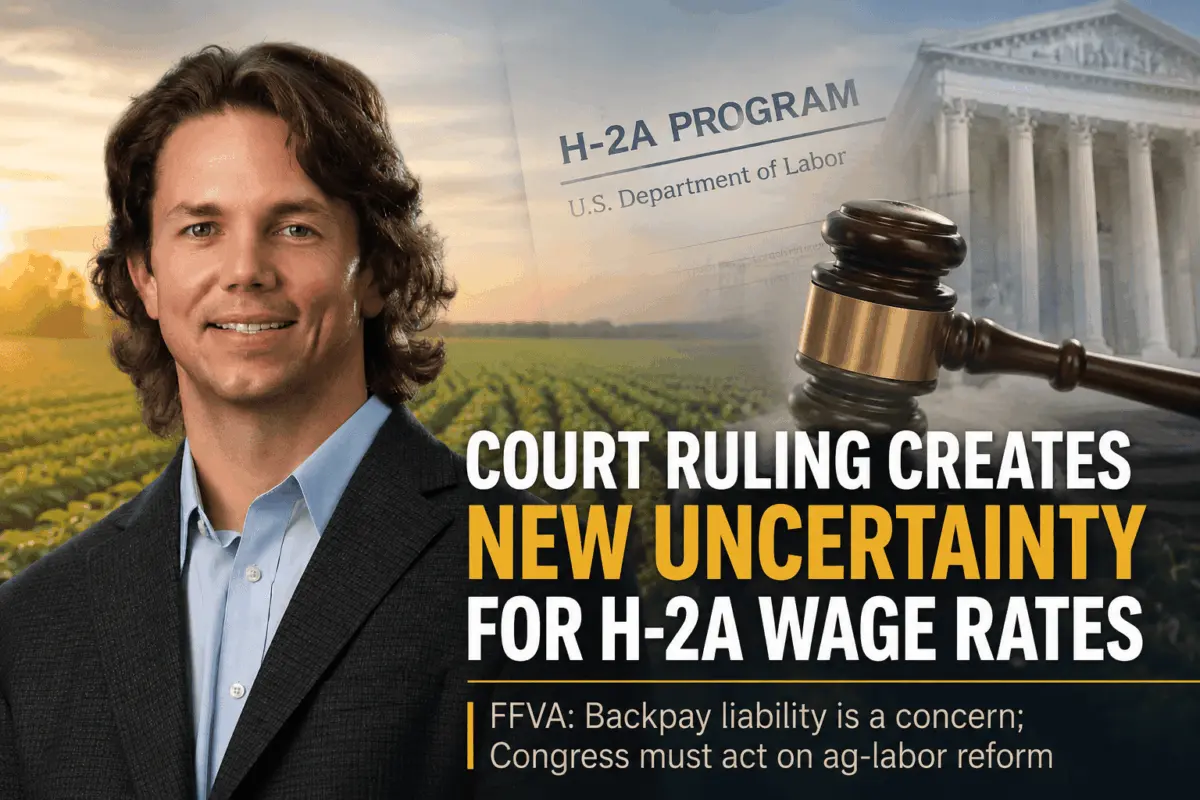

EXECUTIVE OVERVIEW
A landmark federal court ruling in California has struck down the U.S. Department of Labor’s (DOL) 2025 regulatory framework for calculating Adverse Effect Wage Rates (AEWR) under the H-2A agricultural guestworker program. The judicial decision declares the current calculation methodology unlawful, asserting that key regulatory provisions lacked adequate justification and failed to satisfy core statutory standards.
While the ruling injects profound turbulence into an already fragile agricultural labor landscape, the immediate financial impact on farm operators remains static. The presiding federal district court has granted a temporary stay, permitting the existing wage structure to remain in place while the Department of Labor goes back to the drawing board to formulate a compliant replacement rule. Consequently, agricultural employers do not face immediate modifications to their current H-2A payroll obligations.
However, beneath the surface of this temporary reprieve lies a volatile ticking clock. The court’s decision explicitly mandates that the DOL issue warnings to employers regarding the looming possibility of retroactive backpay liabilities. Should the eventual replacement methodology establish wage rates higher than those currently disbursed, agricultural producers could find themselves legally on the hook to retroactively bridge the financial gap. For specialty crop growers, fruit and vegetable producers, and nursery operators—sectors where labor expenses often account for the lion’s share of operational overhead—the specter of unexpected backpay compounds an environment of chronic regulatory instability.
Industry advocacy groups, led by the Florida Fruit & Vegetable Association (FFVA), are sounding the alarm. The ruling has galvanized agricultural leaders to press for sweeping congressional intervention, framing the ongoing judicial ping-pong over H-2A regulations as an existential threat to domestic food security.
Chronology of a Regulatory Crisis: How the H-2A Wage Framework Unraveled
To fully comprehend the gravity of the recent California federal court decision, one must trace the winding, highly litigious path that has characterized H-2A wage policy over recent years. The system used to establish equitable wages for both domestic and foreign agricultural workers has faced continuous structural disruption, regulatory overhauls, and judicial challenges.
The Collapse of Historical Data Sources
For decades, the determination of H-2A wage rates heavily relied upon data derived from the U.S. Department of Agriculture’s (USDA) Farm Labor Survey (FLS). This comprehensive survey served as the statistical backbone for calculating the AEWR—the minimum wage rate that employers must offer and pay to H-2A workers and corresponding domestic workers to ensure that the employment of foreign labor does not adversely affect the wages and working conditions of domestic workers similarly employed.
However, the reliability and continuity of the FLS suffered a severe blow when the USDA temporarily suspended the survey due to budgetary and operational constraints. This statistical vacuum left the Department of Labor scrambling for alternative methodologies to fulfill its statutory mandate under the Immigration and Nationality Act.
Compounding the crisis, preceding AEWR calculation rules promulgated by the DOL faced relentless legal challenges from various labor advocacy organizations and agricultural trade associations alike. Federal courts repeatedly stepped in to vacate or enjoin previous iterations of the rule, arguing that federal agencies had failed to accurately capture regional wage dynamics or properly account for occupational variations within agriculture.
The 2025 Interim Final Rule and Its Demise
In response to these compounding systemic failures and a shifting legal landscape, the Department of Labor issued an interim final rule in October 2025. This regulation sought to establish an entirely new methodology for determining AEWRs without relying on the discontinued USDA survey data. The rule took effect immediately, forcing agricultural employers to pivot overnight to the new wage calculations.
Yet, the 2025 interim framework failed to weather judicial scrutiny. In the latest federal court ruling handed down in California, the judiciary determined that the DOL’s newly minted methodology suffered from fatal flaws. The court concluded that critical provisions of the rule were inadequately justified under the Administrative Procedure Act (APA) and failed to meet statutory benchmarks required to protect workers while remaining equitable to employers.
Rather than instantly invalidating the wage rates—which would have plunged the agricultural sector into immediate administrative chaos—the court opted for a temporary stay, allowing the flawed methodology to persist functionally while the DOL drafts yet another replacement rule.
The Backpay Dilemma: A Sword Hanging Over Farm Balance Sheets
While the immediate operational environment remains unchanged, the legal implications tied to the court’s remedy order have sparked intense anxiety across the agricultural community. The core of this concern centers on the issue of potential retroactive liability.
The Mechanics of Retroactive Liability
In its instructions to the Department of Labor, the court mandated that the agency formally notify all participating H-2A employers that they could potentially be held financially responsible for backpay. This liability would be triggered if the newly formulated, court-compliant wage methodology ultimately yields higher wage rates than the amounts agricultural employers paid while operating under the invalidated 2025 interim rule.
For farm operators who meticulously budget their seasonal expenses months in advance, the prospect of retroactive liability introduces an unquantifiable financial risk. Agricultural production operates on razor-thin margins dictated by commodity pricing, weather anomalies, and global market competition. Injecting the uncertainty of unbounded retroactive labor costs into this equation makes financial forecasting virtually impossible.
Industry Outcry: Penalizing Compliance
Agricultural trade organizations have forcefully pushed back against the logic of retroactively penalizing growers who operated in strict accordance with existing federal regulations.
Jamie Fussell, Director of Labor Relations at the Florida Fruit & Vegetable Association (FFVA), did not mince words when addressing the court’s decision and the looming backpay threat.
"Today’s decision is a reminder that lasting reform cannot come through regulation alone, and the prospect of growers facing backpay liability for complying with a federal regulation is deeply concerning," Fussell stated.
Fussell’s sentiments resonate deeply throughout the agricultural belt. Growers emphasize that they did not circumvent the rules; rather, they adhered to the exact parameters established, published, and enforced by the federal government. To punish employers for following official governmental directives is viewed by agricultural advocates as fundamentally unjust and economically destabilizing.
Hannah Roberts, an agricultural labor economist with the Mid-Atlantic Agri-Business Institute, notes that the psychological and financial toll of this uncertainty cannot be overstated. "When a farmer signs an H-2A contract, they are making a binding financial commitment based on the regulatory certainty provided by Washington," Roberts explains. "If the rules of the game can be retroactively rewritten after the harvest is already in the market, it breaks the financial trust required to sustain labor-intensive farming in the United States."
Economic Context and Market Metrics: Why H-2A Costs Matter
To understand why a shift in H-2A wage methodology carries such massive implications, one must examine the macro-level economic realities of modern American agriculture. The H-2A program has experienced exponential growth over the past decade, driven by a chronic, worsening shortage of domestic agricultural labor.
The Reliance on Guestworker Programs
According to data compiled by the U.S. Department of Labor and the Employment and Training Administration, certified H-2A positions have surged from approximately 150,000 positions annually a decade ago to well over 370,000 positions in recent years. This explosive growth reflects a structural shift: domestic workers are increasingly migrating away from arduous farm labor, leaving producers heavily dependent on the H-2A program to plant, cultivate, and harvest crops.
For labor-intensive sectors—such as Florida’s citrus, tomato, strawberry, and ornamental nursery industries—labor costs represent between 40% and 50% of total cash operating expenses. Unlike manufacturing or technology sectors, agricultural producers operate as "price takers" rather than "price makers." They cannot simply pass unexpected regulatory cost increases onto consumers by arbitrarily raising the price of perishable commodities that compete directly with international imports.
The Compounding Burden of Escalating AEWRs
Even prior to the recent court ruling, Adverse Effect Wage Rates had experienced aggressive upward spirals across nearly every federal region. Between 2015 and 2025, average AEWRs nationwide climbed by more than 50%, far outpacing the general rate of inflation.
These rising labor floors, combined with soaring costs for agricultural inputs, fuel, packaging, and logistics, have squeezed producer profit margins to historic lows. The addition of potential backpay obligations compounds an already fragile financial ecosystem, threatening the economic viability of mid-sized family farms that lack the capital reserves to absorb sudden retroactive balance-sheet shocks.
Official Industry Responses and Strategic Outlook
As the legal battleground shifts back to the Department of Labor, agricultural stakeholders are recalibrating their advocacy strategies. The prevailing consensus among major farming associations is that regulatory tinkering has reached a dead end.
FFVA and the Push for Legislative Overhaul
The Florida Fruit & Vegetable Association, along with a coalition of national agricultural groups, is publicly declaring that executive agencies and federal courts can no longer provide the structural stability required by the modern agricultural sector. FFVA is actively urging its members to remain calm, continue adhering strictly to current wage mandates while awaiting formal DOL guidance, and direct their primary advocacy efforts toward Capitol Hill.
"Congress must act with urgency to finally secure the reforms needed to the H-2A program and provide growers with certainty to continue feeding American families," Fussell emphasized in a statement following the ruling. "Continued inaction only makes it harder to keep food production here at home."
The Securing Agriculture’s Workforce Act (SAWA)
At the center of the legislative solutions being championed by FFVA and allied organizations is the push for structural statutory reform, most notably through renewed engagement on measures such as the Securing Agriculture’s Workforce Act (SAWA) and comprehensive agricultural labor reform packages.
Proponents of legislative reform argue that statutory changes—unlike the ever-shifting administrative rules promulgated by successive presidential administrations—can establish long-term predictability. Key elements sought by agricultural advocates include:
- Wage Stability and Predictability: Implementing a rational, predictable wage-setting mechanism that accounts for regional economic variations and commodity values rather than relying on volatile survey data.
- Streamlined Application Processes: Reducing bureaucratic red tape and processing delays within the Department of Labor and U.S. Citizenship and Immigration Services (USCIS).
- Year-Round Workforce Access: Expanding the H-2A program beyond seasonal parameters to accommodate livestock, dairy, and nursery operations that require a stable, year-round workforce.
- Workforce Stability Measures: Introducing provisions that offer legal status stabilization for experienced agricultural workers already residing within the United States.
Future Outlook: What Growers Must Do Now
As the Department of Labor reviews the California federal court’s decision and begins the complex task of formulating a new AEWR calculation methodology, agricultural employers find themselves in a holding pattern fraught with legal ambiguity.
Immediate Actionable Recommendations for Agricultural Employers
- Maintain Current Payroll Compliance: Despite the ruling, employers must continue paying current H-2A wage rates without deviation. The court’s temporary stay ensures that existing wage structures remain legally binding until a replacement rule is officially finalized and implemented.
- Monitor Department of Labor Directives: Growers should maintain close communication with their legal counsel, state agricultural extension offices, and trade associations (such as FFVA) to track official notices regarding the forthcoming DOL replacement methodology and any specific instructions concerning potential backpay notifications.
- Audit Labor and Payroll Records: Given the remote possibility of retroactive liability, farm managers should ensure that all H-2A payroll records, hours worked, and job classifications are meticulously documented and securely archived. Comprehensive record-keeping will be essential should employers need to calculate historical exposures or defend against erroneous liability claims.
- Engage in Grassroots Advocacy: With industry groups pressing Congress for legislative remedies like SAWA, agricultural employers are encouraged to contact their federal representatives to articulate the real-world economic dangers of regulatory instability and potential backpay mandates.
Conclusion
The federal court ruling invalidating the 2025 H-2A wage methodology is the latest chapter in a long-standing crisis over agricultural labor policy in the United States. While immediate wage rates are protected by a judicial stay, the looming shadow of retroactive backpay and the perpetual cycle of regulatory redesign underscore the urgent need for systemic reform. For American farmers striving to secure the nation’s food supply against fierce global competition, the message from the fields is clear: regulatory patches are no longer enough. True stability requires decisive, enduring legislative action from Congress.

0 Comments