

Executive Overview
Long before the advent of digital precision agriculture, gene-editing tools, and satellite-guided tractors, the foundation of modern agricultural productivity was forged in the rich, dark soils of Iowa. At the center of this transformation was Henry A. Wallace—a visionary plant breeder, political leader, and restless intellectual whose adolescent curiosity sparked a biological revolution.
What began as a teenage experiment in field-testing corn varieties in the early 1900s ultimately matured into the commercial hybrid seed industry. Wallace’s pioneering work culminated in the creation of Copper Cross, the first commercially viable hybrid corn, and the founding of the enterprise that would become Pioneer Hi-Bred.
By shattering historical yield ceilings and proving the Mendelian principles of hybrid vigor (heterosis) in a practical setting, Wallace helped unlock unprecedented efficiencies in crop production. This breakthrough did not merely reshape the geographic boundaries of the U.S. Corn Belt; it averted structural food crises, powered twentieth-century industrial growth, and established a blueprint for private-sector agricultural research. This feature examines the trajectory of Wallace’s life-altering innovations, tracing his journey from an inquisitive Iowa high schooler to a titan of global agritech.
Detailed Chronology: From Teen Inquisitor to Agricultural Titan
The birth of the hybrid seed industry was not an overnight flash of inspiration; it was the product of decades of meticulous observation, rigorous scientific training, and stubborn persistence against prevailing farming dogma.
1. The Formative Years (Late 19th Century – 1910)
Henry Agard Wallace was born into an agricultural dynasty deeply embedded in Iowa’s farm culture. His grandfather and father were influential agricultural journalists and educators—his father, Henry Cantwell Wallace, would later serve as U.S. Secretary of Agriculture.
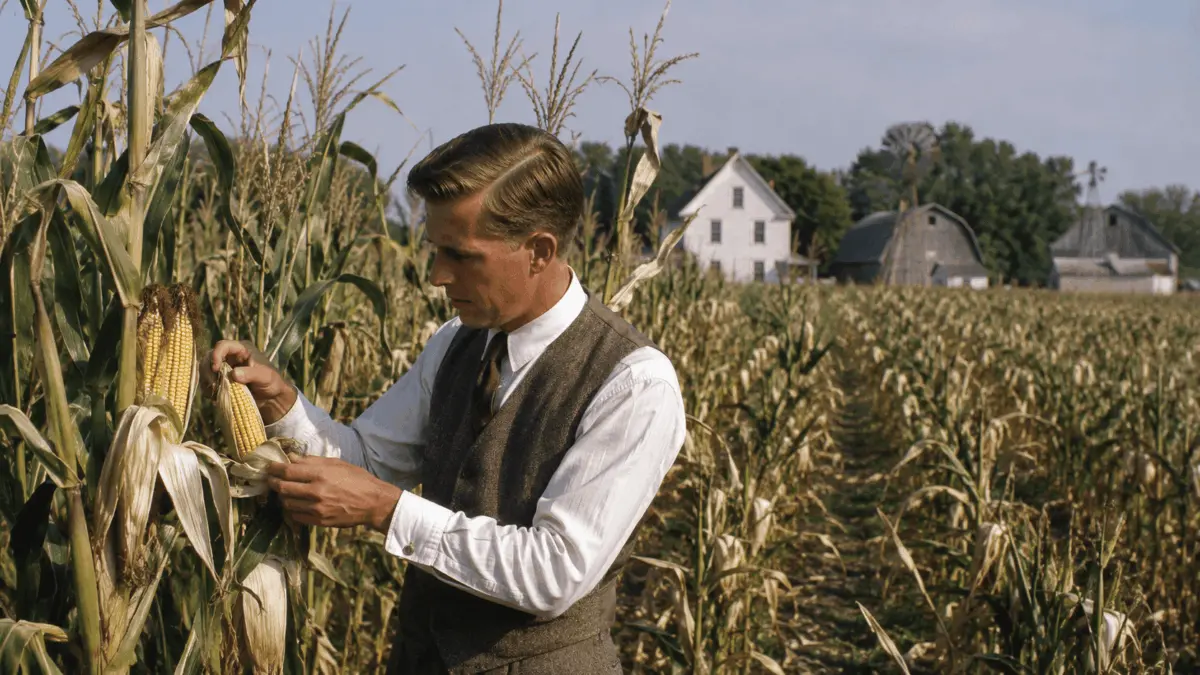
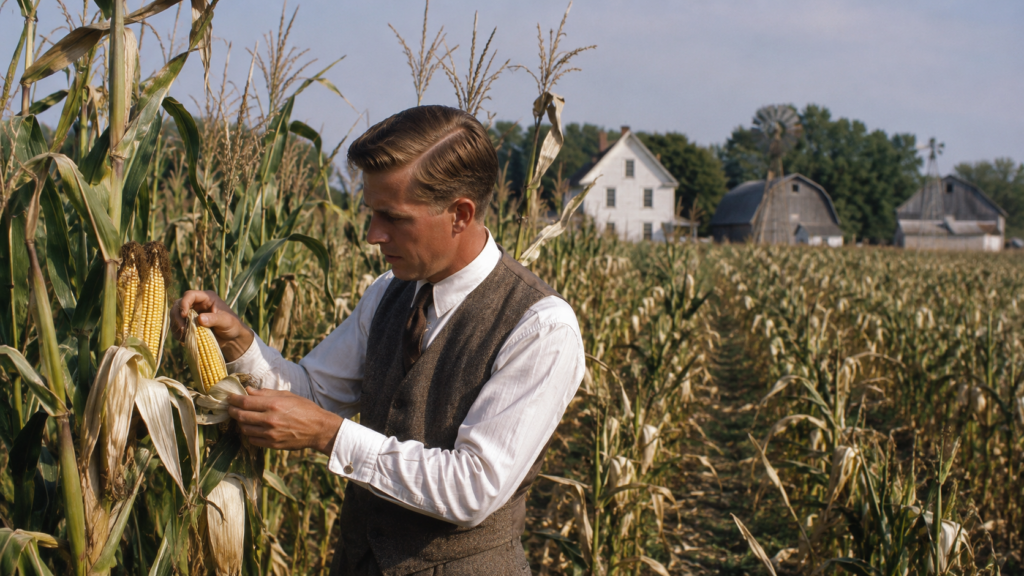
By the time he was sixteen years old, young Henry was already conducting independent agronomic trials on family plots. Dissatisfied with traditional open-pollinated corn varieties that yielded unpredictable results and varied drastically in vigor, Wallace began experimenting with corn breeding. He meticulously cross-pollinated specific strains, bagging tassels and ears by hand, tracking lineage, and recording yield data with scientific precision.
He formalized this self-taught education by enrolling at Iowa State College (now Iowa State University), immersing himself in the burgeoning fields of plant genetics, agronomy, and chemistry. Graduating in 1910, Wallace stepped into a professional world on the cusp of a scientific renaissance.
2. Systematic Breeding and the Breakthrough of 1923
Armed with a deeper understanding of Mendelian genetics, Wallace accelerated his breeding program post-graduation. Traditional farmers traditionally saved seed from their best-performing open-pollinated crops each year—a practice that led to genetic stagnation over time. Wallace, however, recognized the potential of inbreeding lines to isolate specific traits, followed by deliberate cross-breeding to capture hybrid vigor.
By 1923, his tireless efforts yielded Copper Cross, a high-performing hybrid corn variety. Copper Cross was more than just a successful crop; it was a profound proof-of-concept. It demonstrated that controlled hybridization could dramatically outperform heritage varieties under field conditions, exhibiting superior stalk strength, disease resistance, and volumetric grain yield.
3. Public Acclaim and the Iowa Corn Yield Contest (1924)
Scientific theories require public validation to alter commercial landscapes. In 1924, Wallace entered Copper Cross into the prestigious Iowa Corn Yield Contest.
The hybrid’s performance stunned traditional farmers and agricultural extension agents alike. By decisively outyielding standard open-pollinated entries, Copper Cross forced the agricultural community to take notice. The victory served as a watershed moment, shifting the conversation from academic genetics to practical, farm-level economics. Yield statistics from the contest provided undeniable empirical proof that the future of farming lay in scientifically engineered seed.
4. Commercialization and the Birth of Pioneer (1926)
Recognizing that superior genetics required a structured delivery mechanism to reach American farms, Wallace took a radical step. In 1926, alongside industrialist and associate Roland Turner, he established the Hi-Bred Corn Company in Johnston, Iowa.
This venture represented a historic milestone: the creation of the world’s first commercial enterprise dedicated explicitly to the research, development, and sale of hybrid corn seed. Moving away from the tradition of farmers saving their own seed, Wallace’s company introduced a proprietary business model where farmers purchased fresh hybrid seed annually to capture peak genetic performance. The company eventually adopted the name Pioneer Hi-Bred, expanding into a multinational agricultural powerhouse.
Supporting Context & Metrics: The Scale of the Transformation
To fully understand the magnitude of Henry A. Wallace’s contribution, one must analyze the economic and agronomic metrics that define the twentieth-century agricultural explosion.
The Mathematics of Heterosis
Before hybrid seed, U.S. corn yields hovered stubbornly around 25 to 30 bushels per acre—a figure that had remained largely static since the era of European settlement. Open-pollinated varieties lacked genetic uniformity, making fields vulnerable to lodging (falling over), drought, and pest pressures.
When hybrid corn was introduced and widely adopted between the 1930s and 1950s, the trajectory of American agriculture altered permanently:
- Yield Expansion: Average U.S. corn yields climbed steadily throughout the mid-20th century, breaking past 100 bushels per acre by the late 1960s, and today routinely exceeding 175 to 200+ bushels per acre in prime agricultural regions.
- Acreage Optimization: Because yields per acre tripled and quadrupled, farmers were able to produce vastly more grain on significantly less land, reducing pressure on fragile ecosystems and native prairies.
- Economic Ripple Effects: The predictability of hybrid crops transformed corn from a local subsistence and feed crop into a high-octane economic engine, fueling the livestock industry, industrial bioproducts, and international commodities trade.
The Intersections of Science, Business, and Statecraft
Wallace’s career defies simple categorization. While his legacy is anchored in agronomy, his intellectual curiosity propelled him into high-stakes public service. Following his commercial success with Pioneer, Wallace served as U.S. Secretary of Agriculture (1933–1940) under President Franklin D. Roosevelt, where he helped design New Deal agricultural policies to stabilize farm prices during the Great Depression. He later served as the 33rd Vice President of the United States (1941–1945).
Yet, historians frequently argue that Wallace’s most enduring global impact was biological rather than political. The dissemination of hybrid corn technology served as the opening salvo of the broader Green Revolution, a movement that later saved an estimated one billion people from starvation worldwide through the deployment of high-yielding cereal grains.
Official Statements & Historical Perspectives
The historical weight of Wallace’s contributions is well-documented by academic institutions and agricultural historians alike.
"Henry A. Wallace stands as a towering figure in the annals of American science and agriculture. His early experiments did not just improve a crop; they fundamentally redefined the relationship between scientific research and commercial farming. By proving the viability of hybrid vigor, he laid the cornerstone for modern plant breeding and global food security."
— Iowa State University Agricultural Historical Archives
Mark Oppold, host of the American Agriculture History Minute, emphasizes the grassroots nature of Wallace’s achievements:
"When we look back at the giants of American farming, we often think of massive machinery or sweeping government legislation. But Henry Wallace reminds us that the most profound breakthroughs often begin simply: a teenager walking through an Iowa cornfield, asking stubborn questions about nature, and refusing to accept that crop yields had reached their ultimate limit."
Future Outlook: Sustaining Wallace’s Legacy in Modern Agritech
As contemporary agriculture faces unprecedented twenty-first-century challenges—including changing climate patterns, extreme weather volatility, arable land depletion, and the demand to feed a projected global population of nearly 10 billion by 2050—the foundational principles established by Henry A. Wallace remain more relevant than ever.
1. From Hybridization to Gene Editing
The systematic breeding and field-testing methods pioneered by Wallace evolved into marker-assisted selection, and today, into advanced biotechnologies such as CRISPR-Cas gene editing. Modern seed scientists no longer wait generations for natural crosses; they precisely target genes responsible for drought tolerance, nitrogen-use efficiency, and disease resistance. However, the core philosophy—using rigorous science to optimize plant performance—traces a direct lineage back to Wallace’s Iowa test plots.
2. The Private-Public Research Partnership
Wallace’s journey from academic experimentation to founding a commercial seed enterprise established the modern model of agritech innovation. Today, the synergy between land-grant universities (such as Iowa State) and private seed corporations continues to drive global agricultural research and development.
3. Climate-Resilient Agriculture
As extreme weather threatens traditional growing zones, modern breeders are revisiting the genetic diversity of wild relatives and historical landraces—much like Wallace did a century ago. By mining genetic databases for resilient traits, agronomists are working to develop the "next Copper Cross"—crops capable of thriving in high-heat, low-water environments.
Conclusion
Henry A. Wallace’s transformation from an inquisitive Iowa teenager to a pioneer of agricultural biotechnology underscores a timeless truth: human ingenuity, married to empirical science, can systematically overcome natural limits. His development of hybrid corn and founding of the commercial seed industry permanently altered the human trajectory, ensuring that the global food supply could scale to meet the demands of a modernizing world.

0 Comments