

Executive Overview
As late summer transitions into the peak of the agricultural harvest cycle, the American Southeast is once again gearing up for one of its most vital seasonal operations: the peanut harvest. Across the fertile soils of Georgia and South Carolina, tractors are moving through fields, and producers are closely monitoring soil moisture, pod maturity, and weather forecasts to determine the exact window for digging. This crucial phase marks the culmination of months of rigorous crop management, battling unpredictable weather, and investing heavily in inputs.
Simultaneously, behind the scenes of this multi-million-dollar industry, an equally intensive operation is swinging into high gear. The Federal-State Inspection Service (FSIS) has finalized its preparations to grade the incoming 2026 peanut crop. From sprawling commercial facilities to rural buying points, inspectors are stepping up to the front lines to evaluate the quality, moisture content, and market value of the farmer stock peanuts about to flood the supply chain.
In Georgia alone, a massive network of 116 buying points stands ready to receive the harvest, supported by a fully trained corps of state and federal inspectors. Meanwhile, neighboring South Carolina is ramping up its own regional infrastructure, overseeing 10 active buying points and onboarding dozens of newly trained personnel. Together, these two states represent a powerhouse of peanut production, and the precision of the grading process will dictate market dynamics for growers, shellers, and consumers alike. This comprehensive report examines the kickoff of the 2026 peanut harvest, the meticulous training regimens ensuring grading accuracy, and the economic stakes riding on this year’s crop.
Detailed Chronology: From Field Preparation to the Grading Floor
The journey of a peanut from a subterranean pod to a graded commodity ready for commercial processing is governed by strict timelines, meticulous science, and logistical coordination. The 2026 harvest season follows a structured calendar that began months before the first digger blade touched the soil.
The Summer Prelude: Training the Evaluators
While crops were still developing vegetative growth and setting pods under the intense southern sun, the groundwork for quality assurance was already underway. In July 2026, the Federal-State Inspection Service launched its comprehensive refresher training programs.
Inspecting peanuts is not a casual task; it requires a deep understanding of agricultural standards, kernel integrity, foreign matter detection, and moisture content measurement. Veteran inspectors—many with decades of seasonal experience—reported back to training facilities for intensive 40-hour refresher courses. These sessions are designed to recalibrate inspectors’ eyes and techniques against the latest United States Department of Agriculture (USDA) grading standards.
By running through standardized testing protocols, evaluating sample lots of varying quality, and reviewing updates to grading procedures, the inspection service ensures absolute consistency. This uniformity is vital: a grade assigned to a trailer of peanuts in Tifton, Georgia, must be identical in standard and fairness to a grade assigned in Barnwell or Dillion, South Carolina.
August to September: Assessing Maturity and Pulling the Trigger
As August drew to a close, agricultural extension agents and experienced farmers began the painstaking process of hull scraping—a method used to determine the exact maturity profile of the peanut crop by checking the color of the mesocarp layer beneath the hull.
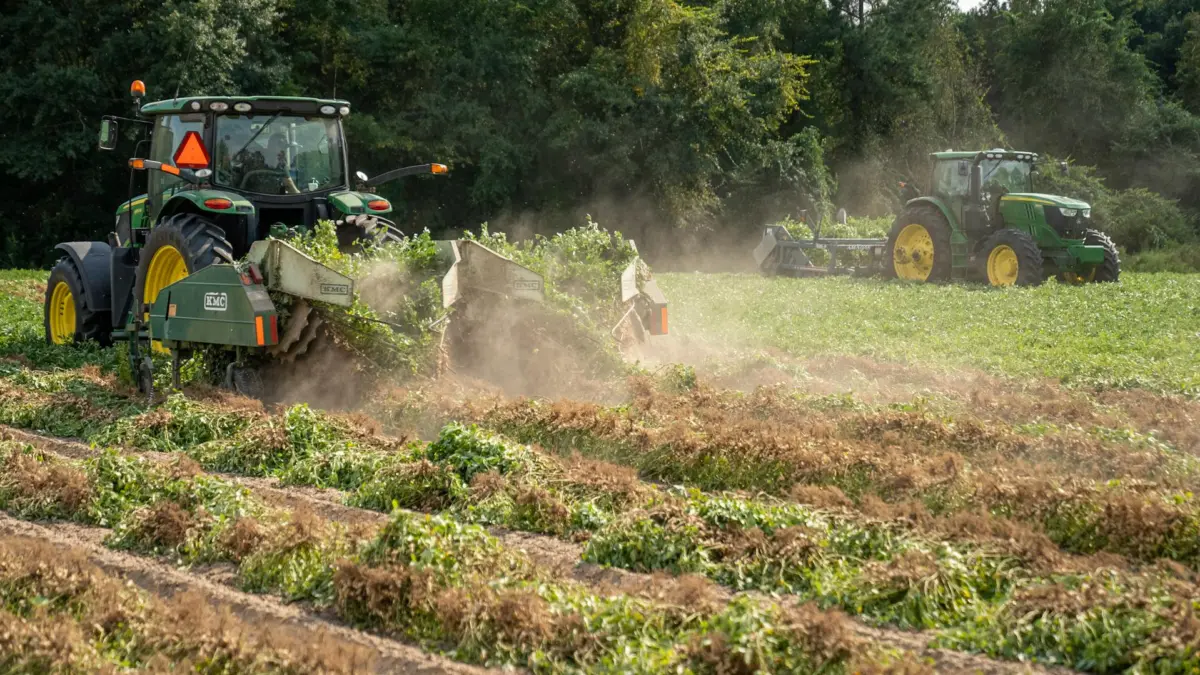
By early September, the green light was given. Fields across the peanut belt began to show optimal maturity, prompting growers to initiate the "digging" phase. During this phase, mechanical diggers slice the taproot just below the soil surface, lift the peanut plant, and invert it so that the pods are exposed to the sun and air. This crucial curing-in-the-wind process reduces initial moisture content before a combine sweeps through a few days later to thresh the pods from the vine.
The Arrival at Buying Points
With the combines rolling, the logistical bottleneck shifts directly to the buying points. As fleets of tractor-trailers and grain carts filled with freshly harvested farmer stock peanuts pull onto the scales, the FSIS inspectors take center stage. Every incoming load is sampled, tested for foreign material, shelled down to assess kernel count and damage, and officially graded. This step is the financial anchor for the grower; the grade directly determines the loan value or market price the farmer will receive for their year’s labor.
Supporting Context & Metrics: The Scale of Production in Georgia and South Carolina
To truly understand the magnitude of the 2026 inspection effort, one must examine the sheer scale of the agricultural footprint in the Southeastern United States.
Georgia’s Dominance and Infrastructure
Georgia remains the undisputed "Peanut State," traditionally accounting for nearly half of all peanut production in the United States. To manage this colossal volume, the state relies on a vast, decentralized network of infrastructure.
- 116 Buying Points: Across Georgia’s agricultural heartland—stretching from the wiregrass region of South Georgia up toward the Fall Line—there are 116 active buying points. These facilities act as regional hubs where agriculture meets commerce.
- Workforce Deployment: Staffing 116 locations requires hundreds of certified inspectors, samplers, and administrative assistants. The pre-season training regimen ensures that every single one of these points is adequately staffed with personnel capable of handling peak harvest surges without causing undue delays for truckers and farmers waiting to unload.
South Carolina’s Growing Footprint
While smaller in total acreage than its neighbor to the west, South Carolina is a vital contributor to the regional peanut economy, known for producing high-quality runner and Virginia-type peanuts.
- 10 Strategic Buying Points: South Carolina currently operates 10 designated buying points strategically placed near major production zones.
- Workforce Expansion: To meet the demands of the 2026 harvest, state agricultural authorities oversaw the training of approximately 50 inspectors specifically for South Carolina operations. In addition to these certified professionals, ongoing recruitment efforts are focused on bringing in assistant inspectors to help manage the flow of farmer stock peanuts, ensuring that labor shortages do not compromise grading speed or accuracy.
Official Perspectives and Operational Insights
The seamless transition from field harvest to commercial grading is no accident; it is the result of continuous coordination between state departments of agriculture, federal oversight bodies, grower associations, and private buying point operators.
The Rigor of Inspector Training
Agricultural officials emphasize that the integrity of the entire U.S. peanut market relies on the unbiased, highly technical work performed by inspectors at the buying points. A standard 40-hour certification course covers a multitude of complex parameters:
- Moisture Testing: Excess moisture can lead to mold development, specifically aflatoxin contamination, which poses serious health risks and economic losses. Inspectors use calibrated dielectric moisture meters to ensure loads meet safe storage thresholds.
- Damage and Defect Identification: Inspectors must expertly identify damaged kernels, shriveled pods, insect damage, and loose shelled kernels (LSKs), all of which factor into the official numerical grade.
- Foreign Material Assessment: Soil, stems, rocks, and leaves brought in from the field are weighed and deducted from the gross weight of the load to determine the clean weight of the farmer stock peanuts.
By bringing veteran inspectors back for rigorous refresher courses ahead of the 2026 season, the inspection service effectively mitigates human error and standardizes evaluations across state lines. The collaboration between Georgia and South Carolina training programs further highlights a unified regional approach to quality control.
Future Outlook: Navigating the 2026 Season and Beyond
As the 2026 peanut harvest moves into full swing, all eyes remain fixed on weather patterns, market pricing, and supply chain efficiencies. While the physical infrastructure—from the 116 buying points in Georgia to the 10 facilities in South Carolina—is fully prepped and operational, the agricultural sector faces broader systemic challenges looking ahead.
Weather and Crop Quality
The ultimate quality of the 2026 crop will depend heavily on weather conditions throughout September and October. Prolonged rainfall during the harvest window can delay digging, increase disease pressure, and degrade kernel quality while still in the windrows. Conversely, favorable, dry autumn weather will allow producers to harvest at peak maturity, resulting in high grades, strong yields, and robust miller demand.
Technological Advancements in Grading
Looking toward the future, both federal and state agricultural agencies are continually evaluating ways to modernize the inspection process. While traditional hand-grading methods remain the gold standard for accuracy and legal accountability, integration of digital imaging, automated moisture sensors, and streamlined data-reporting software is gradually reshaping how buying points operate. These technological enhancements aim to reduce turnaround times for farmers waiting in line during peak harvest hours while maintaining the strict standards required by the USDA.
Economic Implications for Growers
For the individual farmer, the grading process represents the moment of truth. Years of high input costs—including skyrocketing prices for diesel, fertilizer, crop protection chemicals, and seed—mean that profit margins are tighter than ever. A favorable grade can make the difference between a profitable year and a financial struggle. Thanks to the thorough preparation of the Federal-State Inspection Service and the deployment of hundreds of highly trained inspectors across Georgia and South Carolina, growers can trust that their crops will be evaluated with precision, fairness, and absolute professionalism as the 2026 harvest season rolls onward.

0 Comments