

TOKYO — Asian stock markets presented a fractured picture on Monday, as stellar rallies in Tokyo and Seoul—bolstered by insatiable global appetite for artificial intelligence infrastructure—clashed with regional pullbacks and severe macro-economic headwinds. While semiconductor heavyweights pushed Japanese and South Korean benchmarks to impressive heights, escalating military hostilities in the Persian Gulf sent international crude prices soaring past $96 a barrel, threatening global supply chains and intensifying inflationary jitters ahead of pivotal U.S. monetary policy decisions.
Executive Overview
The first trading session of the week was defined by a stark dichotomy: the unyielding momentum of the global technology sector versus the mounting anxieties of geopolitical conflict and tightening monetary conditions.
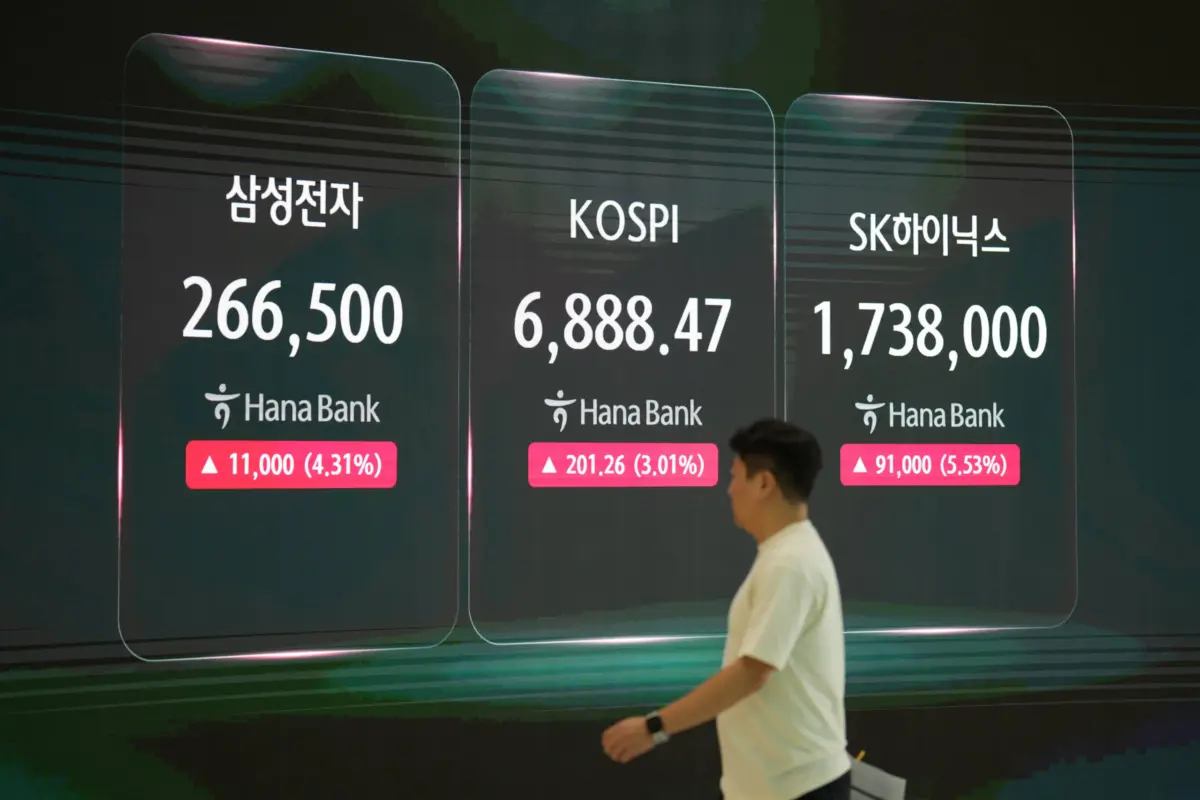
In East Asia, benchmarks in Tokyo and Seoul shrugged off broader regional malaise, fueled by robust buying in major computer chip manufacturers and AI supply-chain firms. Japan’s Nikkei 225 surged 1.7% to close at 66,104.93, while South Korea’s Kospi jumped a commanding 3.3% to finish at 6,907.53. Major tech stalwarts led the charge, with memory giant SK Hynix soaring 6.2% and Samsung Electronics climbing 4.5%.
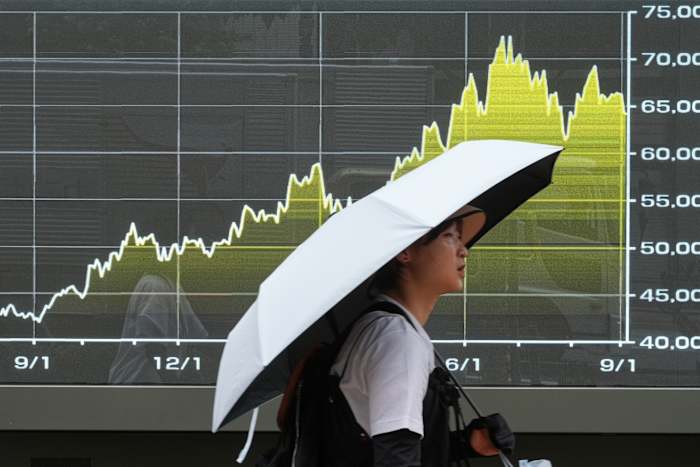
However, this localized euphoria stood in sharp contrast to other major Asian exchanges. Hong Kong’s Hang Seng retreated 1.1% to 25,377.12, the Shanghai Composite shed 0.2% to 3,920.70, and Australia’s S&P/ASX 200 finished virtually flat at 9,005.30.
Compounding the regional divergence, an intensifying six-month U.S.-Iran conflict sent shockwaves through energy markets. Brent crude spiked 67 cents to $96.95 a barrel following a dangerous escalation in the strategic Strait of Hormuz, directly threatening global energy security and complicating an already delicate global economic recovery.
Detailed Chronology: Geopolitical Flashpoints and Market Reactions
The current market volatility is inextricably linked to a rapid succession of military and economic events unfolding across multiple time zones:

- Late Last Week (Wall Street Lead-In): U.S. equities closed out the week in negative territory following an unexpectedly robust jobs report. The U.S. government revealed that employers added 162,000 jobs in August, defying consensus expectations and dampening hopes for immediate monetary easing. The S&P 500 fell 0.4%, the Dow Jones Industrial Average dropped 0.5%, and the Nasdaq Composite dipped 0.3%. U.S. government bond yields ticked upward, with the 10-year Treasury yield rising to 4.78% from 4.77%.
- Friday, Sept. 4 (Tokyo Close): Japanese markets digested currency fluctuations as the U.S. dollar hovered near 156.22 Japanese yen. Market participants began positioning themselves for the Bank of Japan’s upcoming policy board meeting later in the month.
- Over the Weekend (Strait of Hormuz Escalation): Tensions in the Middle East reached a boiling point. Following a series of reciprocal strikes—including U.S. military actions against three Iranian oil tankers in response to Iranian ballistic missile launches at U.S. warships—Tehran announced plans to establish an "exclusion zone" outside the Strait of Hormuz. This zone is intended to target commercial and foreign vessels attempting to transit the vital waterway, which remains effectively closed.
- Monday, Sept. 7 (Asian Trading Hours): As markets opened for the week, the geopolitical shockwaves immediately impacted energy benchmarks. Brent crude breached $96.95 a barrel, while benchmark U.S. West Texas Intermediate (WTI) crude climbed 61 cents to $92.09 a barrel. Simultaneously, tech-heavy Asian markets opened strongly, decoupling from energy-driven anxieties to post substantial gains driven by semiconductor demand.
Supporting Context & Metrics
To fully understand the forces steering global capital markets in September 2026, analysts point to a confluence of structural tech trends, commodity pressures, and central bank dynamics.
The AI Infrastructure Super-Cycle
Despite lingering concerns regarding elevated equity valuations, the hardware trade underpinning the artificial intelligence boom shows no signs of fatigue. Market observers emphasize that the "AI complex" remains the primary engine of growth for export-driven Asian economies.
"The AI complex continues to provide the local equity markets with its most dependable growth pulse," observed Stephen Innes, a veteran market strategist and former trader. "It is firmly in the leadership seat and reminding investors that, for all the hand-wringing around valuation, the hardware trade is still refusing to roll over."

Energy Vulnerabilities and Supply Disruptions
The ongoing closure of the Strait of Hormuz—the world’s most critical oil transit chokepoint—presents a severe threat to global price stability. With Brent crude trading at $96.95 a barrel and climbing, manufacturing and transport sectors worldwide face renewed input cost pressures. The friction has been exacerbated by conflicting reports from the region; while the U.S. military forcefully denied Iranian claims that an uncrewed American naval vessel had been successfully struck in the strait—calling the assertion a "total lie"—the mere perception of naval warfare in the corridor has upended maritime insurance and shipping routes.
Macroeconomic Data and Labor Market Resilience
In the United States, the unexpected addition of 162,000 jobs in August has fundamentally altered the calculus for the Federal Reserve. Inflation continues to linger well above the central bank’s stated 2% target, hovering stubbornly over 3%. With the next Federal Open Market Committee (FOMC) meeting scheduled to conclude on September 16—and crucial August consumer price inflation figures due on September 11—fixed-income markets are increasingly pricing in the likelihood of a resumption in interest rate hikes before the end of the year.
Official Statements and Industry Commentary
Financial leaders and geopolitical analysts have offered stark assessments of the intersecting crises currently gripping global markets:

-
Stephen Innes on Tech Sector Resilience:
"The AI complex is firmly in the leadership seat and reminding investors that, for all the hand-wringing around valuation, the hardware trade is still refusing to roll over."
-
Linh Tran, Market Analyst at XS.com, on Currency and Central Bank Dynamics:

"The stronger-than-expected U.S. employment report generated only a limited recovery in the dollar, suggesting that the market is currently responding more strongly to the changing BOJ policy outlook." Tran noted that the persistent weakness of the Japanese yen remains a central focus for policymakers in Tokyo, even as the dollar struggles to maintain upward momentum against shifting domestic interest rate expectations.
-
U.S. Military Command on Persian Gulf Altercations:
Refuting Tehran’s claims regarding maritime engagements in the Strait of Hormuz, defense spokespeople categorized Iranian reports as a "total lie," underscoring the high-stakes psychological and informational warfare running parallel to physical kinetic exchanges in the region.
Future Outlook
As the global economy navigates the remainder of September 2026, market participants face a dense calendar of high-impact events that will likely dictate asset allocation for the remainder of the autumn.
- Monetary Policy Decisions: With the U.S. Federal Reserve meeting concluding on September 16, and the Bank of Japan convening its own policy board later in the month, currency and bond traders are bracing for potential divergence in monetary stances. A hawkish shift by the Fed, combined with a normalization tilt by the BOJ, could trigger significant capital flows across G10 and emerging Asian currencies.
- Inflation and Labor Data Releases: The release of U.S. consumer price data on September 11 will serve as the ultimate litmus test for whether sticky inflation will force the central bank’s hand on interest rates.
- Geopolitical Trajectory in the Middle East: The security status of the Strait of Hormuz remains the ultimate wild card for global commerce. Any formal implementation of an Iranian "exclusion zone," or further kinetic escalation involving naval assets and energy infrastructure, threatens to push crude oil decisively past the psychological $100-a-barrel threshold, potentially choking off economic growth in energy-importing nations across Asia and Europe.
- Labor Day Market Reopening: Following the U.S. closure for Labor Day, Wall Street’s re-entry on Tuesday will test whether American equities can decouple from Middle Eastern supply fears or if the weight of high energy prices and prospective rate hikes will drag major U.S. indices into a deeper correction.

0 Comments