
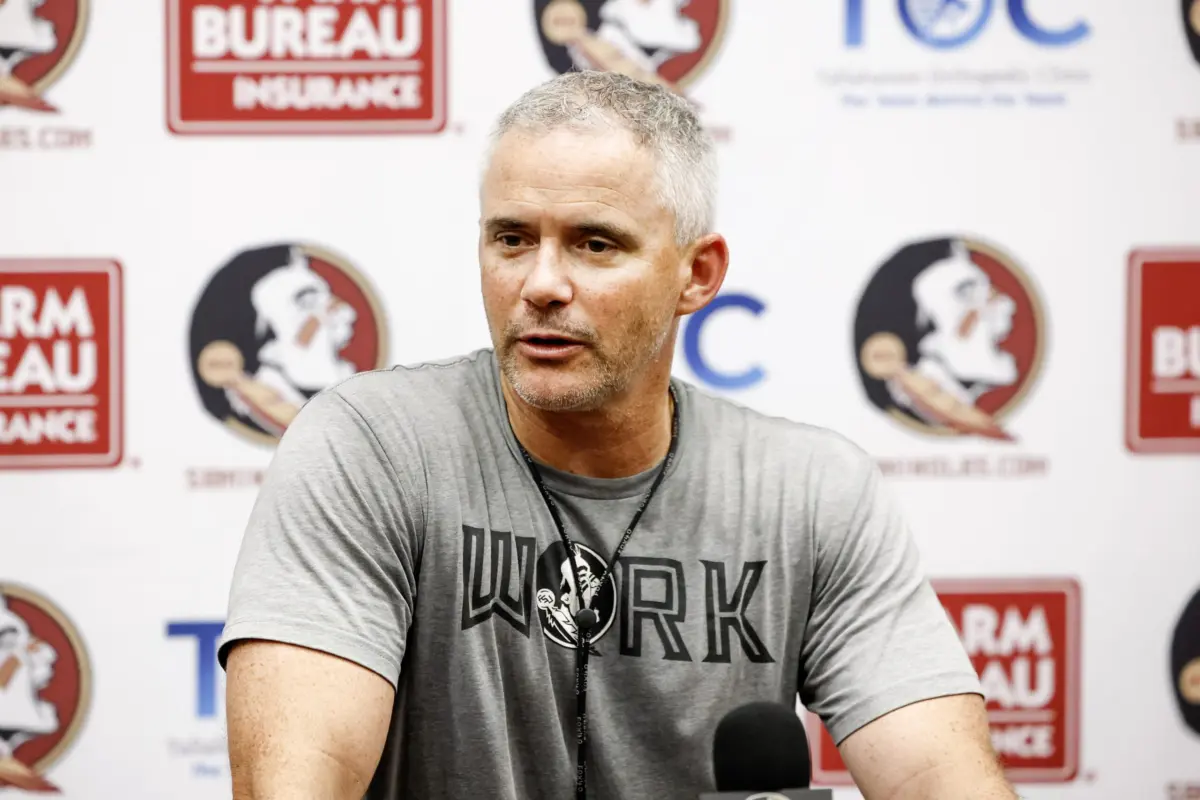

The Florida State Seminoles find themselves at a precarious crossroads early in the 2026 college football season. Sitting at a sub-.500 record of 1-2 following a demoralizing 50-36 defeat at the hands of the Alabama Crimson Tide inside Bryant-Denny Stadium, the program is grappling with a familiar set of compounding issues: defensive vulnerabilities, mounting injury concerns at key skill positions, and a glaring inability to finish games when holding a commanding lead.
Saturday’s contest in Tuscaloosa began as a masterclass in execution for head coach Mike Norvell’s squad. Capitalizing on aggressive play-calling and an inspired performance from quarterback Ashton Daniels, the Seminoles stormed out to a 21-6 advantage, stifling the vaunted Crimson Tide offense through the first four possessions. Yet, what unfolded thereafter became a historic defensive collapse. Alabama scored on nine consecutive offensive possessions, exploiting structural breakdowns, missed assignments, and depth issues that ultimately unraveled Florida State’s upset bid.
Adding insult to a turbulent start, the Seminoles have now dropped 10 consecutive games on the road dating back to 2024. As the team limps back to Tallahassee, the coaching staff faces immense pressure to rectify deep-seated defensive flaws before hosting Norvell’s alma mater, Central Arkansas, at Doak Campbell Stadium. With foundational contributors sidelined for extended periods, the Seminoles must rely on rapid player development and accountability from top to bottom to rescue their campaign.
Detailed Chronology: How the Crimson Tide Overcame a 15-Point Deficit
The afternoon began with unmistakable promise for the visitors. Despite facing unique pre-game challenges—including turbulent travel logistics that required a bus ride from Birmingham to Tuscaloosa and weather-induced schedule disruptions—Florida State appeared locked in from the opening whistle.
[1st Quarter: FSU Dominance]
FSU builds a 21-6 lead behind aggressive passing and stout defense (holding Bama to 6 points on 4 possessions).
          │
          ▼
[2nd - 4th Quarters: The Collapse]
Alabama adjusts; scores on 9 consecutive possessions. FSU's defense fails to get off the field on crucial 3rd-and-longs.
          │
          ▼
[Final Score: 50-36]
FSU drops to 1-2 on the season, extending their dreadful road losing streak to 10 straight games.
The Seminoles’ offense caught Alabama completely off guard early on. Quarterback Ashton Daniels operated with supreme confidence, distributing the ball effectively downfield to a receiving corps that consistently won one-on-one matchups. The offensive line, featuring a newly configured rotation with Paul Bowling earning his first start and Nate Pabst locking down right tackle, held firm against an elite Alabama pass rush, affording Daniels the time needed to expose gaps in the secondary.
By the time Florida State mounted a drive to pull ahead 21-6, the upset was not merely a hypothetical; it was actively unfolding on national television. However, the momentum shifted abruptly midway through the second quarter.
A combination of weather delays and sustained offensive drives by Alabama began to wear down a thin Florida State defensive front. The turning point of the game manifested on a crucial 4th-and-3 play while the Seminoles still held their lead. Rather than conceding yardage, Alabama dialed up a explosive play-action scheme that caught the FSU secondary out of alignment, resulting in a momentum-shifting first down.
From that moment onward, the defensive dam broke. Alabama’s offense manufactured scoring drives with clinical efficiency, systematically attacking the perimeter and exploiting missed communication angles in the Seminoles’ coverage packages. By the time the fourth quarter arrived, Florida State’s defense had surrendered nine straight scoring drives, allowing the Crimson Tide to salt away the clock and hand the Seminoles a humbling 50-36 defeat.
Supporting Context & Metrics: Defensive Breakdowns and Roster Strain
The stark statistical reality facing Florida State is hard to ignore: for the second consecutive week, the Seminoles’ defense surrendered over 550 yards of total offense. This defensive regression has cast a heavy shadow over an otherwise promising offensive resurgence.
The Defensive Crisis: Scheme vs. Execution
During the post-game press conference, defensive coordinator Tony White and head coach Mike Norvell faced rigorous questioning regarding the systemic viability of the defensive scheme. Opponents are consistently finding success on high-leverage downs—most notably third- and fourth-down conversions. In the Alabama matchup, the Crimson Tide repeatedly converted crucial third-and-long situations, exposing glaring gaps in coverage discipline.
Norvell was transparent in his assessment, noting that while the foundational principles of the defensive scheme are sound, the translation from the practice field to live-game execution has been severely deficient:
- Miscommunications: Instances of missed signals and busted coverages have directly led to explosive plays, including back-breaking touchdowns in consecutive weeks.
- Edge Containment: Mobile quarterbacks have repeatedly found running lanes up the middle and along the perimeter due to poor pursuit angles and blown gap assignments.
- Lack of Turnovers: After forcing four takeaways against SMU, the Seminoles failed to secure a single turnover against Alabama, starving the offense of extra possessions needed to secure an upset.
Injury Bug Bites Deep: Samuel Singleton Jr. Sidelined
Compounding the team’s on-field struggles is an escalating injury crisis. Running back Samuel Singleton Jr., who was enjoying an explosive start to the 2026 campaign, suffered a severe injury during the Alabama game that will require an extended absence. While the coaching staff remains hopeful for a return late in the season, his loss removes a vital dynamic playmaker from the backfield.
Singleton’s absence mirrors the early-season loss of linebacker Blake Nichelson, forcing the Seminoles to rely heavily on youth and unproven depth. Running backs coach Tim Harris Jr. and Norvell both emphasized that veteran backup Tre Wisner and true freshman Amari Thomas will be thrust into larger roles moving forward.
Official Statements & Press Conference Insights
The post-game media availability provided a candid look inside the emotional state of Florida State’s leadership team. Coaches and players alike shouldered the responsibility for the collapse while voicing a unified determination to course-correct.
Mike Norvell on Accountability and Resilience
Head coach Mike Norvell firmly rejected the idea of placing the blame exclusively on the players, choosing instead to reflect critically on the coaching staff’s responsibility to position athletes for success:
"None of it is solely on players. It never will be. There are times that we’ve got to win one-on-ones… but it always comes down to the things that coaches and what we can do to make sure we’re putting our players in the best position."
Norvell also heaped praise on quarterback Ashton Daniels, whose stellar play inside one of college football’s most hostile environments was largely overshadowed by the defensive collapse:
"There’s not a lot of quarterbacks in the history of college football that have gone into that stadium and played the way he played. I was really proud of him for that."
Defensive Coordinator Tony White on Aggressiveness
Defensive coordinator Tony White was visibly remorseful regarding his play-calling decisions during high-leverage moments of the game, particularly the final drives where Alabama sealed the victory:
"That last drive really bugged me. I should’ve stayed aggressive. I should’ve stayed attacking."
White indicated that the defensive staff is actively re-evaluating their personnel packages, hinting at the introduction of heavier sets during four-minute situations and expressing regret over not utilizing a Cover 0 scheme on critical late-game downs.
Future Outlook: The Road Back to Consistency
As the calendar turns toward Week 4, the immediate objective for Florida State is clear: reset, heal, and re-establish an identity of resilience.
The Seminoles return home to Doak Campbell Stadium this Saturday to host FCS opponent Central Arkansas (2-2) at 3:00 p.m. ET (broadcast live on the ACC Network). While on paper this matchup presents a favorable bounce-back opportunity for a reeling squad, the coaching staff has stressed that internal standards—not the opponent’s pedigree—must dictate their preparation.
+-----------------------------------------------------------------+
|                        FSU WEEK 4 OBJECTIVES                    |
+-----------------------------------------------------------------+
| 1. Correct Coverage Busts: Streamline defensive communications  |
|    to eliminate explosive plays on third down.                  |
| 2. Elevate Young Depth: Accelerate the development of freshmen  |
|    like Amari Thomas and Franklin Whitley to offset injuries.   |
| 3. Sustain Offensive Aggression: Build upon Ashton Daniels'     |
|    breakout passing performance in Tuscaloosa.                  |
+-----------------------------------------------------------------+
For a program accustomed to national championship contention, a 1-2 start accompanied by defensive vulnerabilities is undeniably painful. However, as Norvell pointed out to his players in the locker room, the narrative of the 2026 season is far from finalized. If the Seminoles can harness the explosive capability they flashed during the opening quarters against Alabama and pair it with four quarters of disciplined defensive execution, the trajectory of their season can still be salvaged.
The journey back to elite status begins Saturday in Tallahassee—not merely with a victory, but with the consistent application of fundamentals, focus, and grit.

0 Comments