

Executive Overview
For nearly a century, the blue corduroy jacket has served as an enduring symbol of American leadership, agricultural innovation, and rural community stewardship. The Future Farmers of America—officially recognized today as the National FFA Organization—stands as one of the most successful and influential youth development initiatives in global history. Yet, the sprawling nationwide network of over 900,000 student members traces its foundational DNA back to a modest high school classroom in Blacksburg, Virginia.
In March 1920, an innovative agricultural educator named Henry Groseclose took a localized approach to vocational instruction, organizing a modest club for young men interested in pursuing farming as a career. What began as an experimental localized framework to bridge classroom theory with practical fieldwork rapidly cascaded across state lines. Driven by a shared vision to elevate the social, economic, and professional standing of agrarians, this grassroots movement culminated in a historic national convention in Kansas City, Missouri. There, 33 visionary students representing 18 states formally unified the organization, establishing an institutional powerhouse fueled by annual dues of just 10 cents.
This investigative retrospective explores the extraordinary trajectory of the FFA’s origins. By examining Henry Groseclose’s pedagogical philosophies, the rapid regional expansion across the American South, the pivotal convergence in Kansas City, and the enduring legacy of early agricultural policy, this feature underscores how a solitary educator’s localized initiative transformed the trajectory of American agriculture.
Detailed Chronology: From Blacksburg Beginnings to National Prominence
To fully comprehend the magnitude of the FFA, one must examine the socio-economic landscape of rural America in the early 20th century. Farming was rapidly shifting from a purely subsistence-based lifestyle to an increasingly mechanized, science-driven enterprise. However, formal avenues for training youth in modern agricultural sciences were severely limited.
1917–1920: The Legislative Catalyst and the Classroom Spark
The groundwork for vocational agricultural education was laid nationally with the passage of the Smith-Hughes National Vocational Education Act of 1917. This landmark federal legislation provided vital funding for vocational agriculture courses in public high schools, recognizing that the nation’s economic security relied heavily on a well-trained agrarian workforce.
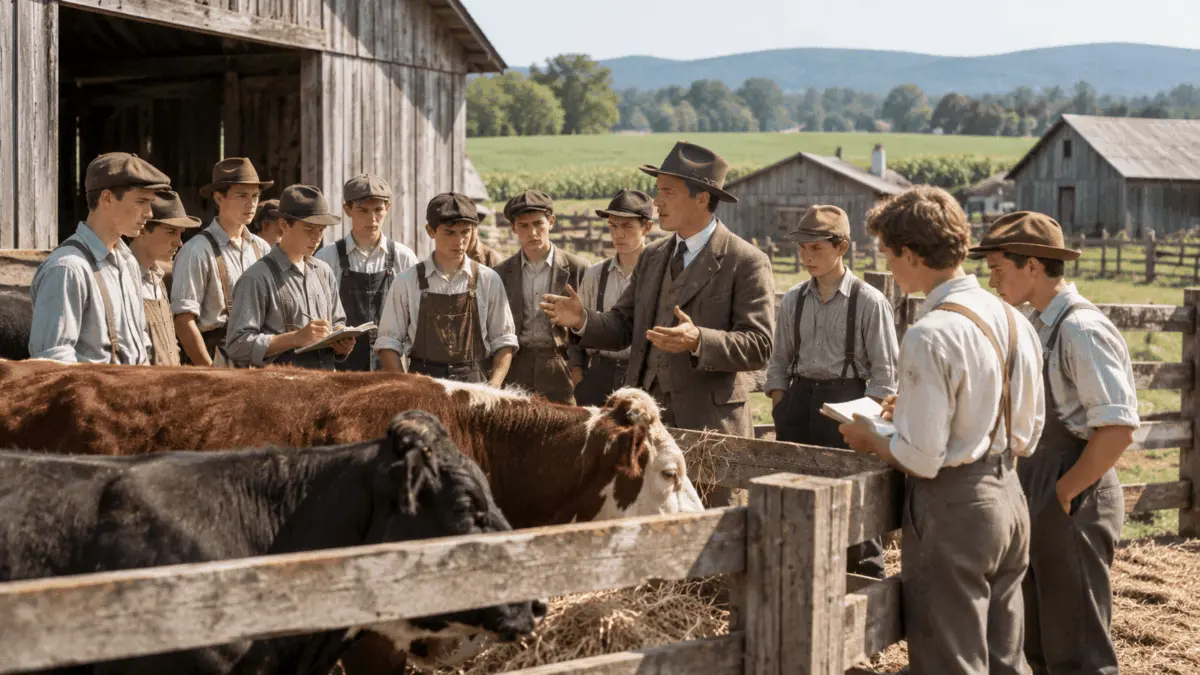
Seizing upon the opportunities created by the Smith-Hughes Act, Henry Groseclose assumed his role as an agricultural education teacher at Blacksburg High School in Virginia. Groseclose observed that while classroom instruction imparted vital technical knowledge regarding soil chemistry, crop rotation, and livestock husbandry, students lacked a dedicated vehicle for leadership training, peer collaboration, and civic responsibility.
In March 1920, Groseclose addressed this void by organizing a specialized club for high school boys enrolled in his agricultural courses. The club provided a forum for students to conduct parliamentary procedure, manage cooperative projects, and build self-confidence. Crucially, Groseclose’s model was designed not merely to assist students in growing better crops, but to cultivate them as well-rounded community leaders.
The 1920s: The Virginia Movement and Regional Adoption
Word of Groseclose’s successful experiment in Blacksburg did not remain isolated in Montgomery County. As agricultural supervisors and educators from neighboring districts observed the heightened engagement, academic performance, and enthusiasm of Groseclose’s students, the blueprint was rapidly replicated.
By the mid-1920s, similar agricultural clubs had sprouted across Virginia. Recognizing the need for structural cohesion, state education leaders formalized these local chapters into the Future Farmers of Virginia (FFV). Groseclose played an instrumental role in drafting the constitution and bylaws for the state organization, infusing the framework with rituals, emblems, and a creed that emphasized the dignity of agricultural labor and the importance of leadership.
The success of the Virginia model caught the attention of regional and federal agricultural education leaders, including visionary figures like C.H. Lane and Arthur P. Williams. They recognized that the FFV blueprint possessed scalable potential on a national scale. The localized seed planted in Blacksburg was primed to break through state borders.
November 1928: The Kansas City Convergence
The definitive turning point in the history of agricultural education occurred in November 1928 in Kansas City, Missouri, concurrent with the National Livestock Judging Contest.
Gathering at the Baltimore Hotel, 33 forward-thinking student delegates representing 18 states convened with a singular mission: to establish a unified, national organization dedicated to young agriculturalists. These student leaders debated structural frameworks, adopted official colors (national blue and corn gold), and formally chartered the Future Farmers of America.
During this inaugural national convention, Leslie Applegate of New Jersey was elected as the organization’s first national president, while Henry Groseclose—often affectionately remembered as the "Father of the FFA"—was heavily involved in shaping the foundational administrative structure. The fledgling organization established modest operational parameters, most notably instituting annual national dues at precisely 10 cents per member. Despite the nominal fee, the collected capital provided the initial financial scaffolding required to bind disparate state chapters into a cohesive national body.
Supporting Context & Metrics: Economic Realities and Institutional Growth
The meteoric rise of the FFA cannot be separated from the economic realities of rural America during the interwar period. The 1920s brought severe agricultural recessions, falling commodity prices, and structural shifts that made farming increasingly precarious. Educational leaders understood that survival required more than traditional sweat; it demanded financial literacy, cooperative marketing skills, and scientific adaptability.
The 10-Cent Dues: A Microcosm of Accessibility
In an era when cash was exceptionally scarce for farm families, the decision to set annual national FFA dues at 10 cents was a deliberate strategy to ensure absolute accessibility. No ambitious student was barred from membership due to financial hardship. This egalitarian ethos democratized leadership training, ensuring that rural youth from economically modest circumstances could access the same developmental opportunities as their more affluent peers.
| Historical Milestone / Metric | Fact / Figure | Significance |
|---|---|---|
| Inception Date | March 1920 | Henry Groseclose establishes the initial agricultural club in Blacksburg, VA. |
| Legislative Foundation | Smith-Hughes Act (1917) | Provided federal funding for vocational agricultural education in public schools. |
| National Convention | November 1928 (Kansas City, MO) | 33 delegates from 18 states officially charter the Future Farmers of America. |
| Initial National Dues | 10 cents per member | Ensured universal economic accessibility for rural youth during the interwar period. |
| First National President | Leslie Applegate (New Jersey) | Led the newly unified organization during its historic foundational year. |
Bridging Classroom Instruction and Experiential Learning
The educational philosophy championed by Groseclose and his contemporaries centered on the "three-circle model" of agricultural education, which integrates:
- Classroom and Laboratory Instruction: Providing foundational scientific and technical knowledge.
- Supervised Agricultural Experience (SAE): Requiring students to design, manage, and evaluate real-world agricultural enterprises (ranging from livestock production to agribusiness ventures).
- FFA Leadership Development: Offering competitive events, public speaking platforms, and community service initiatives.
This holistic approach ensured that graduates did not merely possess theoretical knowledge; they emerged as capable entrepreneurs, community organizers, and industry innovators.
Official Perspectives and Historical Assessments
Agricultural historians and educational authorities continually emphasize the profound impact of Henry Groseclose’s early work on modern youth development.
Dr. Dale Miller, an agricultural education historian, notes:
"Henry Groseclose understood that farming was as much about human capital as it was about soil and seed. By structuring an organization that valued parliamentary procedure, public speaking, and democratic participation alongside practical farming skills, he transformed vocational training into a crucible for national leadership."
Furthermore, modern leadership within the National FFA Organization frequently traces its core values directly to the legacy of the 1928 founders. Current institutional strategy maintains that while the technologies of agriculture have evolved exponentially—shifting from horse-drawn plows and manual record-keeping to precision agriculture, biotechnology, and data-driven agronomy—the fundamental mission remains unchanged: developing premier leadership, personal growth, and career success through agricultural education.
Reflecting on the historical trajectory, agricultural communications veteran Mark Oppold, in his chronicling of American agricultural history, emphasizes the ripple effect of local innovation:
"The story of Henry Groseclose is a testament to the fact that monumental national movements often begin with a single teacher recognizing untapped potential in a classroom of teenagers. His dedication in Blacksburg catalyzed a cultural shift that empowered generations of rural youth to take ownership of their futures."
Future Outlook: The Modern Evolution of an Enduring Legacy
As the National FFA Organization looks toward its second century of operation, the blueprint established by Groseclose, Applegate, and the 1928 delegates continues to adapt to an increasingly complex global food system.
Expanding Beyond Production Agriculture
While the organization’s historic roots lie firmly in traditional crop and livestock production, contemporary FFA chapters reflect the staggering diversity of the modern agricultural sector. Today’s members pursue careers in:
- Agricultural biotechnology and genetic engineering
- Environmental science and natural resource conservation
- Agricultural engineering and precision machinery operation
- Food science, safety, and supply chain logistics
- Agribusiness management, international trade, and agricultural communications
The modern blue jacket represents an expansive professional ecosystem encompassing science, technology, engineering, and mathematics (STEM) fields applied to the global bioeconomy.
Sustaining the Core Ethos in the 21st Century
Despite sweeping technological advancements—ranging from autonomous tractors to satellite-guided crop monitoring—the core pillars established in 1920 remain unbroken. Leadership development, community service, and ethical stewardship are as vital to a modern agritech entrepreneur as they were to a 1920s high school student in Blacksburg, Virginia.
The journey from a 10-cent dues experiment in a regional high school club to a premier national youth organization underscores a timeless truth: when young people are provided with the tools, the mentorship, and the institutional platform to lead, they do not merely inherit the future—they actively cultivate it. Henry Groseclose’s visionary pedagogy ensures that the roots of American agricultural leadership will remain deep, resilient, and eternally green.

0 Comments