
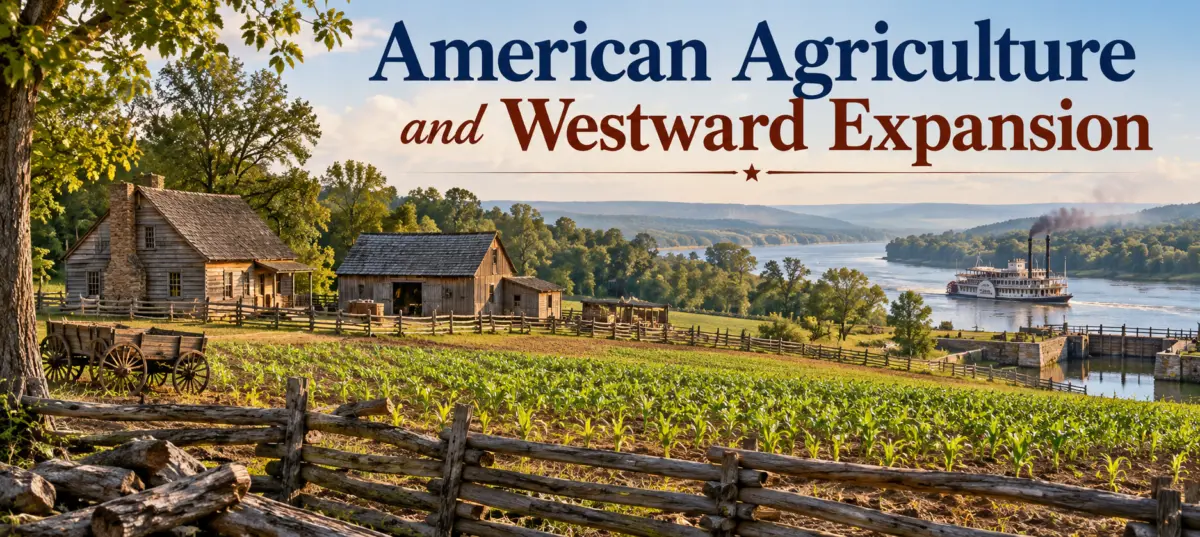

Executive Overview
The early 19th century stands as a defining epoch in the trajectory of the United States, a period during which the nation transformed from a fragmented collection of agrarian settlements into a continental economic powerhouse. At the epicenter of this metamorphosis was American agriculture. For the average citizen of the early 1800s, farming was not merely a commercial enterprise; it was a grueling, daily struggle for survival and a fundamental way of life. The vast majority of families operated on a subsistence model, producing just enough food, fiber, and livestock to sustain their households, with only a fraction of their yield making it to local trade networks.
However, a confluence of geopolitical ambition, infrastructural innovation, and relentless human labor reshaped this rural landscape. The relentless push toward the western frontier—catalyzed by watershed events such as the Louisiana Purchase—unlocked millions of acres of virgin, highly fertile soil. Simultaneously, breakthroughs in transportation technology, notably the advent of canals and the widespread deployment of steamboats, began to bridge the vast distances separating isolated homesteads from burgeoning commercial centers.
This comprehensive report examines the economic, infrastructural, and human dimensions of early American agricultural expansion. By tracing the evolution from localized subsistence farming to an interconnected commercial marketplace, we explore the immense capital, physical toil, and speculative cycles that laid the bedrock for the modern United States agricultural economy.
Detailed Chronology: The Evolution of 19th-Century Farming
The Subsistence Baseline (c. 1800–1810)
At the dawn of the nineteenth century, the American economy was overwhelmingly agrarian, yet it lacked the systemic integration we take for granted today. Most farms operated under an inward-looking paradigm. Families relied on mixed husbandry—growing diverse crops like corn, wheat, and rye alongside maintaining small livestock herds—to feed themselves. Barter systems dominated local commerce, with surplus crops traded locally for blacksmithing, textiles, or salt. Transportation costs were prohibitively high, making the long-distance overland haul of bulky agricultural goods financially unviable.
The Geopolitical Catalyst: The Louisiana Purchase (1803)
The landscape of American opportunity shifted overnight with the Louisiana Purchase of 1803. President Thomas Jefferson’s acquisition of approximately 828,000 square miles of land from France effectively doubled the size of the young republic. Control of the Mississippi River and the vital port of New Orleans ensured that western farmers had an outlet for their goods. This historic land acquisition planted the seeds for massive demographic shifts, signaling to farmers, land speculators, and pioneers that the nation’s future lay in the fertile river valleys and expansive plains of the West.
The Infrastructural Revolution (1810s–1830s)
As settlers crossed the Appalachian Mountains and pushed into the Ohio and Mississippi River valleys, the tyranny of distance threatened to isolate them. The solution was an unprecedented wave of internal improvements:
- The Canal Era: The opening of the Erie Canal in 1825 was a monumental turning point. By connecting the Great Lakes to the Hudson River, it slashed shipping costs between the Midwest and New York City from historic highs to a fraction of a cent per ton-mile, transforming New York into the nation’s premier commercial hub.
- The Steamboat Expansion: Following Robert Fulton’s commercial successes, steamboats proliferated on major waterways like the Mississippi, Ohio, and Missouri rivers. Unlike flatboats, which could only travel downstream, steamboats allowed reliable two-way commerce, dramatically accelerating the flow of agricultural inputs, harvested crops, and manufactured goods.
The Rise of the Speculative Frontier (1830s–1850s)
With land accessible via newly established water routes, a distinct socio-economic cycle emerged. Enterprising individuals could purchase inexpensive federal land, clear the dense forests or break the tough prairie sod, and construct basic farmsteads. Through sheer labor, they rapidly appreciated the value of the real estate. Many farmers engaged in a cyclical migration: establishing a profitable, improved farm, selling it at a substantial profit to incoming settlers, and using the capital to purchase larger, cheaper tracts further west. This dynamic fueled a continuous wave of agricultural expansion that pushed the nation’s borders ever closer to the Pacific.
Supporting Context & Metrics: The Economics of Early Settlement
Understanding the success of early American agriculture requires looking past the romanticized imagery of the frontier and examining the hard economic realities, capital requirements, and human costs involved.
The Hidden Costs of "Cheap" Land
While federal land acts often made acreage available at seemingly nominal prices per acre, the initial outlay was only a fraction of the total cost of farm establishment. Transforming raw wilderness or tallgrass prairie into a productive agricultural asset demanded staggering capital investments in labor and materials:
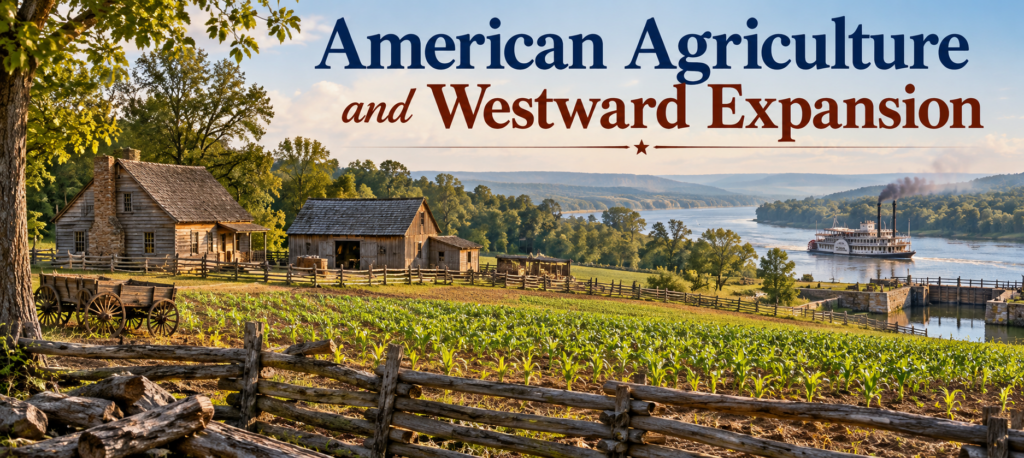
- Land Clearing: In forested regions, a settler faced the arduous task of ring-barking or felling massive hardwoods, removing stumps, and burning brush. It was common for a family to require years just to clear enough acreage to produce a reliable cash crop.
- Infrastructure Development: Before a farm could generate income, basic shelter had to be built. Cabins, barns, livestock enclosures, and miles of split-rail fencing were mandatory investments.
- Equipment and Livestock: Iron plows, seed stock, draft animals (oxen or horses), and hand tools represented a significant financial burden, often requiring families to take on debt or enter into credit arrangements with local merchants.
Quantitative Shifts in Market Integration
| Era | Primary Production Focus | Principal Transport Mode | Market Radius |
|---|---|---|---|
| Early 1800s | Household subsistence, localized barter | Wagon, pack animal, flatboat | Immediate local community (5–15 miles) |
| 1820s–1830s | Emerging surpluses, regional trade | Early canals, river steamboats | Regional hubs, coastal cities (50–300 miles) |
| Mid 1850s+ | Commercialized cash crops, mass scale | Expanded canal networks, early rail | National and international export markets |
As these metrics demonstrate, the transition was not merely geographical; it was structural. Agriculture shifted from a risk-mitigation strategy for individual families into an export-driven engine that supplied growing domestic urban populations and foreign markets alike.
Official Statements and Historical Perspectives
Historians, economists, and agricultural leaders frequently reflect on this foundational era to underscore the resilience and ingenuity required to build America’s food systems.
Mark Oppold, chronicling these eras through the American Agriculture History Minute, frequently emphasizes the duality of the frontier experience:
"The early 19th century provided unprecedented access to fertile land, thanks to westward expansion and engineering marvels like canals and steamboats. Yet, we must never romanticize the sheer grit required. The transformation of raw wilderness into a functioning farmstead was an investment of blood, sweat, and substantial capital that laid the literal and figurative groundwork for our modern agricultural economy."
Economic historians note that the institutional frameworks established during this era—such as predictable land sales, property rights protection, and federally supported infrastructure improvements—created an environment where risk-taking was rewarded.
Early 19th-century policy debates similarly reflected the growing importance of the agrarian sector. Figures of the era frequently debated the balance between federal infrastructure spending (the "American System") and states’ rights. Proponents of internal improvements argued that without canals and cleared rivers, the agricultural potential of the West would remain locked away, denying the nation the unified domestic market it desperately needed to compete globally.
Future Outlook and Legacy in Modern Agriculture
The echoes of 19th-century agricultural expansion continue to reverberate through modern farming systems, supply chains, and economic policies. While the horse-drawn plow and the wooden flatboat have long since given way to GPS-guided combines and containerized freight rail, the core tenets established during the westward expansion remain foundational:
- Infrastructure as an Economic Lifeline: Just as canals and steamboats dictated which farming regions thrived in the 1800s, modern agricultural success relies heavily on resilient supply chains, deep-water ports, well-maintained highways, and rail networks to move billions of bushels of grain and millions of tons of livestock to global markets.
- Capital Intensity and Risk Management: The historical reality that "cheap land is expensive to farm" has evolved into the modern truth that land acquisition and precision technology require immense capital investments. Today’s producers face high input costs, mirroring the historical burden of clearing forests and building farmsteads.
- From Local to Global Interconnectedness: The 19th-century leap from subsistence farming to commercial integration set the stage for today’s hyper-globalized agricultural trade networks. Modern producers must navigate international trade agreements, currency fluctuations, and worldwide demand trends—a direct descendant of the shift away from isolated local markets.
As contemporary agriculture faces modern challenges—ranging from climate variability and water scarcity to technological disruptions—looking back at the foundational era of the 19th century offers a vital perspective. It serves as a reminder that the American agricultural system was forged through a combination of visionary expansion, infrastructural innovation, and the enduring resilience of generations of farmers who dared to look beyond the horizon.

0 Comments