

Executive Overview
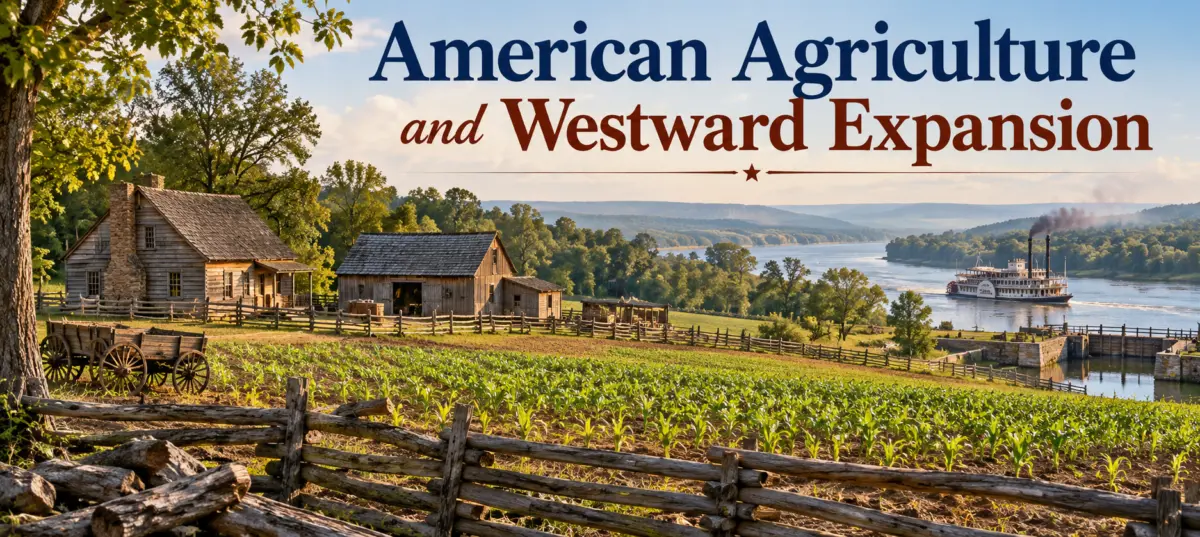
The early 19th century stands as a defining epoch in the economic and geographic evolution of the United States. During this transformative era, the nation transitioned from an agrarian landscape defined largely by isolated, self-sustaining family homesteads into an increasingly interconnected, market-driven commercial powerhouse. At the epicenter of this monumental shift was the interplay between aggressive westward expansion, unprecedented geographical acquisition, and the rapid modernization of transportation infrastructure.
While the fundamental unit of American labor remained the family farm, the scope of agricultural enterprise expanded dramatically. Catalyzed by historic milestones such as the Louisiana Purchase, settlers pushed past the Appalachian Mountains and into the fertile valleys of the Mississippi River basin. This geographic leap was reinforced by technological marvels of the era—most notably the proliferation of navigable canals and the commercialization of the steamboat.
Yet, the romance of the American frontier was underwritten by relentless physical labor, considerable financial risk, and complex economic cycles. Cheap land did not equal free enterprise; clearing untamed wilderness, constructing homestead infrastructure, and bridging the tyranny of distance required staggering investments of time, sweat, and capital. For many early American farmers, land ownership was not merely a means of cultivating crops, but a speculative economic engine—a continuous cycle of clearing, improving, appreciating, and migrating. This deep dive examines the historical mechanics of 19th-century American agriculture, tracing its evolution from localized subsistence to the bedrock of a national commercial economy.
Detailed Chronology: Milestones in 19th-Century Agricultural Evolution
To fully understand how American agriculture scaled to meet the demands of a growing republic, it is necessary to trace the chronological milestones that systematically dismantled geographic isolation and integrated frontier farming into regional and global markets.
The Turn of the Century and the Subsistence Baseline (1800–1805)
At the dawn of the 19th century, the vast majority of Americans lived on farms, yet the economy bore little resemblance to modern agribusiness. Production was decentralized and local. Farm families operated primarily as self-sufficient economic units, growing grains, raising livestock, and producing textiles largely to satisfy household needs. Whatever surplus remained—be it a few bushels of wheat, excess pork, or homespun goods—was traded or sold within immediate local markets, rarely traveling more than a few miles from the farm gate due to primitive, mud-bound road networks and exorbitant overland freight costs.
The Louisiana Purchase and Continental Scale (1803)
The geopolitical landscape of American farming shifted overnight with the Louisiana Purchase of 1803. By acquiring approximately 828,000 square miles of territory from France, President Thomas Jefferson effectively doubled the landmass of the United States. This monumental acquisition secured absolute control over the Mississippi River and its vital port of New Orleans, laying the legal and spatial foundations for millions of future farmsteads. It transformed the American imagination, casting the West as an inexhaustible agrarian utopia—an "Empire of Liberty" fueled by independent yeoman farmers.
The Transportation Revolution: Canals and Steamboats (1810s–1830s)
Geographic expansion meant little without the means to move goods efficiently. The decades following the War of 1812 witnessed a frenetic era of infrastructure development known as the Transportation Revolution.
- The Steamboat Era: Following Robert Fulton’s successful commercial demonstrations, steamboats transformed the Mississippi, Ohio, and Missouri rivers into two-way commercial highways. For the first time, agricultural commodities could be shipped upstream against heavy currents, dramatically lowering the cost of moving bulk grain and cotton to southern markets.
- The Canal Boom: Completed in 1825, the Erie Canal served as the crowning engineering achievement of the era. Spanning 363 miles, it linked the Atlantic seaboard (via the Hudson River) directly to the Great Lakes and the agricultural heartland of the old Northwest Territory. Shipping costs plummeted from around $100 a ton to less than $10 a ton, while transit times shrank from weeks to days.
The Speculative Frontier Cycle (1820s–1850s)
As federal land policies evolved—such as the Land Act of 1820, which lowered the minimum acreage purchase requirements and price per acre—land acquisition accelerated. This period birthed a distinct socio-economic pattern: the pioneer farmer as a land developer. Settlers purchased raw, inexpensive government land on the western fringe, cleared the dense forests or broke the stubborn prairie sod, constructed rudimentary farmsteads, and brought the soil to peak fertility. Once the land’s commercial value appreciated—often fueled by the arrival of nearby towns or transportation routes—the farmer would sell the improved parcel at a substantial profit. The capital gained was then rolled over to finance the purchase of a larger tract further west, repeating a continuous cycle of westward migration and capital accumulation.
Supporting Context & Metrics: The Economics of Frontier Farming
The expansion of American agriculture cannot be understood through sentimentality alone; it was an enterprise governed by hard economic realities, labor mathematics, and infrastructural dependencies.
The True Cost of "Cheap" Land
While the federal government marketed western lands as inexpensive—often priced at $1.25 to $2.00 per acre under various legislative acts—the cash-poor nature of frontier settlers meant that acquisition was only the first hurdle. Establishing a working farm demanded an upfront capital investment that routinely priced out the most destitute laborers unless they could secure credit or engage in years of wage labor to build a stake.
| Development Phase | Primary Challenges | Required Investment / Resources |
|---|---|---|
| Land Acquisition | Raising initial capital; navigating federal land office auctions. | Cash or credit for land purchase ($100–$400 for initial tracts). |
| Land Clearing | Felling ancient hardwood forests, ringing trees, or breaking dense prairie root systems. | Months of grueling physical labor; oxen or horses; heavy axes and specialized plows. |
| Infrastructure Building | Constructing log cabins, livestock barns, storage sheds, and split-rail fencing. | Timber harvesting; cooperative labor (barn raisings); hardware and tools. |
| Market Access | Transporting fragile or perishable goods over primitive roads to localized or river points. | Wagons, draft animals, toll road fees, and freight charges. |
Quantifying the Freight Revolution
To appreciate how transportation infrastructure altered agricultural profitability, one must examine the friction of distance. Prior to the canal and steamboat eras, overland transport by wagon was economically viable for only high-value, low-bulk items. Hauling wheat over land for more than 150 miles often cost more than the grain itself was worth at market.
With the advent of the Erie Canal and steam navigation:
- Market Reach: Farmers within a 50-mile radius of a canal or navigable river suddenly found themselves plugged into national and international supply chains, trading directly with eastern urban centers and European ports.
- Price Realization: The stabilization and reduction of shipping expenses meant that a significantly higher percentage of the final market value of crops remained in the pockets of the producers, providing the surplus capital necessary for reinvestment in agricultural technology and land expansion.
Official Statements and Historical Perspectives
The profound ideological and economic significance of agriculture during this era was frequently articulated by the nation’s political architects and contemporary observers, who viewed the yeoman farmer as the ultimate guardian of republican virtue and economic stability.
Thomas Jefferson on the Agrarian Ideal
As the intellectual father of American westward expansion, Thomas Jefferson famously championed the moral superiority of the agricultural lifestyle in his Notes on the State of Virginia (1785), a philosophy that guided federal land policies well into the 19th century:
"Those who labour in the earth are the chosen people of God, if ever he had a chosen people, whose breasts he has made his peculiar deposit for substantial and genuine virtue. It is the focus in which he keeps alive that sacred fire, which otherwise might escape from the face of the earth. Corruption of morals in the mass of cultivators is a phenomenon of which no age nor nation has furnished an example."
Jefferson’s vision directly influenced the push to acquire western territories, as he believed that boundless land was the only reliable antidote to the industrial crowding and social stratification witnessed in European cities.
Contemporary Economic Observations
Mid-19th-century commentators and agricultural reformers increasingly recognized that farming was shedding its purely domestic character to become a complex commercial science. An editorial from a prominent agricultural journal of the era captured this transition:
"The day has passed when the American husbandman can look upon his calling merely as a means of filling the family larder. The opening of the great West, knit together by the tireless steamboat and the artificial river, demands a new race of agriculturalists—men who view the soil as an industrial asset, who measure their yields against distant markets, and who understand that the value of the land lies not merely in what it grows, but in the intelligent labor and capital they invest within its boundaries."
Historians of economic development note that this mindset laid the institutional groundwork for the eventual industrialization of agriculture, where productivity, market responsiveness, and logistical efficiency became the primary drivers of rural wealth.
Future Outlook: Setting the Stage for Modern Agribusiness
The structural transformations of the early 19th century did not merely solve the immediate economic challenges of a young republic; they established the foundational architecture for modern American agriculture.
As the century progressed past the 1850s, the patterns forged during the era of early westward expansion intensified. The lessons learned in clearing the eastern hardwood forests and navigating the river systems of the Mississippi basin prepared the nation for the ultimate agricultural conquest: the tilling of the vast, treeless Great Plains.
Furthermore, the integration of agriculture into national transportation networks set the stage for subsequent technological revolutions. The reliance on canals and steamboats naturally evolved into the railway boom of the mid-to-late 19th century, which further collapsed distance and tied the American breadbasket to global export markets. The capital accumulation models pioneered by land-speculating farmers evolved into corporate agribusiness structures, while the physical demands of breaking raw land catalyzed the invention of mechanized farm implements, such as the steel plow and the mechanical reaper.
Ultimately, the early 1800s proved that American agriculture was dynamic, expansionist, and inextricably linked to the broader currents of national development. By converting cheap land into productive farmsteads through grueling labor, and by leveraging revolutionary transportation networks to bridge the American interior with the world, the early 19th-century farmer transformed the United States from a collection of subsistence settlements into an agricultural titan.
This comprehensive historical review is part of an ongoing series exploring the milestones, economic realities, and human stories that shaped the foundation of American agriculture.

0 Comments