

Executive Overview
On Saturday, August 22, 2026, Pope Leo XIV arrived in the picturesque, mountainous enclave of the Republic of San Marino for a high-stakes, single-day apostolic journey. Embraced by the crisp Alpine air and the deep-seated historic pride of Europe’s oldest surviving sovereign state, the American pontiff used the global stage to deliver a sweeping critique of modern political and economic systems. Against the backdrop of escalating geopolitical friction, widening socioeconomic divides, and cultural fragmentation, Leo framed the microstate not merely as a historical curiosity, but as an enduring blueprint for civic harmony, democratic governance, and moral responsibility.
Flanked by the republic’s dual heads of state—Captains Regent Alice Mina and Vladimiro Selva—the pontiff addressed local dignitaries, civil authorities, and thousands of enthusiastic pilgrims gathered outside the historic Palazzo Pubblico and the ancient Basilica of San Marino. His message was both an accolade and a warning: while celebrating the republic’s unique institutional framework rooted in power-sharing and mutual respect, he cautioned the international community against systems that subjugate human dignity to unchecked power, materialism, and ideological polarization.
The visit, rich in symbolic resonance, marks only the third time a reigning pontiff has set foot in the enclave, following historic visits by St. John Paul II in 1982 and Pope Benedict XVI in 2011. Yet, Pope Leo XIV’s arrival occurs at a distinctly turbulent historical juncture. As democratic institutions face internal stress tests globally and nations grapple with polarizing moral questions—including San Marino’s own landmark 2021 legalization of abortion—the papal visit forced a delicate conversation at the intersection of timeless Catholic social teaching, modern civil rights, and the preservation of sovereign autonomy.
Detailed Chronology of the Apostolic Visit
Morning Arrival and Civic Receptions
The papal helicopter touched down just outside the historic city walls of San Marino under a brilliant late-August sun. Pope Leo XIV was greeted by Captains Regent Alice Mina and Vladimiro Selva, who formally welcomed the pontiff on behalf of the 35,000 citizens of the republic. The arrival set off a day of tightly choreographed yet deeply emotional public engagements that blended statecraft with pastoral outreach.
Following the tarmac welcome, the motorcade wound its way up the winding medieval roads to the heart of the capital. Crowds draped in the white and light-blue flags of San Marino lined the cobblestone pathways, cheering as the pope’s vehicle passed.
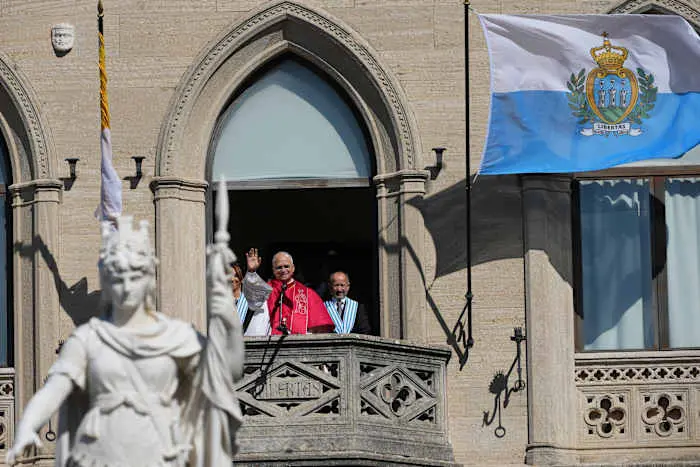
At the Palazzo Pubblico (City Hall), Pope Leo XIV stepped out onto the iconic central balcony alongside Captains Regent Mina and Selva. The historic gesture mirrored the traditional display of republican unity and civic peace. In his address to the civil authorities gathered within the seat of government, the pontiff traced the origins of the state back to its fourth-century roots, paying profound homage to its patron saints, Marino and Leone.
Liturgical Celebrations and Pilgrims at the Basilica
By midday, the focus of the visit shifted from temporal governance to spiritual communion. Pope Leo XIV processed into the neoclassical Basilica of San Marino, where thousands of faithful—many of whom had waited hours under the midday sun—had gathered both inside and outside the sacred walls.
The liturgy was marked by a deep sense of quiet reverence, punctuated by choral arrangements that echoed through the ancient stone pillars. In his homily, the pontiff drew direct parallels between the foundational ethos of Saints Marino and Leone—who sought refuge from persecution to build a society based on labor, faith, and mutual aid—and the contemporary need for spiritual resilience. He exhorted the faithful to resist the creeping culture of indifference, urging communities to view their neighbors not as threats, but as extensions of a shared human family.
Following the service, the pope spent considerable time greeting elderly residents, local clergy, and young families, before holding a closed-door diplomatic consultation with members of the republic’s 60-member parliament, the Grand and General Council.
Supporting Context & Metrics: The Anatomy of a Microstate
To fully grasp the weight of Pope Leo XIV’s praise, one must examine the unique structural and historical architecture of San Marino. Completely landlocked and enveloped by the Emilia-Romagna and Marche regions of Italy, San Marino spans a mere 61 square kilometers (24 square miles) and maintains a population hovering around 35,000.
| Metric / Indicator | Statistical Overview | Historical / Structural Context |
|---|---|---|
| Foundation Date | September 3, 301 AD | Traditionally founded by Saint Marinus, making it the world’s oldest constitutional republic. |
| Territory & Population | ~61 sq. km / ~35,000 citizens | Encircled entirely by Italy; boasts one of the highest GDP per capita rates globally. |
| Executive Leadership | Two Captains Regent | Elected every six months by parliament to ensure shared authority and prevent tyranny. |
| Legislative Body | Grand and General Council | A 60-member unicameral parliament responsible for national legislation and foreign policy. |
| Prior Papal Visits | 2 (Modern Era) | St. John Paul II (1982) and Benedict XVI (2011); Leo XIV is the third. |
| Social Policy Milestones | 2021 Abortion Referendum | Voters overwhelmingly approved legalizing abortion in the first 12 weeks, shifting secular policy. |
The Mechanics of Power-Sharing
San Marino’s executive branch is a fascinating political anomaly in the modern world. Rather than concentrating executive authority in a single president, prime minister, or monarch, the republic elects two Captains Regent every six months. Serving as dual heads of state and heads of the executive, these leaders act as mutual checks on one another. This unique institution, preserved through centuries of monarchical shifts and world wars across Europe, was explicitly cited by Pope Leo XIV as a masterclass in institutional humility and the dispersal of power.
The Intersections of Faith and Modern Legislation
Despite its deeply rooted Catholic identity—where over 90% of the population is baptized within the faith—San Marino has experienced significant cultural shifts in recent years. Most notably, in October 2021, the republic made international headlines when its citizens voted overwhelmingly in a public referendum to legalize abortion during the first 12 weeks of pregnancy. The vote dismantled a statute that had criminalized the procedure for decades, placing the traditionalist social values of the Vatican at odds with the evolving secular consensus of the citizenry.
While Pope Leo XIV did not explicitly mention the 2021 referendum during his public addresses, his recurring emphasis on upholding human dignity "from conception to natural death" left no doubt regarding the Vatican’s unwavering doctrinal stance. Observers noted that the pontiff navigated this sensitive cultural fault line with diplomatic finesse, choosing to praise the republic’s historical commitment to freedom while clearly delineating the boundaries of Catholic moral teaching.
Official Statements and Rhetorical Themes
The rhetoric deployed by Pope Leo XIV during his San Marino itinerary was rich in both political philosophy and pastoral urgency. Analysts have categorized his core messages into three distinct pillars:
1. San Marino as a "Laboratory of Good Politics"
Addressing the Grand and General Council, the pontiff elevated the microstate as a global exemplar during an era characterized by democratic backsliding and populist polarization.
"We live in a world wounded by many conflicts, where the temptation to build walls, close borders, and view the other with suspicion threatens the very fabric of human coexistence," Pope Leo XIV stated from the Palazzo Pubblico. "In contrast, San Marino stands as a living laboratory of good politics—a testament that small communities, anchored in moral responsibility and mutual respect, can offer profound lessons in public service to the wider international order."
He warned that political and economic systems frequently degenerate when they prioritize technocratic efficiency, capital accumulation, or absolute power over the well-being of individual human beings.
2. The Defense of Human Dignity
In language that resonated deeply with Vatican curial officials, the pontiff forcefully linked political freedom with moral duty. True freedom, he argued, is not merely the absence of external restraint, but the freedom to pursue the common good and protect the most vulnerable.
“A society can truly be measured by how it treats its weakest members,” Leo remarked, utilizing standard Catholic doctrinal phrases regarding the sanctity of life from conception to natural death. He cautioned against modern legislative trends that commodify human life or reduce persons to economic units, calling instead for a renewed political imagination rooted in Christian humanism.
3. Solidarity in the Face of Regional Challenges
Beyond national politics, the pope addressed the socioeconomic pressures facing the broader San Marino-Montefeltro region. He specifically praised grassroots initiatives where rural and semi-urban communities have banded together to combat depopulation, the draining of public services, and the isolation of the elderly. By fostering networks of mutual aid, these communities, he noted, provide a living antidote to the atomization of modern life.
Future Outlook: Implications for Vatican Diplomacy and European Microstates
Pope Leo XIV’s pilgrimage to San Marino carries lasting implications that extend far beyond the borders of the tiny republic. As the Vatican navigates an increasingly multipolar and fractured geopolitical landscape, the Holy See appears to be recalibrating its diplomatic messaging. Rather than solely engaging superpowers and supranational bodies like the United Nations or the European Union, the papacy is increasingly shining a light on small, resilient political models that preserve human scale and civic virtue.
Reaffirming the Church’s Social Doctrine
For the pontificate of Leo XIV, the San Marino visit serves as a strategic touchstone for his broader social encyclicals. By celebrating a state that successfully marries democratic self-governance with deep historical traditions, the pope is pushing back against the narrative that secular democracy and religious values are inherently incompatible. Instead, he presents a synthesis where spiritual values act as the foundational mortar holding civic institutions together.
Local Pressures and Ongoing Dialogue
Locally, the visit has sparked intense dialogue among San Marinese politicians, civil rights advocates, and church leaders. While progressive factions celebrated the nation’s sovereign right to modernize its legal codes—such as the 2021 abortion laws and the recognition of civil unions—conservative elements within the local Catholic community welcomed the pope’s reaffirmation of traditional moral anthropology as a necessary spiritual anchor.
Moving forward, the relationship between the Republic of San Marino and the Holy See remains exceptionally warm, anchored by centuries of diplomatic ties and shared geographic and cultural heritage. As Europe grapples with migration crises, economic instability, and the erosion of social trust, Pope Leo XIV’s journey to the world’s oldest republic serves as an urgent reminder: the durability of a nation is measured not by the size of its territory or the strength of its armaments, but by the depth of its civic virtue and its unwavering commitment to the human person.

0 Comments