

Executive Overview
ZAP, N.D. — As golden autumn sunlight blankets the sweeping plains of Mercer County, the agricultural rhythm of North Dakota reaches its annual crescendo. For most farming communities, harvest time is a grueling, round-the-clock marathon against the impending winter frost—a season defined by roaring diesel engines, dust-choked horizons, and the heavy weight of financial and operational stakes. But north of Zap, on the historic acreage stewarded by the Sailer family, the annual harvest is something far more profound. It is a living, breathing testament to longevity, a masterclass in generational continuity, and a rare display of familial synchronicity.
At a time when modern agribusiness is increasingly consolidated, corporate, and detached from its roots, the Sailer family farm offers an inspiring counter-narrative. Here, three distinct generations—the third, fourth, and fifth—are actively operating heavy machinery side-by-side in the same fields.
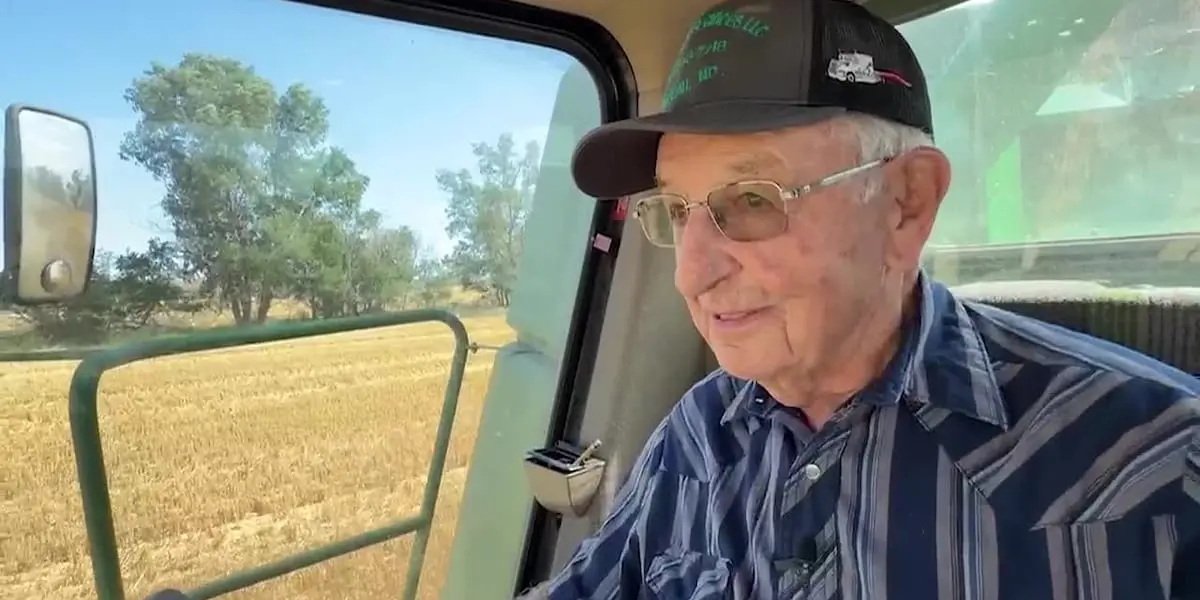
At the center of this remarkable operation is 91-year-old Eugene Sailer. While most individuals of his vintage are long retired, Eugene continues to climb into the cab of a massive combine harvester day after day, performing vital work during the most demanding season of the agricultural calendar. Alongside him are his son, Troy, and his grandchildren, Justin and Karlee.
This in-depth feature explores the inner workings of the Sailer family farm during the 2026 harvest, examining the operational dynamics, the deep historical roots connecting five generations to this specific North Dakota landscape, the technological evolution of modern farming, and the irreplaceable intangible value of working alongside a nonagenarian patriarch who insists he is simply “helping out.”
Detailed Chronology: A Day in the Life of the Sailer Harvest
To truly understand the operational tempo of the Sailer farm, one must observe them at dawn. The North Dakota air is crisp, biting with the chill of late August, yet the farmyard is already alive with activity. Diesels rumble to life, warming up against the morning frost, while dew still glistens on the stalks of ripening crops across hundreds of acres of fertile prairie.
The Morning Briefing and Deployment
For the Sailers, harvest orchestration requires precise coordination. While there are no formal boardrooms or corporate slide decks, the division of labor is executed with military precision, forged through decades of shared experience.
- The Patriarch’s Routine: Eugene Sailer does not wait for an invitation or a wake-up call. Every morning, long before the sun crests the horizon, he is dressed, ready, and waiting. “We don’t ask him to come out,” notes his grandson, 22-year-old Justin Sailer. “He just shows up every morning. He’s always ready to go, and it gives him something to look forward to.” For Eugene, the motivation is pure and simple: a lifelong devotion to honest labor. “I like to help out. I grew up working all my life, so I got to keep working,” he explains with characteristic humility.
- The Cab Crew: Justin Sailer, who literally grew up inside the cab of a combine, now commands one of the primary harvesting units. Having spent his infancy in a buddy seat, Justin transitioned seamlessly into the driver’s seat as he matured. Today, at 22, he manages the complex header controls, monitors moisture levels, and navigates the sprawling acreage with the intuition of someone who has spent his entire life studying the land.
- Logistics and Support: The harvest pipeline requires a delicate balance of cutting, hauling, and storing. Karlee Sailer, Justin’s sister, commands the high-capacity grain cart, running alongside the combines to capture the cascading grain on-the-fly, ensuring the harvesters never have to stop. Meanwhile, their father, Troy Sailer, drives the heavy-duty semi-trucks, ferrying the harvested bounty from the field edges back to the farm’s central storage facilities.
The Midday Rhythm
As the afternoon sun climbs overhead, burning off the morning haze and drying the crops to an optimal moisture level, the fields become a symphony of industrial efficiency. Massive rotary combines churn through the crop rows, churning out golden streams of grain.
Among them is Eugene. Operating a machine equipped with modern ergonomics, the 91-year-old navigates his row with steady hands and sharp eyes. He admits a particular fondness for harvesting corn, noting with a smile that the hopper fills up much faster, keeping the pace brisk and rewarding.
When asked about his stamina, Eugene waves away the notion that what he is doing is extraordinary. To him, he is not spearheading a complex commercial operation; he is just a man passing the time doing what he has done since the mid-20th century. When the sun dips low and the dust settles across the fields, Eugene trades his combine keys for a golf club—proving that retirement is still a distant, optional concept.
Supporting Context & Metrics: The Evolution of North Dakota Agriculture
The story of the Sailer family is not just a heartwarming human-interest vignette; it is set against the backdrop of significant structural and technological shifts in American agriculture, particularly within the challenging landscape of the Northern Plains.
Generational Succession in American Farming
According to data compiled by the United States Department of Agriculture (USDA) Economic Research Service, the demographics of American farming are rapidly aging. The average age of the U.S. principal farm operator continues to hover near 58 years old, and multi-generational farms where three or more generations actively work the fields simultaneously are increasingly rare.
Economic pressures, high land costs, and the heavy capital expenditure required for modern machinery often drive younger generations away from rural communities. The fact that the Sailer family has successfully bridged five generations on the same plot of land—from Eugene’s ancestors up to Justin and Karlee—places them in an elite category of agricultural longevity.
Technological Divide and Synergy
One of the most fascinating dynamics within the Sailer combine cabs is the generational bridge over modern agricultural technology. Today’s combines are veritable rolling supercomputers, integrated with:
- GPS Auto-Steering: Precision guidance systems accurate to within an inch, reducing overlap and soil compaction.
- Yield Monitors: Real-time digital mapping systems that measure crop volume and moisture on-the-go.
- Telematics: Cloud-connected diagnostics that monitor engine health and fuel efficiency from remote devices.
Eugene Sailer is the first to joke about this digital revolution. “They’re a lot smarter than I am,” Eugene remarks with a chuckle, speaking of his grandchildren. “This computer stuff, that’s not for me.”
Yet, this dynamic highlights a brilliant symbiotic relationship. The younger generation brings the mastery of precision-ag technology, maximizing efficiency and yield optimization, while the older generation provides institutional memory, weather intuition, troubleshooting resilience, and an indefatigable work ethic that cannot be programmed into software.
Official Statements and Personal Reflections
The emotional resonance of the 2026 harvest is captured best in the words of the family members themselves, whose reflections reveal a profound sense of gratitude and mutual respect.
Troy Sailer (Fourth Generation):
"It’s pretty awesome when you got the third, fourth, and fifth generations working together. It is pretty special. We’re blessed. Not everybody gets to wake up and work alongside their father at 91, nor do they get to watch their children step seamlessly into the boots of those who came before them."Karlee Sailer (Fifth Generation, Grain Cart Operator):
"Not everyone is lucky enough to work with their 91-year-old grandpa every day. We cherish the memories a whole lot. When you look back at the end of the season, the memories we’re making out here in these fields are worth more than any crop we’ll ever harvest."Justin Sailer (Fifth Generation, Combine Operator):
"I’ve been sitting in the buddy seat since I was probably a baby. Now, getting to run my own machine right alongside my sister, my dad, and my grandpa? It’s hard to put into words. It’s definitely a blessing. He teaches us lessons every single day—not just about farming, but about how to treat people, how to stay humble, and how to love what you do."Eugene Sailer (Third Generation, Patriarch & Combine Operator):
"I just like to help out. I grew up working all my life, so I got to keep working. It gives me something to look forward to every morning. Besides, corn is my favorite—the hopper just fills up so fast."
Future Outlook: Sustaining the Sailer Legacy
As the 2026 harvest draws to a close and the golden hills of Mercer County prepare for the dormant winter months, the Sailer family’s accomplishments offer a powerful blueprint for the future of family-owned agriculture in North Dakota and beyond.
The challenges facing regional farmers remain formidable. Input costs for seed, fertilizer, and diesel fuel continue to fluctuate; unpredictable weather patterns, from localized droughts to unseasonal frosts, threaten crop yields; and global commodity markets introduce persistent economic volatility. For independent farming operations, survival depends not only on smart financial management and technological adoption, but on resilience, adaptability, and cohesion.
For the Sailers, that cohesion is anchored by family heritage. By passing down operational knowledge organically—from Eugene to Troy, and from Troy to Justin and Karlee—the farm preserves a wealth of experiential wisdom that cannot be replicated in a textbook.
Looking ahead, Justin and Karlee represent the vanguard of a new era for the family enterprise. Armed with advanced agricultural technology, digital agronomy tools, and the rock-solid foundation instilled by their father and grandfather, they are well-equipped to carry the Sailer name forward into the decades to come.
Yet, long after the combines are serviced, washed, and parked in the machine shed for the winter, and long after the last truckload of grain is weighed and stored, the enduring legacy of this North Dakota harvest will remain rooted in something far more enduring than yield charts or market prices. It will live on in the shared laughter over two-way radios, the quiet pride of a grandfather watching his grandchildren master the craft, and the unspoken understanding that the true harvest is the family itself.

0 Comments