
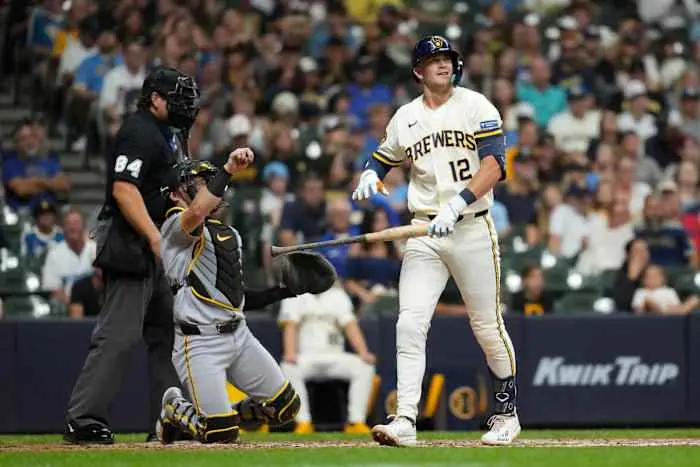

Executive Overview
In the modern landscape of Major League Baseball, where franchise-altering contracts are routinely handed to prospects before they have established their big-league footing, a delicate tension often exists between front-office investment and clubhouse accountability. That tension erupted into public view on Tuesday night, August 25, 2026, at Citi Field in New York.
With the Milwaukee Brewers locked in a tight, late-season battle against the New York Mets, manager Pat Murphy—the two-time defending National League Manager of the Year—made a statement that reverberated far beyond the visitors’ clubhouse. In the fifth inning of an eventual 3-2, 10-inning loss, Murphy abruptly benched rookie shortstop Cooper Pratt, the organization’s prized 22-year-old infielder who signed an eight-year, $50.75 million contract extension in April.
====================================================================
                     GAME AT A GLANCE (AUG 25, 2026)
====================================================================
Matchup:         Milwaukee Brewers (81-51) vs. New York Mets
Final Score:     Mets 3, Brewers 2 (10 Innings)
The Turning Point: Cooper Pratt benched in 5th inning for lack of hustle
The Decider:     Pinch-runner David Hamilton commits walk-off throwing
                 error in the bottom of the 10th
====================================================================
Pratt’s offense? A critical failure to execute a sacrifice bunt in the third inning, followed by a glaring lack of hustle on a shallow fly ball in the fifth that fell for a bloop hit. Rather than celebrating a baserunner in a tight game, Murphy immediately pulled Pratt for a pinch-runner, sending an unmistakable message to both the rookie and a Brewers team currently holding the best record in Major League Baseball at 81-51.
While the substitution ultimately carried a bitter irony—the replacement runner, David Hamilton, committed the game-ending throwing error in the tenth inning—the decision highlighted the uncompromising, high-standard culture that has kept Milwaukee atop the National League Central.
Detailed Chronology: The Anatomy of a Bench-Press
The disciplinary action was not the result of a single isolated mistake, but rather a rapid accumulation of mental lapses in a game where margins for error were razor-thin.
The Third-Inning Bunt Failure
The trouble began in the top of the third inning. With the game scoreless, Brewers outfielders Garrett Mitchell and Joey Ortiz opened the frame with consecutive singles off Mets starting pitcher Zac Thornton. Milwaukee was struggling to generate consistent hard contact, prompting Murphy to call for a sacrifice bunt from Pratt, who was batting ninth in the order.
The objective was clear: advance Mitchell and Ortiz to second and third base, setting up the top of the order—headlined by superstar Jackson Chourio and second baseman Brice Turang—to drive them in.
Pratt’s execution, however, faltered immediately:
- Pitch 1: Pratt attempted to bunt but fouled it off.
- Pitch 2: Thornton offered a fastball directly down the middle of the plate. Pratt pulled his bat back, taking a strike instead of laying down the sacrifice.
- Pitches 3 & 4: Forced to swing away with two strikes, Pratt fouled off consecutive pitches.
- The Result: Pratt hit a sharp comebacker directly to Thornton, who easily threw to third base to force out Mitchell.
The momentum evaporated. Thornton retired Chourio and Turang in succession to escape the jam, leaving the Brewers empty-handed.
PRATT'S 3RD-INNING AT-BAT SEQUENCE
[Pitch 1: Fastball] ---> Foul Bunt Attempt (0-1)
[Pitch 2: Fastball] ---> Pulls back on Strike (0-2)
[Pitch 3: Slider]   ---> Foul (0-2)
[Pitch 4: Fastball] ---> Foul (0-2)
[Pitch 5: Changeup] ---> Comebacker to P, Force out at 3B (1 Out)
The Fifth-Inning Tipping Point
The definitive breaking point occurred in the fifth inning. With one out and the bases empty, Pratt hit a high, drifting fly ball to shallow right field. Believing the ball would be easily caught, the rookie paused in the batter’s box, gazed skyward, and began a casual jog toward first base.
However, the swirling New York wind and miscommunication between three converging Mets defenders created chaos. The ball drifted over the infield and dropped fair near the right-field line, bouncing away from right fielder Carson Benge.
Had Pratt run hard out of the box, he would have easily stood at second base with a double. Instead, realizing the ball had dropped, he accelerated too late, made a hard turn at first, and was forced to retreat to the bag with a long single.
====================================================================
                  THE CRITICAL RUN-TIME DISCREPANCY
====================================================================
Standard Home-to-Second Hustle Time:  ~7.8 - 8.2 seconds
Pratt's Actual Time (due to pause):   ~9.5 seconds
Result: Settled for Single; Benched immediately by Pat Murphy
====================================================================
The Hook and the Aftermath
Before the next pitch could be thrown, Murphy walked to the top of the dugout steps and signaled for David Hamilton to pinch-run for Pratt.
Television cameras captured the 22-year-old shortstop walking back to the dugout with a look of stunned realization. He immediately sat next to veteran outfielder Sal Frelick, who appeared to offer stern but constructive counsel on the expectations of the big-league club.
The decision to pull Pratt carried immediate, painful consequences. The game pushed into extra innings tied at 2-2. In the bottom of the tenth, with a runner on third, Hamilton—who had remained in the game defensively—fielded a ground ball and threw wildly past home plate, allowing the winning run to score and handing the Mets a 3-2 walk-off victory.
Supporting Context & Metrics: The Weight of the $50M Contract
To understand the gravity of Murphy’s decision, one must look at Cooper Pratt’s rapid ascent and the financial commitment the Brewers made to him.
COOPER PRATT - 2026 SEASON PROFILE (AS OF AUG 25)
=================================================
Games Played:      49
Batting Average:   .259
Home Runs:         2
Runs Batted In:    18
Stolen Bases:      10
Contract Status:   8 Years, $50.75 Million (Signed April 2026)
Draft Pedigree:    6th Round (2023) out of high school
Selected in the sixth round of the 2023 amateur draft, Pratt quickly became the crown jewel of Milwaukee’s player development system. Blessed with elite defensive instincts and a mature approach at the plate, his rise through the minor leagues was so meteoric that the Brewers bypassed standard service-time manipulation strategies. In early April 2026, before he had even played a game in the majors, the front office locked him up with an eight-year, $50.75 million contract extension—a clear signal that Pratt, alongside Jackson Chourio, was the future of the franchise.
Pratt made his major league debut on June 16, 2026, and his performance has been highly respectable for a rookie shortstop, batting .259 with 10 stolen bases in 49 games.
However, with financial security and immense hype can come the danger of complacency. By benching a player who represents a fifty-million-dollar investment, Pat Murphy sent a clear message: in Milwaukee, financial status does not buy exemption from fundamental effort.
Official Statements: Tough Love and Total Accountability
In the post-game press conference, neither the manager nor the rookie shied away from the reality of what had transpired. Their comments painted a picture of a young player eager to learn and a veteran manager committed to maintaining championship standards.
Manager Pat Murphy
Murphy, whose gritty, old-school managerial style has been credited with keeping the small-market Brewers consistently competitive, defended his decision with characteristic bluntness:
"I love the kid and I believe in the kid immensely, but he’s got to be a player that does those things. It’s just not tolerated. By anybody. It sends a message to everybody else, too—you’ve got to run.
He’s a great kid—it’s not laziness. You’ve got to have your head in the game. Because there’s games like today, it comes down to [Francisco] Lindor’s great catch or whatever it might be, an errant throw or whatever. You’ve got to be locked in if you’re going to play at this level. So hopefully, a good learning experience."
Shortstop Cooper Pratt
Rather than displaying defensiveness or frustration, Pratt showed a level of maturity that explained why the Brewers invested so heavily in his character:
"I’ve got to be better. It’s not winning baseball. I didn’t help the team win and it won’t happen again, that’s for sure. No excuses. I should have been running hard, no matter if it is foul or fair. I should have been hustling to get to second base.
There’s a certain way to play here and I may be new, but it doesn’t matter. It’s the way we’re run right through the organization from rookie ball to the big leagues. And I didn’t do that. And I will do that. No excuses."
Future Outlook: The Blueprint for a Postseason Run
As the Brewers march toward October, the benching of Cooper Pratt will likely be viewed as a pivotal teaching moment rather than a permanent fracture.
====================================================================
                NL CENTRAL STANDINGS & POSTSEASON OUTLOOK
====================================================================
1. Milwaukee Brewers     81-51 (.614)  ---   Projected: #1 Seed
2. Chicago Cubs          72-60 (.545)  9.0 GB
3. St. Louis Cardinals   69-63 (.523)  12.0 GB
====================================================================
With an nine-game lead in the NL Central as of late August, the Brewers are well-positioned to secure their fourth consecutive division title. However, as Murphy noted, postseason baseball is decided by micro-moments—a perfectly executed bunt, a runner taking an extra base on a bobbled ball, or a defense remaining completely focused for nine (or ten) innings.
For Pratt, this benching serves as a rite of passage. In a clubhouse filled with young talent like Chourio and veteran leaders like Frelick, the standard of hustle is non-negotiable. If Pratt responds by elevating his focus and intensity over the final month of the regular season, this temporary embarrassment could provide the mental toughness required to survive the pressure cooker of the MLB postseason.
For the rest of the league, the incident serves as a warning: the Milwaukee Brewers may not have the largest payroll in baseball, but under Pat Murphy, they will not be outworked.

0 Comments