
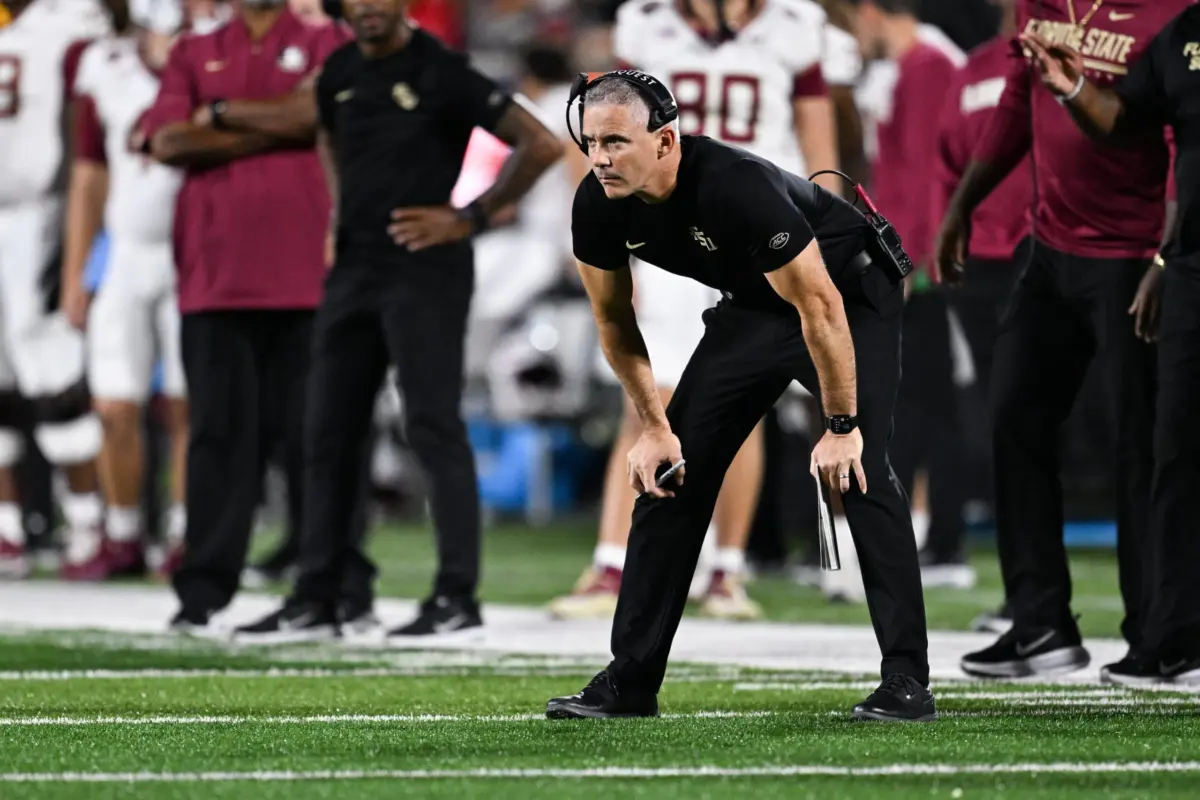

Executive Overview
It was supposed to be the night the narrative flipped. For the first 15 minutes of Friday’s contest against the Louisville Cardinals, Florida State University looked every bit the disciplined, well-coached juggernaut head coach Mike Norvell has continuously promised to build. Playing on the road in a hostile environment, the Seminoles dictated the tempo, imposed their will in the trenches, and commanded a pristine 14-0 lead.
Then, the floor caved in.
What followed was not merely a blown lead, but a catastrophic systemic implosion. Over the span of 40 minutes of game action, Louisville orchestrated a staggering 44-6 run, reducing a once-promising Florida State squad to a disorganized, demoralized unit. The Cardinals piled up 397 yards on the ground—the second-most ever surrendered by an FSU defense in the storied history of the program—turning a comfortable early-game cushion into a humiliating 44-20 defeat.
This Friday night disaster was not an isolated aberration. Rather, it served as a crystal-clear micro-cosm of the broader, terminal trajectory of the Mike Norvell era in Tallahassee. As the Seminoles’ record away from Doak Campbell Stadium continues its historic freefall—now extending a bewildered streak of over 1,000 days without a true road victory—the conversation around the program has shifted away from mere Xs and Os. It is no longer about play-calling miscues, personnel shifts, or defensive alignment errors.
Instead, it is about a rotting culture. Football teams, by their very nature, inherit the psychological DNA of their head coach. When adversity strikes, programs mirror the emotional resilience—or lack thereof—projected from the sideline. For Florida State, Friday night confirmed a chilling reality that has been brewing for years: when the going gets tough, the Seminoles fold. And until profound structural and leadership changes are made, this fatal flaw will remain a defining feature, rather than a bug, of the Florida State football program.
Detailed Chronology: From Masterclass to Meltdown
To understand the magnitude of Friday’s collapse, one must examine the stark contrast between how the game started and how rapidly it unraveled.
The Scripted Perfection
In the opening quarter, Mike Norvell was working magic as FSU’s offensive play-caller. Everything went precisely according to plan. The Seminoles put together a masterclass of a game-opening drive, chewing up the clock and real estate with a methodical 14-play march featuring 11 rushing attempts. It was physical, intentional, and culminated in a touchdown that silenced the Louisville crowd.
When FSU’s defense forced a turnover on downs on the ensuing possession, Norvell’s offense wasted no time pressing the advantage. Converting a crucial fourth down along the way, the Seminoles punched it in once more to double their advantage, claiming a commanding 14-0 lead on the road.
Louisville’s initial response reeked of desperation. Facing a 4th-and-4 on their next drive, Cardinals head coach Jeff Brohm blinked, opting to trot out his field-goal unit for a low-percentage 54-yard attempt rather than trusting his offense. The kick missed. Once again, FSU seized pristine field position, converted yet another fourth down, and stood perched on the precipice of a three-score knockout blow.
The Turning Point
Then came the fateful sequence that broke the back of the Seminole program.
Facing a 3rd-and-goal from the Louisville two-yard line, Norvell opted for a high-risk, play-action pass. It was a do-or-die moment where a simple, bruising run up the middle could have safely staked FSU to a 17-0 advantage. The Cardinals did not bite. Recognizing the play-calling tendencies, Louisville’s defense snuffed out the long-developing pass play with ease.
Rather than kicking the short field goal to establish a three-possession lead, Norvell stubbornly left his offense on the field. Once again, instead of relying on a power running game, he dialed up another slow-developing, intricate play. The Cardinals’ defense blew it up behind the line of scrimmage.
In an instant, the emotional momentum of the entire stadium inverted.
The Avalanche
As soon as Louisville’s offense touched the field following the goal-line stand, they never looked back. On the very next play, an FSU defense that had looked impenetrable was gashed for a 97-yard touchdown run, shrinking the lead to 14-7 in the blink of an eye.
The compounding errors arrived in waves. Following a poor kickoff return and a lifeless three-and-out by the Seminole offense, Louisville struck again, knotting the score at 14-14. From that moment forward, Florida State was chasing ghosts. By the time the Seminoles found the end zone again, they were buried under a 35-20 deficit with just 8:30 remaining in the fourth quarter.
During that disastrous stretch, Florida State was outscored 44-6, transforming a 14-0 laugher into a 44-20 blowout that will live in infamy as one of the darkest sequences of the Norvell tenure.
Supporting Context & Metrics: The Anatomy of a Collapse
While a single 97-yard run or a missed goal-line conversion does not single-handedly lose a football game, the underlying metrics from Friday night illustrate a total systemic failure across all three phases of the game.
The Ground Game Deficit
The most glaring statistical anomaly lies in the trenches. Louisville managed a meager 15 rushing yards in the first quarter, appearing completely overmatched by FSU’s defensive front. Yet, as the game wore on and the Seminoles’ mental resolve fractured, the floodgates opened.
Louisville finished the contest with a staggering 397 yards on the ground—marking the second-most rushing yards ever allowed by a Florida State team in the history of the program. Despite being completely shut out in the first quarter, the Cardinals waltzed into the end zone with six rushing touchdowns.
Offensive Stagnation and Cracking Under Pressure
Conversely, the Seminole offense suffered a catastrophic collapse after their hot start. Florida State began the game a promising 4-of-5 on third-down conversions. For the remainder of the evening, however, they went a dismal 3-of-12, finishing the night 7-of-17.
Individual players began to crack visibly under the mounting pressure. A prime example occurred in the third quarter when wide receiver Micahi Danzy—who had earlier hauled in a brilliant, acrobatic one-handed touchdown catch—suffered a catastrophic drop on a routine, D1-caliber pass. The dropped ball stalled the drive, forcing FSU off the field for a three-and-out immediately after falling behind 21-14.
The statistical symmetry of the collapse is damning: after Florida State was stuffed at the goal line in the first half, they proceeded to punt on five consecutive drives, while Louisville answered by scoring touchdowns on four straight possessions (excluding the halftime break).
A Chronical Road Woe
Friday night’s meltdown was not an isolated incident; it represents a deeply ingrained cultural rot. Florida State has now gone over 1,000 days without securing a true road victory away from the friendly confines of Doak Campbell Stadium.
This psychological fragility mirrors an identical script played out against Alabama earlier in the season, where FSU raced out to a 21-6 lead, surrendered a crucial stop late in the second quarter, and crumbled by halftime. It echoes the 2025 season script, wherein the Seminoles routinely beat up on inferior Atlantic Coast Conference opponents at home—such as shellacking Virginia Tech and Wake Forest by a combined 76-21—only to suffer lifeless, listless road defeats to Clemson, North Carolina State, and Florida.
Official Statements and Accountability
Following the wreckage in Louisville, Mike Norvell faced the music in the post-game press conference, offering an assessment that pointed directly to a lack of mental toughness and preparedness.
"Too many times where we didn’t show the detail, the discipline, the mental toughness that’s necessary on the road," Norvell told the Louisville media. "Starts with me… the guys were not prepared for those moments like they needed to be."
Norvell attempted to reconcile the wild statistical fluctuations between weeks, highlighting the team’s inability to execute when the psychological pressure mounts:
"A week ago [after the UVA win], we weren’t talking about the drawing board. We gave up 20 rushing yards a week ago. This week was 400 yards. It’s not because we forgot to coach this week. You’ve got to be able to execute in the moment."
While Norvell rightly points toward execution, the refusal to look deeper into program leadership ignores a vital reality of modern collegiate athletics: football programs invariably take on the psychological identity of their head coach.
Across the college football landscape—from in-state rivals Miami and Florida, to national powerhouses like USC, Oklahoma, and Clemson—programs reflect the temperament of the men leading them. When a head coach struggles to stabilize momentum swings, his players inevitably follow suit. At Florida State, that inability to weather a storm has calcified into the program’s defining characteristic.
Future Outlook: A Cycle Without End
As the dust settles on another devastating weekend in Tallahassee, the immediate future of the 2025 Florida State football season raises complex questions.
Will FSU win more football games the rest of the year? Statistically, yes. The schedule following the upcoming bye week softens significantly, opening a realistic path toward bowl eligibility against less formidable opponents. Seminole fans will likely witness a few more bounce-back victories against lower-tier conference foes at home, briefly masking the deeper infection within the program.
However, these cosmetic wins do nothing to solve the underlying disease. When the going gets genuinely tough—when the lights shine brightest, the environment grows hostile, and the team needs an alpha leader to step up in the crucible of competition—this iteration of Florida State simply does not possess the infrastructure to deliver.
Nights like Friday night feel jarring in the immediate aftermath, but in truth, they should surprise no one. Ever since the miraculous string of double-digit second-half comebacks defined their 2023 campaign, the Seminoles have proven fundamentally incapable of responding to genuine adversity.
Mike Norvell has cycled through offensive and defensive coordinators, recruited entirely new waves of talent, rotated starting quarterbacks on an annual basis, and now works under a newly appointed athletic director. Yet, the constant remains the same. Until the leadership at the very top changes, Florida State’s inability to handle adversity will remain a foundational, unshakeable feature of the program—dooming the Seminoles to repeat this agonizing cycle year after year.

0 Comments