
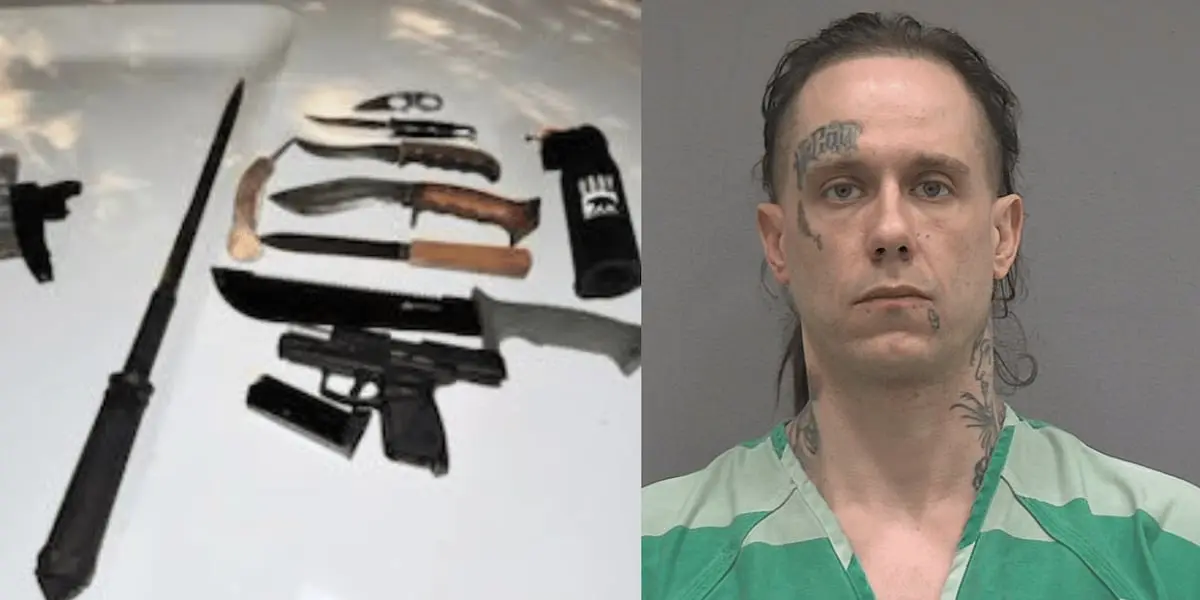

GAINESVILLE, Fla. — A routine traffic enforcement operation on the streets of Gainesville transformed into a high-stakes tactical intervention on Tuesday, culminating in the arrest of a 37-year-old convicted felon. Local law enforcement officers intercepted the suspect in the 1300 block of South Main Street, uncovering a loaded firearm, a clandestine prison shank, multiple edged weapons, and chemical deterrents concealed within his vehicle.
The suspect, identified as Joshua Bailey, now faces severe felony charges as authorities probe deeper into the circumstances surrounding his armed transit through the city. The incident highlights the inherent unpredictability of everyday traffic stops and underscores the persistent challenges police face regarding illegal firearm possession by repeat offenders within Alachua County.
Executive Overview
On Tuesday, patrol units with the Gainesville Police Department (GPD) executed a traffic stop that rapidly escalated from a standard speeding infraction into a major weapons seizure. What began as a routine enforcement action on South Main Street—a heavily trafficked urban corridor in Gainesville—revealed a hidden cache of offensive weaponry.
Upon pulling over the vehicle driven by Joshua Bailey, officers conducted a standard investigation that yielded a loaded Taurus G2 9mm handgun. The firearm was discovered stowed in close proximity to the suspect’s personal identification and wallet, indicating immediate accessibility. Further searches of the vehicle and personal effects uncovered an arsenal that included multiple knives, a crude yet lethal prison-style shank, and a canister of bear spray.
Subsequent background checks performed by dispatch and investigating officers revealed that Bailey has an active prior criminal record, cementing his legal status as a convicted felon. Under both Florida state and federal law, it is strictly illegal for a convicted felon to possess firearms, ammunition, or certain concealed weapons.
Bailey was immediately taken into custody and transported to the Alachua County Jail. He has been formally charged with Possession of a Firearm by a Convicted Felon, though prosecutors are actively evaluating whether additional charges stemming from the supplementary weaponry are warranted. This comprehensive report details the chronology of the arrest, examines broader public safety metrics concerning felons in possession of firearms, reviews official statements from law enforcement, and looks ahead at the judicial proceedings to follow.
Detailed Chronology of the Operation
Phase 1: The Initial Infraction and Vehicle Stop
The sequence of events began mid-day on Tuesday along the urban landscape of South Main Street. According to preliminary incident reports released by the Gainesville Police Department, patrol officers deployed in the area observed a vehicle traveling at a rate of speed significantly exceeding the posted legal limit.
Recognizing the potential hazard posed by speeding in a densely populated commercial and residential sector, officers initiated a traffic stop. Activating their emergency overhead lights and sirens, the patrol unit guided the suspect vehicle to a safe halt near the 1300 block of South Main Street.
The driver, later identified as Joshua Bailey, brought the vehicle to a stop without incident. Initially, the interaction appeared to follow the standard protocol of a traffic enforcement encounter: officers approached the vehicle, requested the driver’s license, vehicle registration, and proof of insurance, and began preliminary dialogue regarding the observed traffic violation.
Phase 2: Probable Cause and the Discovery of the Firearm
As the interaction progressed, observations made by the responding officers established the legal threshold required to expand the scope of the traffic stop from a simple speeding inquiry into a more thorough investigation.
During the interaction, officers observed indicators that prompted a closer inspection of the vehicle’s interior compartments and accessible bags. Upon conducting a search, officers located a bag positioned inside the cabin. Inside this bag, alongside personal effects that included Bailey’s wallet, authorities discovered a loaded Taurus G2 9mm semi-automatic handgun.
The proximity of the loaded firearm to the suspect’s immediate control and identification raised immediate tactical concerns for the safety of the officers on the scene. A firearm discovered in such a configuration is considered readily accessible for immediate use, heightening the potential risk profile of the routine traffic stop.
Phase 3: Uncovering the Arsenal
With the discovery of the loaded handgun, officers systematically expanded their search of the vehicle to ensure no additional threats were present. The subsequent search revealed an array of supplementary weapons that far exceeded what would typically be encountered during a standard traffic stop.
Among the items recovered by law enforcement were:
- Multiple Knives: Various edged weapons strategically placed within the vehicle for rapid deployment.
- A Prison Shank: A crude, improvised stabbing instrument characteristic of contraband typically manufactured within correctional facilities, signaling potential exposure to institutional subcultures or specialized threat tactics.
- Bear Spray: A high-capacity canister of ultra-potent chemical deterrent spray, capable of incapacitating individuals or law enforcement personnel at a distance.
The accumulation of these diverse tactical weapons suggested to investigators that the suspect was equipped for potential physical confrontation, raising immediate questions regarding his intent and activities leading up to the stop.
Phase 4: Verification and Arrest
With the weapons secured, officers initiated real-time database queries through dispatch to verify the driver’s identity and criminal history. The records check quickly returned critical information: Joshua Bailey was a convicted felon.
In the State of Florida, a conviction for a felony strips an individual of their civil rights to own, transport, or possess firearms or certain defensive/offensive implements until those rights are formally restored by executive clemency or specific legal mechanisms. Because Bailey was actively driving with a loaded firearm and an array of concealed weapons despite his felony record, he was in direct violation of state statutes.
Officers safely handcuffed Bailey, secured him in the rear transport compartment of a GPD cruiser, and cleared the scene without further incident. He was transported directly to the local detention facility for booking, where he was formally charged with Possession of a Firearm by a Convicted Felon.
Supporting Context & Metrics: The Intersection of Traffic Stops and Illegal Firearms
The Hidden Dangers of Routine Traffic Enforcement
To the general public, a traffic stop is often viewed as a mundane administrative nuisance—a brief pause in a commute that results in a warning or a monetary fine. However, law enforcement training manuals universally teach that there is no such thing as a "routine" traffic stop.
Nationwide statistics compiled by law enforcement agencies and officer safety organizations consistently demonstrate that traffic stops rank among the most hazardous duties patrol officers perform. Suspects wanted for violent crimes, individuals transporting illicit narcotics, and illegal possessors of firearms frequently cross paths with law enforcement simply by committing minor traffic infractions, such as speeding, failing to signal, or driving with a broken taillight.
In the case of Joshua Bailey, a simple speeding violation served as the catalyst that removed an illegal firearm and an improvised prison shank from the streets of Gainesville. Without proactive patrol enforcement and rigorous investigative curiosity during the stop, these weapons would have remained mobile within the community.
Felons in Possession: A Persistent Public Safety Challenge
The charge levied against Bailey—Possession of a Firearm by a Convicted Felon (often prosecuted under Florida Statute § 790.23)—is a cornerstone of modern criminal jurisprudence aimed at reducing gun violence.
- Legal Framework: Under Florida law, any person who has been convicted of a felony in the courts of this state, or of a crime against the United States, or of any other state, territory, or country, is strictly prohibited from owning or having in their care, custody, possession, or control any firearm or electric weapon or device.
- Severity of Offense: Depending on the nature of the prior conviction and the circumstances surrounding the current possession, this charge is typically classified as a second-degree felony, carrying a statutory penalty of up to 15 years in state prison, alongside mandatory minimum sentences in cases involving prior violent felony convictions under the state’s Habitual Offender statutes.
- Macro-Level Impact: Criminological data across Alachua County and the broader state of Florida indicates that illegal firearm possession by repeat offenders is a primary driver of urban gun violence. Law enforcement agencies increasingly rely on intelligence-led policing, targeted patrols, and strict enforcement of weapons prohibitions to suppress violent crime rates.
The Significance of the Seized Weaponry
The specific inventory of weapons recovered from Bailey’s vehicle offers analytical insight into the nature of the threat:
- Taurus G2 9mm: A popular, highly concealable, striker-fired semi-automatic handgun capable of accepting double-stack magazines. Its presence, loaded and chamber-ready in a bag with a wallet, indicates immediate tactical readiness.
- Improvised Prison Shank: The inclusion of a shank suggests a familiarity with correctional environments and specialized street-level or institutional combat methods. Unlike a standard utility knife, a shank is specifically designed for close-quarters physical assault.
- Bear Spray: While marketed as a wildlife deterrent, bear spray contains a significantly higher concentration of inflammatory agents than standard law enforcement pepper spray. When deployed in an enclosed space like a vehicle or against responding officers, it acts as a debilitating chemical weapon capable of neutralizing human adversaries instantly.
Official Statements and Law Enforcement Perspective
While comprehensive press conferences regarding individual arrests are often reserved for high-profile multi-agency operations, representatives from the Gainesville Police Department have emphasized the vital role that proactive patrol work plays in safeguarding local neighborhoods.
"Every day, our officers step onto the streets not knowing what a routine traffic stop might conceal," noted a department spokesperson familiar with the ongoing operations on South Main Street. "A speeding violation is often the thread that unravels a much more significant public safety threat. The swift action of our personnel in identifying this concealed arsenal and removing a convicted felon from possession of a loaded firearm undoubtedly averted a potentially dangerous outcome."
Law enforcement leadership across Alachua County continues to urge community members to remain vigilant and supportive of local policing initiatives. Agencies stress that cracking down on illegal weapons possession remains a top strategic priority, particularly as urban centers combat the proliferation of illicit firearms among individuals legally barred from owning them.
Future Outlook: Judicial Proceedings and Legal Implications
As the investigation transitions from the tactical enforcement phase to the judicial process, Joshua Bailey faces an intricate and rigorous legal road ahead.
1. Arraignment and Bond Hearings
Following his booking at the Alachua County Jail, Bailey will undergo his initial appearance before a magistrate judge. During this hearing, the court will formally read the charges against him, evaluate his past criminal history, and determine appropriate pre-trial release conditions. Given his status as a convicted felon found in possession of a loaded firearm and multiple tactical weapons, prosecutors are expected to advocate for a high bond or pre-trial detention to mitigate the perceived risk to community safety.
2. Formal Charging Decisions by the State Attorney’s Office
The Office of the State Attorney for the Eighth Judicial Circuit will review the complete investigative package compiled by the Gainesville Police Department. While the primary charge booked into jail is Possession of a Firearm by a Convicted Felon, prosecutors will analyze whether additional enhancements or charges are appropriate based on the totality of the seized items:
- Potential scrutiny regarding the concealed knives and the improvised shank.
- An evaluation of whether any of the recovered weapons were reported stolen from residential or commercial burglaries within the region.
- A review of Bailey’s past felony convictions to determine applicability under state sentencing guidelines or mandatory minimum statutes.
3. Trial or Plea Negotiation Phase
Should the case proceed through the court system, defense counsel and state prosecutors will engage in discovery and pre-trial motions. Given the physical evidence recovered directly from the suspect’s vehicle—including the firearm located alongside his personal identification and wallet—the evidentiary foundation for the prosecution’s case is robust. Legal analysts suggest that cases involving direct physical possession by a prohibited person frequently result in negotiated plea agreements, though the presence of the secondary weapons and the suspect’s prior record could heavily influence any proposed sentencing recommendations by the state.
4. Broader Community Impact
The arrest of Joshua Bailey serves as a stark reminder of the underlying dangers present on municipal roadways. For the residents of Gainesville and the broader Alachua County region, the incident reinforces both the vigilance required of local law enforcement and the ongoing legal battles waged to keep illegal firearms out of the hands of repeat offenders. As this case moves toward trial, local authorities remain focused on maintaining rigorous patrol standards to deter unlawful conduct and protect the public from armed threats on local streets.

0 Comments