
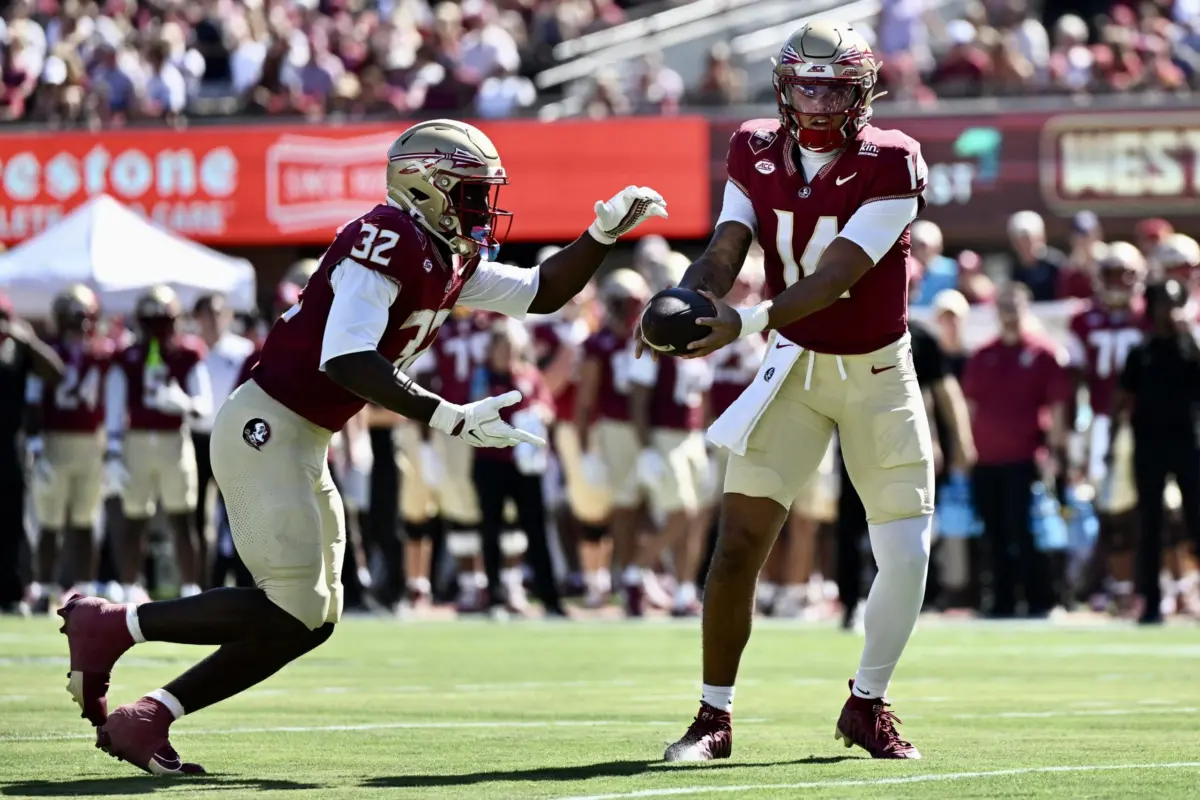

Executive Overview
At storied institutions like Florida State University, matchups against Football Championship Subdivision (FCS) opponents and lower-tier Group of Five programs are traditionally viewed as organizational breathers. Historically, these contests serve multiple calculated purposes: they act as a physiological reprieve for banged-up starters, an opportunity for developmental depth pieces to capture vital live-game reps, and an early exit strategy for loyal fans caught in the punishing early-season heat of the Florida panhandle. When the score gets out of hand by halftime, the narrative is typically about the program’s boundless depth and the electrifying glimpses of future All-Americans flashing under the stadium lights.
However, the opening acts of the current campaign have painted a far more unsettling picture inside Doak Campbell Stadium.
Through the nascent stages of the season—highlighted by a subdued 34-17 victory over Conference USA adversary New Mexico State in Week 0, followed by a sterile 34-7 dispatching of FCS opponent Central Arkansas—the final scorelines have proven profoundly deceiving. On paper, starting the year with consecutive wins should calm the collective nerves of a passionate fan base and provide a steady runway for a coaching staff seeking rhythm. Yet, the manner in which these victories have been achieved has done precisely the opposite.
Far from signaling a dominant powerhouse flexing its muscles, these outings have laid bare structural deficiencies, systemic inconsistencies, and a glaring lack of killer instinct. For a program of Florida State’s historical prestige and elite pedigree, winning ugly against inferior opposition is no longer merely an aesthetic grievance—it is a blaring red siren.
At the epicenter of this growing unease is head coach Mike Norvell. Entering a brutal, unforgiving stretch of the Atlantic Coast Conference schedule, the margin for error has evaporated entirely. The underlying metrics of these early-season performances suggest a team playing with razor-thin structural integrity, propped up temporarily by sheer offensive explosiveness rather than sustainable dominance. As the competition stiffens exponentially in the coming weeks, the burning question inside the athletic department and across national media circles is no longer whether this team can secure bowl eligibility, but whether Mike Norvell can survive a gauntlet that threatens to permanently derail the trajectory of the program.
Detailed Chronology: Breaking Down the Central Arkansas Encounter
To truly understand the existential dread settling over Tallahassee, one must look closely at how Saturday afternoon’s matchup against Central Arkansas unfolded. On paper, a 27-point victory against an FCS opponent should be filed neatly away under routine business. But the lived experience inside the stadium told a vastly different story—one defined by strange rhythms, glaring anomalies, and a pervasive lack of game control.
Right from the opening whistle, the contest defied conventional expectations of a mismatch. Conventional wisdom dictates that an elite FBS defense will aggressively swarm an overmatched FCS offensive line, forcing immediate three-and-outs and handing the ball right back to their high-powered offense. Instead, Central Arkansas engineered two consecutive lengthy, methodical drives to open the game, each consuming seven plays and establishing an immediate physical presence.
While Florida State’s offense operated with ruthless efficiency—scoring touchdowns on its first four possessions to comfortably build an insurmountable 24-0 cushion, and converting six of its first seven drives into scoring opportunities—the defensive unit remained entirely incapable of forcing Central Arkansas off the field. In fact, the Seminoles’ defense managed a meager single three-and-out across the entire afternoon, and that lone defensive victory did not arrive until the middle of the third quarter.
This inability to get off the field created an inverted game dynamic. Central Arkansas utterly dominated the time of possession, holding the football for a staggering 39 minutes and 14 seconds. To put that figure into perspective, the Bears managed just two fewer first downs than Florida State, locking down a 24-22 advantage in the chains-moved category. Furthermore, Central Arkansas ran an astonishing 73 offensive plays compared to a remarkably economical 48 plays for the Seminoles.
The game ultimately ended not with a dramatic defensive stand or a celebratory final drive, but with the FSU offense executing routine kneel-downs to mercifully drain the remaining seconds off the clock. It marked the conclusion of an afternoon where the scoreboard read like a blowout, but the field-level reality felt remarkably labored. For a program striving to return to the upper echelons of college football, surviving an FCS opponent through sheer explosive-play efficiency rather than suffocating, wire-to-wire dominance is an ominous omen.
Supporting Context & Metrics: Peering Beneath the Box Score
When analyzing modern football through an analytical lens, statistics can either illuminate the truth or mask deep-seated flaws. In the case of Florida State’s early-season resume, the advanced metrics present a deeply polarized narrative that should alarm any astute observer.
On the surface, individual play-efficiency metrics look astronomical. Florida State’s offense operated with breathtaking verticality against Central Arkansas, chewing up yards at a blistering clip of 8.7 yards per play. Defensively, the Seminoles held the Bears to an anemic 3.4 yards per play. In a vacuum, those two numbers—an 8.7-to-3.4 yard-per-play differential—would normally indicate an absolute, historic shellacking. It points directly to an offense capable of striking lightning from anywhere on the turf, and a defense that, when targeted, routinely slammed the door shut.
Yet, these macro-level efficiency numbers completely obscure the micro-level structural failures that allowed Central Arkansas to dictate the tempo of the afternoon. The staggering discrepancy in total plays (73 to 48) and time of possession (nearly 40 minutes for the visitors) highlights a defense with a chronic inability to sustain momentum or string together stops.
+-----------------------------------+--------------------+--------------------+
| Metric                            | Florida State      | Central Arkansas   |
+-----------------------------------+--------------------+--------------------+
| Final Score                       | 34                 | 7                  |
| Yards Per Play                    | 8.7                | 3.4                |
| Total Offensive Plays             | 48                 | 73                 |
| Time of Possession                | 20:46              | 39:14              |
| First Downs                       | 22                 | 24                 |
| Defensive Three-and-Outs Forced   | 1                  | 0                  |
+-----------------------------------+--------------------+--------------------+
Football is ultimately a game of rhythm, attrition, and possession volume. By conceding 73 plays to an FCS offensive coordinator, Florida State’s defense exposed its depth to unnecessary physical strain, while simultaneously starving its own explosive offense of the repetition required to build a sustainable offensive identity. When an elite offense is limited to just eight true possessions over the course of an entire regulation football game because the opposing offense refuses to leave the field, the margin for error on every single snap skyrockets.
Historically, programs like Florida State—those with national championship aspirations and rosters laden with blue-chip talent—measure themselves not just by whether they win games against outmatched opponents, but by how they win them. When a team can line up, dominate the line of scrimmage, force quick punts, and dictate the physical and psychological terms of engagement from the opening kick, it builds a reservoir of confidence that translates directly into high-stakes conference play.
Conversely, when a team sleepwalks through the middle quarters, surrenders long methodical marches, and relies entirely on quick-strike home-run plays to bail out a leaky defensive framework, it creates an atmosphere of fragility. Through four games, Florida State has not once looked like a polished, cohesive machine capable of executing a disciplined 60-minute game plan. Instead, they have looked like a collection of individual playmakers masking systemic structural decay.
Official Statements & Sideline Realities
As the pressure cooker intensifies in Tallahassee, the rhetoric emanating from the vernal confines of the Moore Athletic Center has attempted to strike a careful balance between accountability and outward optimism. Following the victory over Central Arkansas, head coach Mike Norvell addressed the media with a subdued countenance that acknowledged the statistical anomalies of the afternoon while attempting to pivot toward the physical realities of college football’s long season.
"Look, a win is a win, and we are always going to respect the effort it takes to secure a victory on Saturdays," Norvell noted during his post-game media availability. "We executed at an extremely high level when we had the ball in our hands. Generating over eight yards per snap is a testament to the explosive capability of this offense. But we understand—uniquely and clearly—that the way the game was played structurally is not sustainable moving forward. We gave up entirely too many snaps on the defensive side of the ball. We didn’t get off the field on third down with the consistency that our standard demands. That falls on us as a coaching staff to rectify immediately."
When pressed about the glaring discrepancy in time of possession and the defensive unit’s inability to register multiple three-and-outs against an FCS opponent, Norvell doubled down on the need for internal discipline and execution.
"Football is a game of complementary execution," Norvell explained. "When your offense scores in four plays, it puts the defense right back out on the turf. But that’s not an excuse. Championship defenses find a way to make plays, get off the field, and dictate terms. We have the personnel to do it, but we are hurting ourselves with alignment issues, missed tackles in space, and a failure to finish plays when the pocket collapses. We don’t have time to feel sorry for ourselves or dwell on the style points. We have to correct the technical flaws because the challenges standing directly in front of us require absolute perfection."
Despite the head coach’s measured defense of his program’s trajectory, anonymous whispers from within the broader athletic department and donor circles suggest a rapidly shrinking window of patience. The foundational expectations of Florida State football do not merely include winning games against overmatched foes; they demand visual authority. When players and assistant coaches retreat to the locker room following a 27-point win over an FCS school with expressions of quiet concern rather than celebratory relief, it signals a psychological disconnect between the team’s internal performance and its external output.
Future Outlook: The Brutal Gauntlet and the Hot Seat
While the opening act of the schedule has provided superficial victories, the curtain is about to rise on a theatrical nightmare for the Seminoles. The true reckoning for Mike Norvell and this iteration of Florida State football is no longer looming on the horizon—it has arrived at the doorstep, and the schedule offers zero sanctuary.
To evaluate Norvell’s long-term job security, one must cast an unflinching gaze at the upcoming four-game stretch that will define the autumn. Any realistic expectation of Norvell retaining his post as head coach deep into the fall requires the program to navigate this upcoming gauntlet with remarkable poise and tactical proficiency. Yet, based on everything observed through the first month of the season, such an outcome currently stretches the boundaries of plausible optimism.
The gauntlet commences with a high-stakes home matchup against a Virginia program that established itself as a legitimate conference heavyweight by playing in the ACC Championship Game a season ago. The Cavaliers bring a disciplined, battle-tested brand of football to Doak Campbell Stadium that will ruthlessly expose any lingering defensive lapses or undisciplined tackling angles.
Immediately following that physical test, the Seminoles must pack their bags for a perilous road trip to face a profoundly talented Louisville squad—a game rendered doubly dangerous by the looming disadvantage of a short preparation week. Road environments in the ACC are notoriously hostile when a program shows signs of vulnerability, and Louisville possesses the offensive firepower to exploit a secondary that has struggled to get off the field against lesser competition.
Things escalate from precarious to treacherous with a high-profile rivalry clash on the road against a loaded, elite-tier Miami Hurricanes program. The talent disparity in the trenches during that rivalry matchup could prove catastrophic for an FSU team that struggled to control the line of scrimmage against Central Arkansas.
Finally, the stretch culminates with a showdown against a Clemson program that has historically served as the benchmark for ACC supremacy. Just as national pundits and rival fan bases began writing the obituary for Dabo Swinney’s Tigers amid early-season struggles, Clemson has routinely shown vital signs of life over the last few weeks, rediscovering their championship mettle precisely when counted out.
When synthesising this treacherous slate of opponents with the unconvincing, fragile brand of football Florida State has displayed against New Mexico State and Central Arkansas, the conclusion becomes starkly apparent. At this juncture, it is entirely safe to project that keeping Norvell in charge when the Seminoles travel to Chestnut Hill to face Boston College on November 7 would represent a stunning deviation from historical athletic department expectations.
In modern major-college football, the warning signs are always visible long before the axe officially falls. They manifest in the quiet moments of post-game press conferences, in the lopsided time-of-possession charts against inferior opponents, and in the universal understanding that a program has lost its intimidating aura. When a coaching staff no longer has to offer caveats or mention the proverbial "grain of salt" when analyzing a victory over an FCS opponent because the performance was simply too labored, the program is in genuine, systemic trouble. For Florida State, the time for excuses has expired, and the unforgiving reality of the gridiron is ready to render its final verdict.

0 Comments