
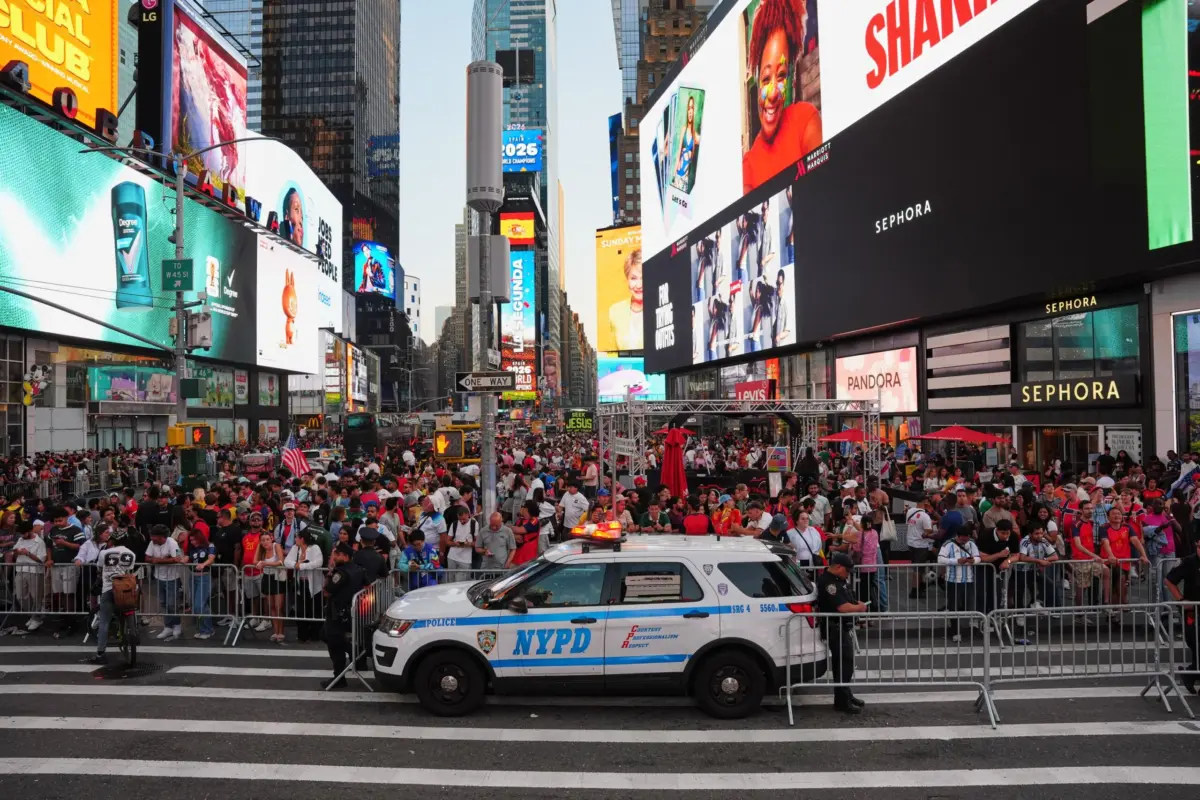

NEW YORK — A bustling Monday afternoon in the heart of Manhattan dissolved into sudden terror on January 2026, when a volatile confrontation unfolded in Times Square. Authorities confirmed that a woman brandishing two knives stabbed at least two individuals before being shot by responding New York Police Department (NYPD) officers near one of the city’s most heavily guarded intersections.
The incident, which triggered a massive emergency response and temporarily paralyzed transit and pedestrian movement around Seventh Avenue and West 42nd Street, has once again thrust the complex issues of urban public safety, emergency police intervention, and the management of severe mental health crises into the national spotlight.
As investigators piece together the timeline of the attack, fresh questions are being raised regarding how a rapidly escalating crisis in one of the most heavily policed tourist destinations in the world unfolded in a matter of minutes.
Executive Overview
The violent sequence of events began shortly after midday on a typical Monday, a time when Times Square is packed with commuters, tourists, office workers, and street performers. According to preliminary reports from the NYPD and local media affiliates, a woman whom authorities described as appearing "emotionally disturbed" began threatening pedestrians with two knives near the intersection of Seventh Avenue and West 42nd Street.
Within moments, the situation escalated from menacing behavior to physical violence. At least two victims sustained stab wounds before fleeing or falling back as bystanders screamed and scattered. Responding to emergency 911 calls, NYPD units flooded the area. Upon locating the suspect, officers attempted to de-escalate the situation. However, the woman reportedly refused to drop the weapons and retreated toward a nearby police substation, prompting officers to discharge their firearms.
Both the suspect and the two stabbing victims were subsequently transported to local area hospitals for emergency medical treatment. While the exact conditions of the victims remain undisclosed pending further updates from medical personnel, the incident immediately caused a ripple effect across New York City’s transit and tourism sectors, closing down major thoroughfares and drawing intense scrutiny from city officials, mental health advocates, and police oversight bodies.
Detailed Chronology of Events
Phase 1: The Initial Disturbance
At approximately midday, pedestrian traffic was moving at its usual frantic pace through the commercial nexus of Times Square. Witnesses reported seeing a woman acting erratically, pacing near the busy corridor of Seventh Avenue and West 42nd Street.
According to reports compiled by local news outlets including WABC, the individual was visibly agitated and drew the alarm of passersby when she brandished two knives. Rather than fleeing, she allegedly began advancing toward individuals in the immediate vicinity, shouting and making threatening gestures. The visual of an armed individual in such a densely populated area immediately triggered panic among nearby crowds, who scrambled to find cover inside surrounding retail stores and subway entrances.
Phase 2: The Stabbing Attack
The transition from verbal threats to physical violence occurred with terrifying speed. Before bystanders or private security could intervene effectively, the suspect lunged at individuals within the crowd.
NBC New York and other responding agencies confirmed that at least two people were struck by the blades during the brief attack. The victims, whose identities have been withheld pending family notification, suffered injuries that required immediate emergency intervention. The suddenness of the assault left little time for defensive measures, transforming a routine afternoon in Midtown into an active crime scene.
Phase 3: Police Arrival and Pursuit
Within minutes of the first emergency dispatch calls, multiple units from the NYPD’s Midtown Manhattan precincts converged on the scene. Officers trained in active-threat response arrived to find a chaotic environment with multiple victims and an armed suspect still at large in the pedestrian plaza.
Upon spotting the responding officers, the woman did not surrender. Instead, she fled away from the immediate site of the stabbings, moving deliberately toward a nearby police substation situated within the busy commercial district.
Phase 4: The Confronation and Police Shooting
Cornered or moving purposefully toward the structure, the suspect was confronted by police officers who ordered her repeatedly to drop the weapons. According to law enforcement sources speaking to local affiliates, the woman refused all verbal commands to disarm herself.
Faced with an imminent lethal threat and what they perceived as a refusal to comply that endangered both officers and any remaining civilians in the vicinity, at least one police officer discharged their weapon, striking the suspect.
Immediately following the shots, emergency medical technicians (EMTs) stationed nearby rushed to the scene. Both the armed suspect and the two stabbing victims were treated on-site before being rushed under police escort to nearby regional trauma centers, setting off a complex multi-agency investigation.
Supporting Context & Metrics: Urban Safety and Mental Health in Midtown
To understand the gravity of Monday’s incident, it is essential to examine the broader context of public safety, policing, and mental health intervention in New York City’s most high-profile public spaces.
Times Square: A High-Security Microcosm
Times Square is not only a global tourist destination but also one of the most heavily monitored and policed zones on earth. Equipped with an extensive network of closed-circuit television (CCTV) cameras, a permanent NYPD substation, and a continuous presence of foot patrols, Counterterrorism units, and private security guards, the area is designed to deter and swiftly suppress criminal activity.
However, criminologists and urban security experts note that the sheer volume of humanity—averaging more than 350,000 pedestrians daily—makes the district uniquely vulnerable to spontaneous acts of violence, particularly those driven by sudden psychological crises or impulsive behavioral outbursts.
+------------------------------------------------------------+
|                TIMES SQUARE CRIME METRICS                  |
+------------------------------------------------------------+
| Average Daily Foot Traffic:     ~350,000 - 400,000 people  |
| NYPD Permanent Presence:        Substation & Foot Patrols  |
| Primary Response Time (Average): < 3 minutes               |
| Common Incidents:               Quality of life, larceny,  |
|                                 spontaneous erratic acts   |
+------------------------------------------------------------+
The Mental Health Crisis Intersection
Monday’s shooting highlights a persistent and harrowing challenge facing metropolitan law enforcement agencies across the United States: the intersection of untreated severe mental illness and public violence.
Law enforcement data from recent years underscores an ongoing struggle with individuals experiencing acute psychiatric episodes in public transit systems and commercial hubs. When an individual in crisis arms themselves with a deadly weapon—such as the two knives wielded in this incident—police officers are frequently thrust into a binary dilemma: neutralize an immediate threat to human life or risk severe injury or death to themselves and innocent bystanders.
Mental health advocates often argue that greater deployment of crisis intervention teams (CIT) alongside traditional policing is vital. However, critics of current municipal policies point out that when an active stabbing is already underway, standard de-escalation protocols must instantly pivot to tactical neutralization to save lives, leaving little room for psychological negotiation during the critical seconds of an active assault.
Official Statements and Initial Reactions
As investigations by the NYPD’s Force Investigation Division (FID) and local prosecutors get underway, city leaders have begun releasing preliminary statements regarding the incident.
An NYPD spokesperson emphasized the rapidly evolving and dangerous nature of the call, noting that officers were forced to make split-second decisions to protect the public from further harm. "Our officers were confronted with a violent individual actively armed with two deadly weapons who had already stabbed multiple innocent people," an official department statement noted. "Every tool of de-escalation is considered, but when confronted with an active, advancing threat, officers must act decisively to preserve human life."
Local business owners and tourism advocacy groups expressed profound concern over the psychological and economic impact of the shooting. The Times Square Alliance issued a brief statement wishing a speedy recovery to the victims while reaffirming faith in the rapid response of local law enforcement.
Meanwhile, civil rights and police accountability watchdogs have called for a transparent, thorough review of the body-worn camera (BWC) footage captured during the confrontation. Such reviews are standard protocol for all police-involved shootings in New York City, designed to determine whether adherence to departmental use-of-force guidelines was strictly maintained.
Future Outlook: Investigations, Policy, and Recovery
The fallout from the Times Square shooting will reverberate across multiple levels of New York City governance and civic life in the coming weeks and months.
1. The Legal and Investigative Process
The NYPD’s Force Investigation Division, alongside the office of the New York State Attorney General’s Office of Special Investigation (OSI), will scrutinize every second of the encounter. Investigators will analyze:
- Body-worn camera footage from all responding officers.
- Surveillance footage from Times Square commercial cameras.
- 911 dispatch logs and radio transmissions.
- Ballistics reports and forensic evaluations of the knives recovered from the scene.
Should the investigation find adherence to departmental guidelines, the case will typically be reviewed by a local grand jury, though the timeline for such reviews can span several months.
2. Medical Recovery of Victims and Suspect
The immediate future depends heavily on the medical prognosis of the three primary individuals involved: the two innocent bystanders who sustained stab wounds and the female suspect who suffered gunshot wounds. Hospital officials have maintained strict privacy regarding their current conditions, but social services and victim advocacy groups are expected to step in to provide trauma support for the injured civilians and their families.
3. Policy Implications for Urban Policing
Incidents of this magnitude invariably reignite fierce political and social debates over municipal safety policies. City Council members and executive leadership face renewed pressure to address gaps in the social safety net, specifically regarding how chronically disturbed or unhoused individuals are identified, supported, and removed from high-risk environments before they pose a lethal danger to themselves or others.
As Midtown Manhattan attempts to return to its usual frantic rhythm, the echoes of Monday afternoon serve as a stark reminder of the fragile balance between public openness and public safety in the modern urban landscape.

0 Comments