

Executive Overview
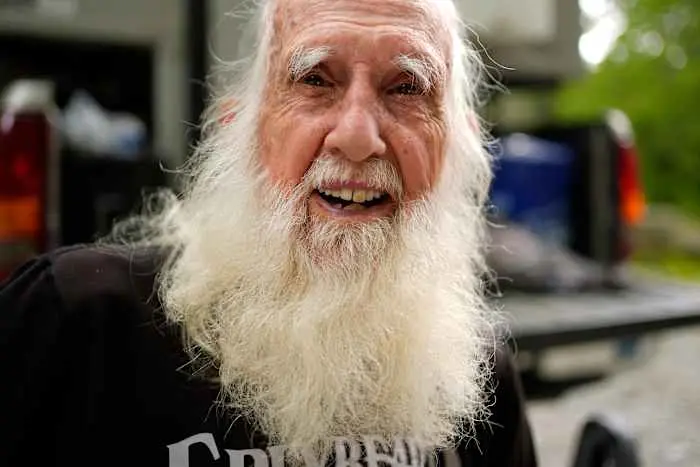
MILLINOCKET, Maine — In an era defined by sedentary comforts and digital distraction, a 91-year-old great-grandfather from Tennessee has redefined the limits of human endurance. Dale Sanders, universally known on the trail as "Grey Beard," has officially reclaimed his title as the oldest person to complete the grueling Appalachian Trail.
Spanning 2,193 miles (3,530 kilometers) from the verdant slopes of Springer Mountain, Georgia, to the jagged, wind-scoured granite summit of Mount Katahdin in Maine, Sanders’ journey was far more than a physical test. It was an epic odyssey punctuated by resilience, perseverance, and staggering statistics. Over the course of his trek, Sanders hit the dirt 71 times—including seven harrowing, bone-rattling tumbles that required medical intervention and sheer willpower to overcome.
Yet, as he hoisted his arms in triumph atop Katahdin on Monday, August 31, 2026, Sanders proved that age is not merely a number, but a canvas for extraordinary achievement. What began as a personal quest to snatch back a lost record transformed into a profound movement, inspiring millions worldwide and turning an aging retiree into a global icon of unyielding vitality.
Detailed Chronology: Step-by-Step Through the Wilderness
The anatomy of a record-breaking thru-hike is measured not just in miles, but in micro-decisions to keep moving forward when every fiber of the body screams for rest. The Appalachian Trail Conservancy defines a thru-hike as completing all sections of the trail—in any order, with permitted pauses—within a rolling 12-month window. Sanders utilized this framework strategically, launching his ambitious comeback on September 6 in West Virginia, weaving through regional segments with calculated breaks, and ultimately culminating his mission at Maine’s highest peak.
The Training Ground and Early Momentum
Long before hitting the dirt in earnest, Sanders spent six rigorous months training near his home outside Memphis, Tennessee. Despite this preparation, the reality of the trail quickly set in. Hiking at age 91 bears virtually no resemblance to hiking at 82—the age at which Sanders first conquered the trail in 2017.
The early months of his campaign tested his balance, cardiovascular endurance, and mental fortitude. While he enjoyed favorable conditions through portions of the Mid-Atlantic, the terrain soon escalated in hostility. Pennsylvania offered a welcome respite, featuring well-maintained pathways and the morale-boosting interventions of "trail angels"—Good Samaritans who materialized with gourmet treats like caramel frappés. "When people are taking care of you and bringing you caramel frappes on the trail, the rocks don’t matter," Sanders remarked with a smile.
The Perils of the Path: Falls and Medical Crises
Gravity, however, proved to be an unyielding antagonist. Sanders meticulously logged 71 falls along the way. While the vast majority were minor slips, seven classified as "hard falls" brought real peril.
In June, while descending the treacherous, boulder-strewn slopes of Killington Mountain in central Vermont, Sanders pitched violently forward. He sustained deep scrapes across his legs, arms, and hands, emerging from the pile of rocks bruised and bloodied. "Thank God nothing got broken, but I was banged up," he recalled. Refusing to let the trauma slow him down, he eschewed bandages: "I didn’t rub the blood off, I just kept hiking."
Weeks later, a more insidious threat materialized. His left arm went completely numb, triggering an emergency evacuation to a Maine hospital. Medical professionals initially feared the nonagonal hiker had suffered a stroke. Fortunately, further diagnostic testing revealed a severely pinched nerve.
Though swiftly cleared to resume his trek, the psychological weight of the health scare brought Sanders to the precipice of quitting. He retreated home in early August to mourn alongside his wife, whose mother had just passed away. It was his wife who ultimately provided the psychological anchor he needed, convincing him to pack his bags and return to the wilderness to finish what he had started.
The Final Ascent to Mount Katahdin
As August waned, Sanders entered the final, brutal stretch of the trek: Maine’s infamous 100-Mile Wilderness and the vertical ascent of Mount Katahdin.
By this stage, physical exhaustion was a constant companion. During one grueling 12-mile (19-kilometer) stretch, fatigue overtook him so completely that he simply laid down flat on the trail, announcing to his support team that he required a "power nap." Two minutes later, the nonagenarian rose, dusted off his gear, and continued marching.
On Monday, August 31, 2026, inside Baxter State Park in Piscataquis County, Maine, Sanders scaled the final vertical obstacles of Mount Katahdin. Upon reaching the summit, he did not immediately celebrate; instead, he paused quietly for a prayer of gratitude, before transforming the peak into a stage of pure joy by celebrating his monumental achievement.
Supporting Context & Metrics: The Anatomy of an Icon
To fully grasp the magnitude of Dale Sanders’ accomplishment, one must examine the intersection of gerontology, outdoor athletics, and the staggering baseline metrics of the Appalachian Trail.
The Physical and Statistical Reality
- The Distance: 2,193 miles (3,530 kilometers) traversing fourteen states.
- The Elevation Gain: Cumulative elevation changes equivalent to climbing Mount Everest multiple times.
- The Trauma: 71 recorded falls, including 7 severe impacts requiring intensive physical recovery.
- The Demographics: According to the U.S. Centers for Disease Control and Prevention (CDC), more than 14 million older adults fall annually in the United States, frequently resulting in catastrophic mobility loss. Sanders bucked this epidemiological trend entirely, continuing his march despite sustaining injuries that would permanently sideline individuals half his age.
A Lifetime of Defying Expectations
Sanders was born in Kentucky in 1935—the exact year the Appalachian Trail was officially completed. As a child, he faced intense bullying due to his diminutive physical stature, an adversity that forged an unshakeable inner resilience. He sought refuge in solo sports that demanded laser focus and intense discipline, such as acrobatics and competitive swimming.
His adulthood was marked by public service and relentless adventure. After serving honorably in the United States Navy, Sanders embarked on a lifelong career in parks and recreation, officially retiring in 2002. Retirement, however, served as the starting gun for his most daring exploits.
Sanders’ resume is a masterclass in longevity sports. Before reclaiming his Appalachian Trail title, he achieved global renown by becoming the oldest person to paddle the entire length of the Mississippi River—a punishing 87-day expedition that he deliberately commenced on his 87th birthday.
Official Statements and Witness Accounts
The reverberations of Sanders’ journey extended far beyond his personal logbooks, transforming accidental trail encounters into unforgettable life lessons for younger generations of outdoor enthusiasts.
Encounters on the High Ridges
In June, Meredith Ewenson was leading a backcountry excursion for a group of ten women in New Hampshire when their paths crossed with Sanders. Initially, the group spotted an elderly hiker navigating the steep gradients in the early morning hours. It was only hours later, when Sanders effortlessly surged past them on an uphill climb, that they caught sight of the distinctive "Grey Beard" logo emblazoned across his t-shirt.
Intrigued, Ewenson’s group pushed hard to reach the Appalachian Mountain Club hut that evening, arriving around 4:00 PM. To their astonishment, Sanders was already there, relaxing.
"I got here at noon," he greeted them casually.
The following morning, as Sanders prepared to break camp, he treated the group to an impromptu "victory dance" before lacing up his boots and hitting the trail.
"My first thought was, Wow, his mobility is insane," Ewenson recalled in an interview. "His face on that body just doesn’t make any sense. My brain couldn’t compute how he was so impossibly fit for being that age. Seeing it in real life is something that I’ll definitely remember forever."
The Evolution of a Mission
When Sanders set out to break the record held by his friend M.J. Eberhart (known as the "Nimblewill Nomad," who captured the title at age 83), his motivations were initially straightforward: he wanted his crown back.
However, as thousands of digital followers swelled his social media channels, Sanders realized his hike had evolved into something much larger than a personal athletic statistic.
"I wanna get it back, but right now, that’s secondary," Sanders reflected during the final weeks of his journey. "Right now, what’s the most important thing—and it’s one of the things that surprised me—is that people are motivated and given encouragement by my efforts."
Future Outlook: Blazing New Ground for Senior Vitality
As Dale Sanders descends from the summit of Mount Katahdin and transitions back to civilian life with his wife in Tennessee, his legacy is already firmly etched into the annals of American outdoor lore.
Medical researchers, sports physiologists, and gerontologists are increasingly looking at outliers like Sanders to understand the boundaries of human aging. His journey challenges deeply ingrained societal assumptions regarding physical decline in the tenth decade of life. By demonstrating that balance, cardiovascular endurance, and cognitive drive can be preserved—and even pushed to extremes—through rigorous mental conditioning and physical persistence, Sanders has authored a new playbook for growing old.
Yet, for Sanders, the philosophy remains wonderfully simple. It is not about the records, the media spotlight, or the digital followers. It is about waking up, putting one foot in front of the other, and refusing to let the terrain—or the calendar—dictate the boundaries of a life well-lived.
As he noted while gazing out over the Maine wilderness: "I am 91, so I’m blazing new ground hiking long distances like this… There’s a huge difference between hiking the trail at 82 and 91. But it is possible, because I’m proving that."

0 Comments