

Executive Overview
The geopolitical landscape of the Middle East has been thrust into a state of heightened volatility following two major, simultaneous developments that threaten to redraw the lines of American foreign policy and regional security.
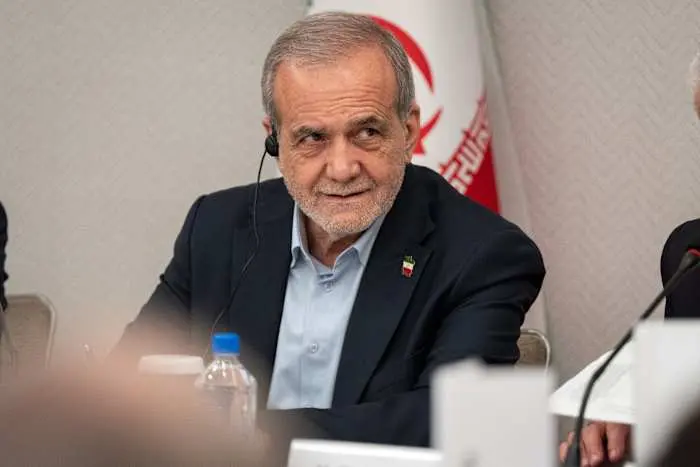
In Tehran, Iranian President Masoud Pezeshkian declared that the Islamic Republic has effectively won its long-standing economic and strategic war against the United States. Speaking through state media, Pezeshkian asserted that the international community has quietly accepted Iran’s resilience, rendering Washington’s aggressive containment policies obsolete. This bold proclamation comes at a critical juncture, as the administration of U.S. President Donald Trump prepares to deploy what officials have termed an "economic D-Day"—a crushing, unprecedented campaign of financial isolation designed to force Iran to halt its nuclear ambitions and fully reopen the vital Strait of Hormuz.
Concurrently, a major diplomatic rift has emerged from within the Trump administration’s own ranks. Tom Barrack, the U.S. Ambassador to Turkey and Special Envoy for Syria, openly contradicted established U.S. foreign policy regarding the Golan Heights. In a widely circulated interview, Barrack characterized the territory as "occupied" by Israel in violation of United Nations resolutions. The remarks directly undermine the landmark 2019 U.S. proclamation recognizing Israeli sovereignty over the Golan Heights, triggering immediate domestic blowback, demands for his resignation, and confusion among key regional allies.
Together, these developments expose a complex dual crisis: a high-stakes economic standoff with a defiant Iran, and an internal policy contradiction that threatens to destabilize Washington’s diplomatic credibility across the Mediterranean and Levant.
Detailed Chronology of the Escalation
[March 2019] -----------------> [Sept 2025] -----------------> [Aug 2026] -----------------> [Aug 2026]
Trump signs Golan               Pezeshkian addresses          Colombia recognizes          Trump admin plans
Sovereignty Proclamation        media in New York             Golan sovereignty            "Economic D-Day"
                                                                                           & Barrack sparks rift
The current diplomatic friction is the culmination of years of shifting alliances, economic warfare, and unilateral foreign policy maneuvers.
The roots of the Golan Heights dispute trace back to the 1967 Six-Day War, when Israel captured the strategic volcanic plateau from Syria, subsequently annexing it in 1981. For decades, the international consensus—anchored by UN Security Council Resolutions 242 and 497—regarded the Golan Heights as occupied Syrian territory. This consensus was disrupted in March 2019 when President Donald Trump signed a historic executive proclamation recognizing Israeli sovereignty over the region.
For years, the United States stood virtually alone in this posture. However, in August 2026, Colombia officially broke ranks with the broader international community to become the second nation to recognize Israeli sovereignty over the Golan Heights, providing a brief diplomatic victory for the joint U.S.-Israeli stance.
Simultaneously, the economic conflict between Washington and Tehran has steadily escalated. Following his return to office, President Trump sought to revive and intensify his "maximum pressure" campaign against Iran. By mid-2026, the White House signaled the imminent launch of an "economic D-Day"—a total blockade of Iranian financial channels and a relentless squeeze on its energy exports. The stated objective was to force Iranian leadership to dismantle its advanced nuclear enrichment programs and cease maritime disruptions in the Strait of Hormuz, a critical chokepoint for global energy markets.
The diplomatic status quo was shattered on Friday, August 21, 2026. In an interview with Lebanese-Australian entrepreneur and media personality Mario Nawfal, U.S. Ambassador Tom Barrack strayed from the official White House line, asserting that Israel "still" occupies the Golan Heights in violation of international law. Within hours of Barrack’s broadcasted comments, Iranian state media published President Pezeshkian’s triumphant address, in which he claimed that the global community had validated Iran’s victory over American economic hegemony, setting off a double-pronged foreign policy crisis for the White House.
Supporting Context & Strategic Metrics
The Strait of Hormuz and the Global Energy Stakes
The economic war between the United States and Iran is not merely a bilateral dispute; it is a conflict with profound implications for global trade. The primary theater of potential physical conflict remains the Strait of Hormuz, a narrow waterway separating the Persian Gulf from the Gulf of Oman.
| Metric | Details |
|---|---|
| Daily Oil Transit | Approximately 20.5 million barrels per day (bpd) of petroleum liquids. |
| Global Consumption Share | Equivalent to roughly 20% of the world’s total petroleum liquid consumption. |
| Key Exporters | Primary maritime corridor for Saudi Arabia, the UAE, Kuwait, Iraq, and Iran. |
| Liquefied Natural Gas (LNG) | Transits over 75 million metric tons of LNG annually, primarily from Qatar. |
Iran’s occasional threats to close or restrict transit through the Strait have historically sent crude oil prices soaring. The Trump administration’s proposed "economic D-Day" aims to strip Tehran of the financial leverage it derives from threatening this chokepoint by imposing secondary sanctions on any nation or corporate entity that purchases Iranian crude or facilitates its maritime shipping logistics.
The Strategic Value of the Golan Heights
The Golan Heights represents a critical geographic buffer zone. Rising roughly 9,000 feet at its highest point, the plateau overlooks northern Israel, southern Lebanon, and southwestern Syria.
- Military High Ground: Control of the heights provides an unparalleled vantage point to monitor military movements in the Syrian plains toward Damascus, which lies just 40 miles to the north.
- Water Security: The region contains the headwaters of the Jordan River and feeds the Sea of Galilee, providing up to a third of Israel’s freshwater supply.
- Geopolitical Alignment: While Colombia’s recent recognition of Israeli sovereignty bolsters the U.S. position, the European Union, the Arab League, and the United Nations continue to reject the annexation, viewing it as a violation of the principle that territory cannot be acquired by force.
Official Statements and Political Fallout
The dual developments have elicited sharp, contrasting responses from state actors, diplomats, and political commentators.
Iran’s Rhetoric of Defiance
Speaking to a domestic audience via the state-run IRNA news agency, President Masoud Pezeshkian sought to project absolute confidence in the face of impending U.S. sanctions:
"The entire world approved our victory and the U.S. is hated. The war with the United States should end because the world has already accepted that Iran has won. We have withstood the worst of their economic fury, and our sovereign independence remains intact."
Analysts suggest Pezeshkian’s rhetoric is designed to bolster domestic morale as the Iranian population braces for the financial shocks of the upcoming U.S. economic offensive. By framing survival as "victory," Tehran seeks to diminish the psychological impact of the Trump administration’s policy of total isolation.
The Barrack Controversy
Ambassador Tom Barrack’s comments during his interview with Mario Nawfal immediately triggered alarm bells within diplomatic circles:
"In the Golan, with Syria, they [Israel] still occupy the Golan, against the U.N. resolutions."
By aligning his language with traditional UN terminology rather than official U.S. policy, Barrack exposed a glaring inconsistency at the highest levels of American diplomacy.
The backlash from the conservative wing of the Republican Party was swift and severe. Prominent activist and close presidential ally Laura Loomer took to social media to demand Barrack’s immediate removal:
"[Tom Barrack] should resign for his lack of understanding of U.S. foreign policy. This is an unacceptable betrayal of our closest ally, Israel, and a direct contradiction of the historic achievements of the Trump administration."
[Tom Barrack Interview]
       │
       ▼
[Conservative Backlash] ──► Laura Loomer: "He should resign..."
       │
       ▼
[State Department Dilemma] ──► Reconcile official policy with Ambassador's statements
The State Department has yet to issue a formal clarification, leaving diplomats scrambling to reassure Israeli counterparts that the official U.S. position recognizing sovereignty over the Golan Heights remains unchanged.
Future Outlook and Diplomatic Implications
The intersection of these two events presents the Trump administration with immediate diplomatic challenges that will reverberate across the Middle East.
The Viability of "Maximum Pressure"
If the United States proceeds with its "economic D-Day," it risks further polarizing its relationship with European and Asian allies who rely on Middle Eastern energy stability. Should Iran respond to increased sanctions by escalating its activities in the Strait of Hormuz, global shipping rates and insurance premiums could skyrocket, potentially triggering a localized energy crisis. Pezeshkian’s assertion that "the world has accepted Iran’s victory" suggests that Tehran may have secured informal economic lifelines, likely through parallel trade networks with China and Russia, blunting the efficacy of unilateral American sanctions.
U.S. Credibility and the Syrian Conflict
As the Special Envoy for Syria, Tom Barrack’s apparent break from official policy severely complicates U.S. mediation efforts in the region. Turkey, where Barrack serves as Ambassador, has long opposed Israeli sovereignty over the Golan Heights and maintains complex ties with Syrian opposition groups and the Damascus government. Barrack’s comments may have been a calculated attempt to align more closely with Ankara’s regional posture; however, the domestic political cost in Washington could render his position untenable.
If Barrack is forced to resign, it will signal a period of instability within the administration’s Middle Eastern diplomatic corps. If he remains, the administration will face persistent questions regarding the coherence of its foreign policy. In either scenario, the incident underscores the difficulty of maintaining a unified diplomatic front in a highly fractured and rapidly evolving geopolitical environment.

0 Comments