
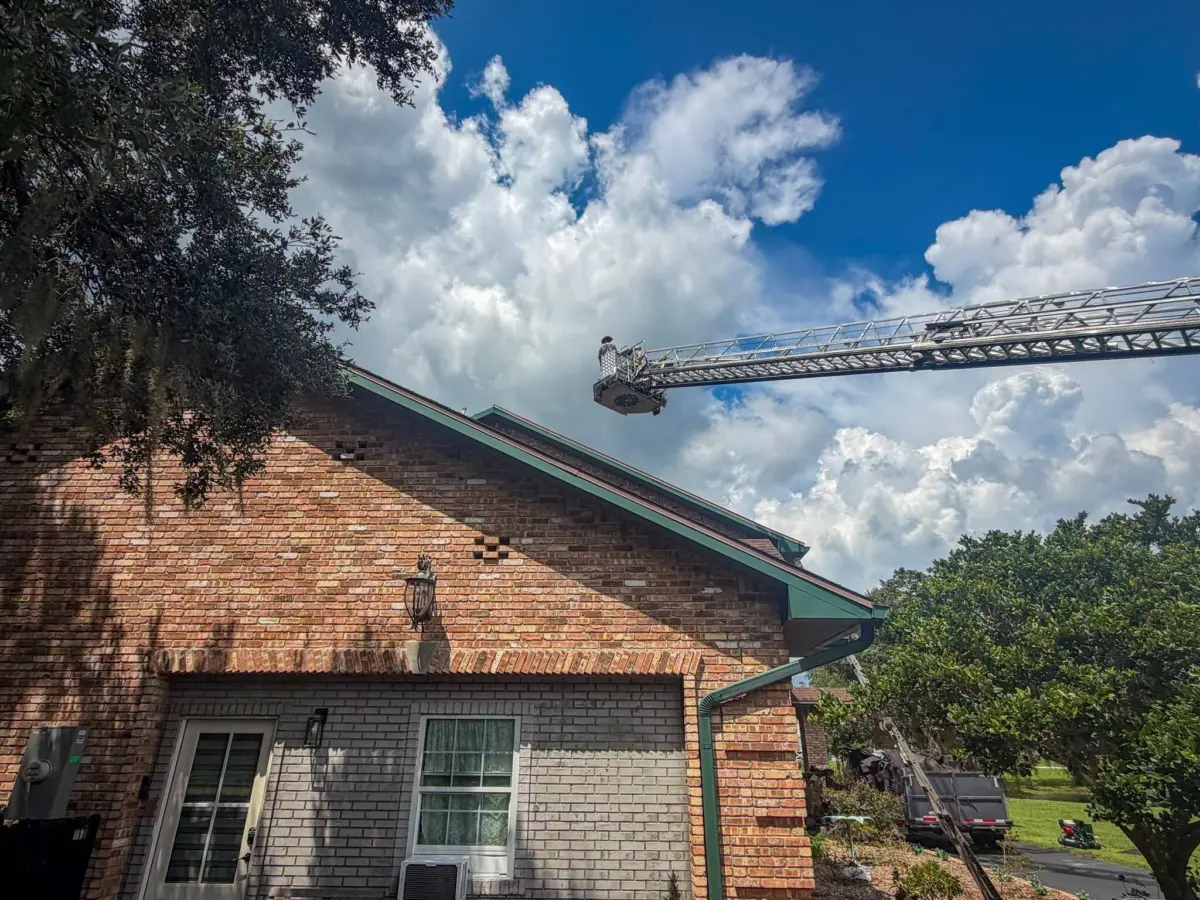

REDDICK, Fla. — A routine workday on a residential property in Marion County took a harrowing turn on Tuesday morning when a man sustained severe electrical injuries after making direct contact with a high-voltage power line. The incident, which occurred just before noon at a two-story home situated along Northwest Highway 225, drew a swift and coordinated response from local fire rescue and emergency medical services.
First responders faced a complex and hazardous extraction on the roof of the structure before successfully transporting the victim to a regional medical facility as a high-priority trauma patient. The event has reignited critical conversations regarding occupational safety, residential electrical hazards, and the paramount importance of strict clearance protocols when working near overhead utility lines.
Executive Overview
The emergency call was logged by Marion County dispatchers shortly before 12:00 PM on August 25, 2026. Units from Marion County Fire Rescue (MCFR), alongside local law enforcement and utility technicians, were dispatched to a residential address on Northwest Highway 225 in Reddick, Florida, following reports of an electrocution.
Upon arrival, emergency personnel discovered an adult male incapacitated on the roof of a two-story residential building. Initial assessments confirmed that the victim had inadvertently come into physical contact with an active overhead power line. Due to the inherent dangers of residual current, structural instability on the roof, and the elevated position of the patient, first responders had to execute a specialized, methodical rescue operation to bring the victim down safely.
Once secured, the man was triaged at the scene and immediately rushed to a local hospital for advanced trauma care. While specific details regarding his current medical status and identity have been withheld pending family notification and ongoing investigations, officials have classified his injuries as severe. Local authorities, utility representatives, and safety regulators are currently reviewing the circumstances leading up to the accident to determine whether safety regulations or industry standards were breached.
Detailed Chronology of Events
The Approach and Incident
While the exact nature of the work being performed on the roof at the time of the incident has not been fully detailed in preliminary incident logs, witnesses and initial dispatch reports indicate the victim was actively engaged in maintenance or construction activities on the upper level of the two-story residence.
At approximately 11:55 AM, emergency services received a frantic 911 call reporting that a worker had been shocked by an overhead electrical wire. Electrical injuries of this magnitude typically occur when a conductive tool, a piece of metal framing, a ladder, or a body part bridges the gap between an energized conductor and a grounded surface, completing an electrical circuit through the human body.
The Emergency Response
Marion County Fire Rescue units arrived on the scene within minutes of the initial alert. First responders faced a multifaceted tactical challenge:
- Electrical Hazard Mitigation: Before any physical contact with the victim could be safely established, rescue crews had to coordinate with the local electric utility provider to verify whether the service drop or distribution line connected to or passing near the home was fully de-energized. Approaching a victim in contact with a live circuit poses a fatal risk of secondary electrocution to emergency personnel.
- Elevated Extrication: With the patient located on the roof of a two-story building, standard ground-level medical interventions were impossible. Firefighters utilized specialized ladder trucks and rigging equipment to access the roof safely.
- Trauma Stabilization: Paramedics performed rapid assessment and life-saving stabilization protocols directly on the rooftop before packaging the patient for a controlled descent.
Transport and Immediate Aftermath
By early afternoon, the patient was successfully lowered from the roof and transferred to an awaiting ambulance. Transported under emergency conditions as a trauma patient, he was admitted to a designated area hospital specializing in acute emergency and critical care medicine.
With the scene secured, utility crews worked to inspect the damaged infrastructure and restore normal service to the immediate neighborhood, while investigators from local safety agencies began examining the physical evidence, measuring clearances, and interviewing witnesses to reconstruct the timeline of the accident.
Supporting Context & Metrics
Occupational Safety and Electrical Hazards
Incidents involving overhead power lines remain one of the leading causes of workplace fatalities and severe injuries in the construction, roofing, and property maintenance sectors. According to data compiled by the U.S. Bureau of Labor Statistics (BLS) and the Occupational Safety and Health Administration (OSHA), electrical hazards account for hundreds of injuries and dozens of fatalities nationwide each year, with overhead power lines representing a disproportionate share of high-voltage accidents.
When individuals work at elevated heights—such as on roofs, scaffolding, or ladders—the risk profile increases exponentially due to several compounding factors:
- Proximity to Service Drops: Residential homes are frequently serviced by overhead drop lines running from utility poles to the structure. These lines often carry standard household voltages (120V to 240V) or higher secondary distribution voltages, which are more than sufficient to cause ventricular fibrillation, severe internal burns, and fatal cardiac arrest.
- Environmental Conductivity: Sweat, metal tools, aluminum ladders, and damp roofing materials drastically reduce the human body’s electrical resistance, making even a momentary brush with a live wire catastrophic.
- The "Fall and Shock" Dynamic: Electrocution often causes immediate muscle tetany (involuntary contraction), preventing the victim from letting go of the conductor. Furthermore, the shock frequently induces a fall from height, resulting in blunt-force trauma that can equal or exceed the internal damage caused by the electrical current itself.
Regional Infrastructure in Marion County
Reddick, situated in the northern portion of Marion County, is characterized by a mix of historic properties, rural homesteads, and suburban residential developments. Many older properties feature mature landscaping and legacy utility infrastructure where overhead lines run in close proximity to rooflines, chimneys, and second-story facades.
Utility companies across Central Florida operate under strict vegetation management and clearance mandates, but property owners, independent contractors, and maintenance workers must remain eternally vigilant regarding the physical distances between work areas and electrical conductors.
Official Statements and Regulatory Oversight
As of late Tuesday, local emergency management and fire rescue officials have emphasized the critical nature of situational awareness when operating near electrical infrastructure.
"Working at heights near active utility lines demands extreme caution and absolute adherence to safety buffers," noted a local emergency response spokesperson. "A split-second lapse in spatial awareness or an unexpected shift in equipment can lead to life-altering or fatal consequences. We urge all contractors, homeowners, and maintenance personnel to treat every overhead line as live and dangerous."
Investigation and Jurisdiction
Because the incident occurred on private residential property during what appears to be contracting or maintenance work, multiple entities may launch reviews into the occurrence:
- Marion County Fire Rescue & Law Enforcement: Focused on the immediate emergency response, initial incident documentation, and ruling out any criminal negligence or foul play.
- Occupational Safety and Health Administration (OSHA): If the victim was operating as an employee of a registered business, OSHA holds federal jurisdiction to investigate whether proper safety training, personal protective equipment (protective grounding, non-conductive ladders), and minimum approach distance protocols (as outlined in OSHA Standard 1910.333 and related construction standards) were enforced by the employer.
- Local Utility Provider: Conducting a parallel technical review of the service lines, meters, and connection points involved in the incident to ensure structural and electrical integrity.
Future Outlook: Prevention and Safety Recommendations
The tragic event on Northwest Highway 225 serves as a stark, sobering reminder of the invisible dangers lurking in everyday work environments. Moving forward, community safety advocates and industry professionals are amplifying calls for rigorous preventative education.
Key Safety Guidelines for Working Near Power Lines
- Maintain Safe Distances: OSHA mandates a minimum clearance of at least 10 feet for most overhead power lines operating at 50 kilovolts or less, with greater distances required for higher-voltage transmission lines. For non-electrical workers, maintaining an even wider buffer is strongly advised.
- Utilize Non-Conductive Equipment: When working on roofs, scaffolding, or near service drops, workers must avoid the use of aluminum ladders, metal poles, or uninsulated tools that can easily bridge electrical gaps. Fiberglass or wooden ladders—when properly rated and maintained—offer safer alternatives, though distance remains the primary defense.
- Request Temporary De-Energization: Prior to undertaking extensive roof repairs, painting, or remodeling near service drops, contractors should contact the local utility provider to discuss temporary line covers ("line guards" or "oser guards") or temporary service disconnection.
- Comprehensive Training: Employers must ensure that all field personnel undergo thorough hazard recognition training, emphasizing that electrical lines do not need to be touched directly to cause injury; electricity can arc across small air gaps if conductors are brought too close.
As the injured man continues his recovery in the hospital, the community of Reddick and the broader Marion County region are left reflecting on the fragility of life and the unyielding necessity of workplace safety compliance. Further updates regarding the victim’s recovery and the formal findings of the safety investigation will be reported as information becomes available.

0 Comments