

Executive Overview
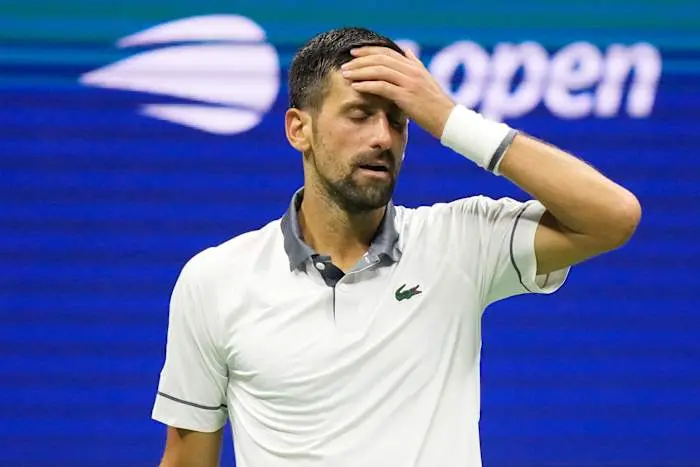
NEW YORK — In a twilight clash that shook the foundations of professional tennis, 24-time Grand Slam champion Novak Djokovic bowed out of the U.S. Open in a stunning first-round defeat on Sunday night. Battling mounting physical ailments, internal sickness, and a relentless 25-year-old opponent, the 39-year-old Serbian icon fell 7-6 (5), 5-7, 4-6, 6-2, 6-1 to Argentina’s Mariano Navone.
The grueling four-hour and thirty-six-minute marathon, ending mere minutes before midnight under the bright lights of Arthur Ashe Stadium, marked the longest opening match of a Grand Slam in Djokovic’s storied career. More significantly, it represents his earliest exit at a major tournament in two decades—dating back to the 2006 Australian Open—and the first time in his illustrious history that he has suffered a first-round defeat at Flushing Meadows.
Coming exactly 21 years to the day of his U.S. Open main-draw debut, the shock defeat has immediately triggered widespread speculation across the sporting world. As Djokovic packed his bags and walked off the iconic New York court, fans, analysts, and peers alike were left grappling with a profound, lingering question: Was this the final time we will ever see the greatest of all time compete on a Grand Slam stage?
Detailed Chronology of the Match
From the opening games, it was clear that this would not be a routine opening-round encounter for the tournament’s No. 4 seed. Despite entering the match visibly under the weather, Djokovic initially asserted his legendary dominance, racing out to comfortable 3-0 and 4-1 leads in the opening set.
However, uncharacteristic errors quickly began to mount. Navone, playing with the fearless abandon of a player facing his childhood idol on the sport’s grandest stage, capitalized on Djokovic’s lapses in concentration and physical energy. The young Argentine clawed his way back into the opening frame, eventually taking it in a tense tiebreak 7-6 (5). It was the first time Djokovic had dropped the opening set of a U.S. Open first-round match since 2006.
As the match wore on into the New York humidity, the toll on Djokovic’s body became glaringly apparent. Television cameras captured the tennis legend throwing up at least once during a changeover. Between the fourth and fifth sets, a medical doctor was summoned to the court. Djokovic was administered oral medication, and a trainer vigorously massaged his lower back while the veteran grimaced in pain, periodically clutching his left foot as apparent cramping set in.
Despite his physical distress, Djokovic’s competitive spirit flickered brightly through the middle sets. With his wife, Jelena, watching anxiously from the player’s box, the 24-time major champion engineered a gritty comeback. He secured the second set 7-5, offering a subdued fist pump to acknowledge the turning tide. In the third, he captured a 6-4 victory, cupping his hand to his ear to draw energy from a captivated crowd that sensed they were witnessing a monumental struggle of grit versus youth.
Yet, the physiological deficit proved insurmountable. Navone, who claimed his maiden ATP singles title earlier this year, refused to fold. By the fourth set, Djokovic’s movement visibly deteriorated; after firing a shot wide, he landed awkwardly and dropped his racket in frustration, essentially conceding the fourth set 6-2 to conserve whatever energy remained for a final push.
It was not to be. Navone dominated the decisive fifth set, breaking Djokovic early and often to cruise to a 6-1 victory. As the final ball dropped, the Argentine dropped to his knees in disbelief, securing the 43rd five-set victory of his career—and his first-ever win against the sport’s ultimate benchmark.
Supporting Context & Metrics: A Statistical Autopsy
The numbers behind Sunday night’s defeat paint a grim picture of a champion fighting a losing battle against both time and biology:
- Unforced Errors: Djokovic committed a staggering 70 unforced errors over the course of the match, highlighting his inability to find a consistent rhythm or sustain baseline pressure.
- Duration: At 4 hours and 36 minutes, the match stands as the longest first-round Grand Slam outing of Djokovic’s career.
- Historical Precedent: Prior to Sunday, Djokovic boasted a pristine 17-0 record in U.S. Open first-round matches. His last opening-round exit at any major occurred 20 years ago at Melbourne Park.
- Recent Form: This defeat compounds an increasingly turbulent summer for the veteran. It follows a shock first-round exit at the hardcourt tune-up event in Cincinnati earlier in August, which itself followed a semifinal loss to world No. 1 Jannik Sinner at Wimbledon.
For Navone, the statistics represent a life-altering breakthrough. The 25-year-old from 9 de Julio, Argentina, secured the biggest win of his professional life, improving his career record in five-set matches to 1-0 while permanently etching his name into tennis lore.
Official Statements and Reactions
The emotional spectrum of the post-match press conference and court interview captured the magnitude of the upset.
"It was very tough for me because you are playing with the ‘GOAT’ on this court," Mariano Navone reflected during his on-court interview, visibly overwhelmed. "For sure, it’s the best thing I’ve had on court. This is an amazing court and the biggest stage. It’s amazing, the way we play. I mean, five sets… I’m very happy. I don’t know. What can I say? This means a lot. It’s a dream come true."
Djokovic, speaking to reporters in the early hours of Monday morning, was candid about the physical walls he hit during the match. Visibly drained, he acknowledged that the internal sickness and physical soreness severely compromised his ability to execute his game plan.
The tennis world was quick to react. Analysts noted that while Djokovic expressed optimism on Saturday that his early exit in Cincinnati would grant him extra training blocks to peak in New York, the strategy ultimately backfired. The reality of modern men’s tennis—defined by punishing baseline power, relentless athletic conditioning, and an aggressive cohort of young challengers—has made surviving early-round marathons an increasingly formidable challenge for players in the twilight of their careers.
Future Outlook: What Lies Ahead for the Legend?
As the dust settles on Arthur Ashe Stadium, the tennis ecosystem is forced to contemplate a landscape without Novak Djokovic at the absolute pinnacle.
Djokovic has spent the better part of two decades rewriting the sport’s record books, capturing 24 Grand Slam singles titles and standing as the last remaining active member of the legendary "Big Three" alongside Roger Federer and Rafael Nadal. However, the physical toll of sustaining this level of excellence into his late thirties has become impossible to ignore.
In his pre-tournament press conferences, Djokovic admitted that navigating the opening rounds of major tournaments has grown progressively more difficult as his body demands longer recovery windows between matches. This latest defeat—characterized by physical collapse, tactical frustration, and an inability to sustain high-intensity play across five sets—raises serious doubts about his future motivations.
Will Djokovic undergo rigorous rehabilitation, nurse his battered body back to health, and return to Melbourne in January 2027 to chase a record-breaking 25th major? Or will the grueling reality of Sunday night serve as the quiet, melancholy final chapter of his unmatched career at Flushing Meadows?
For now, the sport waits in suspense, fully aware that even the most resilient titans eventually must bow to the passage of time.

0 Comments