
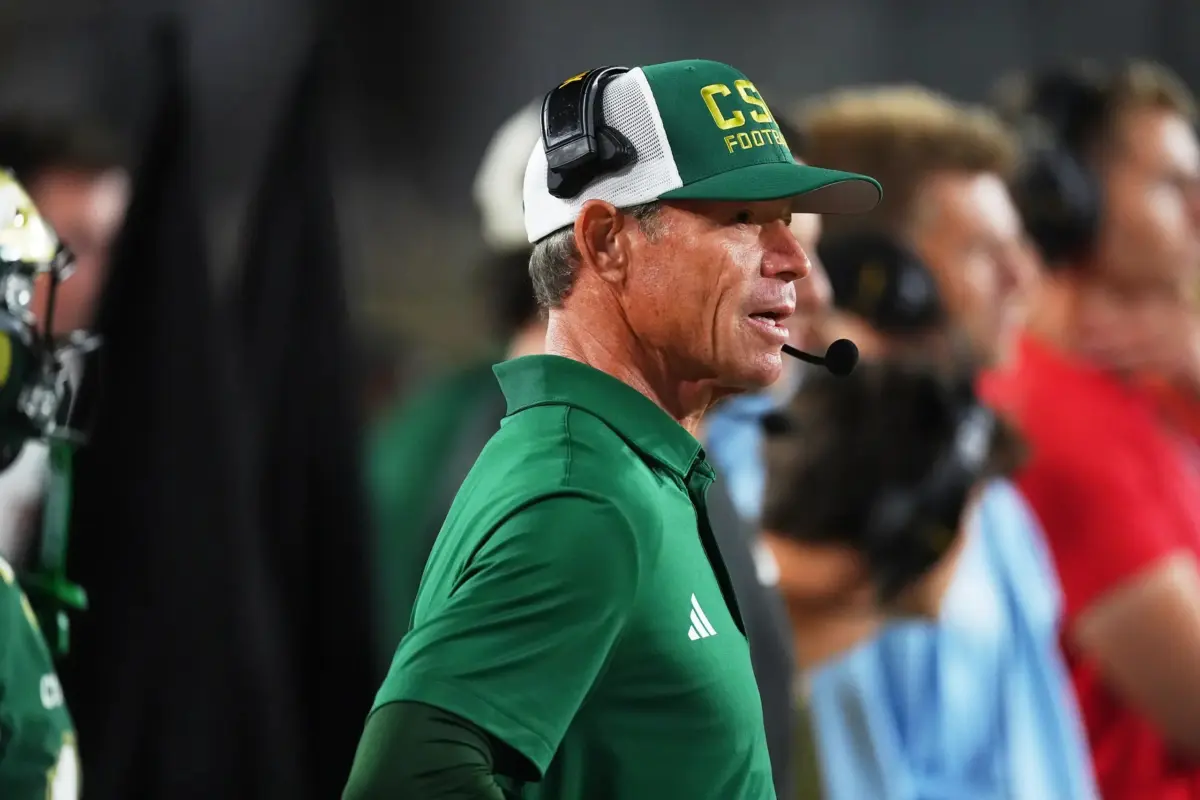

In the high-stakes, pressure-cooker environment of Football Bowl Subdivision (FBS) college football, coaching staffs operate on razor-thin margins. Rarely, however, does a single game unravel so completely that a coordinator vanishes from the sideline mid-contest, resulting in an immediate and permanent termination. That was the surreal reality on Saturday evening in Fort Collins, Colorado, where the Colorado State Rams suffered a humbling 56–26 defeat at the hands of the Oregon State Beavers.
The blowout loss served as the explosive catalyst for a dramatic internal crisis. In the opening half of the contest, as the Oregon State offense systematically dismantled the Rams’ defensive schemes, head coach Jim Mora stripped defensive coordinator Tyson Summers of his play-calling duties. What followed, however, transcended a routine in-game tactical demotion. As the defensive collapse deepened, Summers abruptly abandoned the sideline entirely. By the time the final whistle mercifully sounded at Canvas Stadium, Mora confirmed to a stunned media contingent that the veteran assistant’s tenure with the program was permanently over.
"That is a permanent move that was made following tonight’s game," Mora stated bluntly during his post-game press conference. Clarifying the chaotic sequence of events, Mora noted that while he had made the executive decision to strip Summers of play-calling responsibilities mid-game, he had not ordered his assistant to leave the field. "He made the decision on his own to leave the field, and he is no longer with the program."
This extraordinary public implosion underscores a defense in complete freefall. Colorado State (2-3) has surrendered a staggering 193 points over its first five games of the 2026 season—an abysmal average of 38.6 points per game. The defense’s inability to stop opponents has not only jeopardized the Rams’ competitive trajectory but has also thrust Mora’s first-year rebuilding project into profound turmoil. For Summers, a college football journeyman with more than two decades of coaching experience across high-profile Power Four and Group of Five programs, the sudden departure writes an unceremonious and turbulent final chapter to his time in Fort Collins.
Detailed Chronology of a Sideline Collapse
The events of Saturday, Sept. 19, 2026, began innocently enough under the clear Colorado skies, but the atmosphere inside Canvas Stadium quickly soured as Oregon State’s offense took the field. The Beavers came into the matchup with a clear game plan to exploit the vulnerabilities that had plagued Colorado State’s defense all season.
From the opening kickoff, the Rams looked flat-footed and structurally compromised. Oregon State’s offensive scheme routinely caught Colorado State out of position, gashing the front seven for sizeable runs and exposing the secondary in single-coverage mismatches. By the end of the first quarter, it was evident that Summers’ defensive strategy was failing to stem the tide. Missed tackles, blown assignments, and a complete lack of pass rush allowed the Beavers to march down the field almost at will.
As the score quickly mounted in the second quarter, the tension on the Colorado State sideline reached a boiling point. Head coach Jim Mora, observing a defense disintegrating in real-time, intervened. Making a drastic mid-game pivot, Mora stripped Summers of his play-calling duties, opting to hand the defensive play sheet to another member of the staff to steady the ship.
However, the intervention triggered an unforeseen fracture. Rather than weathering the storm alongside his fellow coaches on the sideline, Summers took off his headset and made the unilateral decision to depart the field of play entirely. He retreated to the locker room area, leaving his defensive unit leaderless on the bench during one of the most difficult stretches of the game.
Down on the field, the team continued to spiral. The emotional shock of the coordinator’s mid-game abandonment seemed to ripple through the squad. Oregon State capitalized on the disarray, converting third downs with ease and building an insurmountable lead. By halftime, the game was effectively out of reach at 35-13, and the collective attention of the stadium had shifted from the scoreboard to the glaring absence of the defensive coordinator.
When the clock finally expired on the 56–26 rout, the post-game media session became an impromptu tribunal. Mora, visibly exhausted and confronting the harshest crisis of his tenure in Fort Collins, did not attempt to mask the severity of the situation. He addressed the elephant in the room immediately, laying bare the chain of events that led to Summers walking away from the team for good. The swiftness of the fallout signaled that the internal fractures within the Colorado State coaching staff had grown far too wide to bridge.
Supporting Context & Metrics: A Statistical Disasters
To understand why a mid-game mutiny and immediate firing occurred, one must examine the broader statistical catastrophe that has defined the Colorado State defense throughout the 2026 campaign. Saturday’s 56-point, 426-yard concession to Oregon State was not an isolated aberration; rather, it was the violent culmination of structural defensive failures that have spanned weeks.
Through five games, the numbers paint a grim picture:
- Total Points Allowed: 193 points
- Points Per Game Average: 38.6 PPG
- Record: 2–3
Just one week prior to the Oregon State debacle, the Rams suffered an equally alarming 59–45 shootout loss against UTSA. In that contest, Colorado State’s defense was repeatedly exposed in space, unable to contain explosive plays or generate crucial third-down stops. Over a two-game stretch against UTSA and Oregon State, the Rams’ defense surrendered a combined 115 points. Opposing offenses have found facing Colorado State to be a stress-free exercise, routinely exploiting soft coverages, failing run fits, and a stagnant pass rush that has rarely forced opposing quarterbacks out of their comfort zones.
The defensive regression is particularly stark when viewed through the lens of Summers’ long tenure in the sport. Over a coaching career spanning more than 20 years, Summers has held prominent defensive and coaching roles at major institutions, including stints at the University of Florida, the University of Georgia, and the University of Colorado. His resume boasts extensive experience at the highest levels of collegiate football, making his inability to stabilize the Colorado State defense all the more puzzling to analysts and fans alike.
Furthermore, Summers’ history in Fort Collins added layers of complexity to his retention. Following the dismissal of former head coach Jay Norvell last season, Summers stepped into the breach as the interim head coach for the final five games of the year. When Jim Mora was subsequently hired to steer the program into a new era, Mora chose to retain Summers, tasking the veteran assistant with turning the defense around. Instead of a defensive renaissance, the partnership resulted in historic defensive vulnerabilities, culminating in Saturday’s unprecedented exit.
Official Statements and Insider Perspectives
The fallout from Saturday’s meltdown triggered a wave of reactions from the athletic department, the coaching staff, and college football analysts tracking the Mountain West Conference.
Jim Mora’s post-game press conference provided a transparent, albeit jarring, account of the dysfunction. Known for his candid and fiery demeanor, the first-year Rams head coach did not mince words when explaining the rationale behind the permanent separation.
"That is a permanent move that was made following tonight’s game," Mora told reporters, addressing the dismissal head-on. Elaborating on the sequence that saw Summers walk off the field, Mora added: "I made the decision to relieve him of his play-calling duties during the first half. Taking away his play-calling wasn’t anything that I would ever consider [forcing him off the sideline]. He made the decision on his own to leave the field, and he is no longer with the program."
Mora’s comments underscored a profound breach of trust. In the ecosystem of a competitive football team, coordinators and assistants are expected to weather adversity alongside the players, particularly when strategies fail. By removing himself from the sideline mid-game, Summers effectively abdicated his leadership responsibilities, rendering his position untenable in the eyes of the head coach.
Athletic department officials have remained relatively tight-lipped regarding the long-term structural changes that will follow, but sources close to the program indicate that an internal restructuring is already underway. Players, meanwhile, are left to process the emotional whiplash of losing a coordinator under such dramatic circumstances while simultaneously preparing for the remainder of a demanding conference schedule.
Future Outlook: Rebuilding on the Fly
As the dust settles on one of the most bizarre Saturday nights in recent college football history, Colorado State faces an arduous path forward. With a 2-3 record and the conference slate looming large, the Rams cannot afford to dwell on the drama of Summers’ departure. The immediate priority for Jim Mora and his remaining staff is to plug the massive leaks in a historically porous defense.
Rebuilding a defense mid-season is one of the most difficult challenges a coaching staff can face. Without the luxury of a bye week to completely install a new scheme, the Rams will likely have to simplify their defensive playbooks, relying on basic alignments and increased effort to mask personnel deficiencies. Promoting from within or redistributing responsibilities among defensive assistants will be Mora’s first order of business as the team prepares for its next opponent.
For Jim Mora, the crisis represents a severe early test of his leadership in Fort Collins. Tasked with revitalizing a dormant program, Mora staked a portion of his initial staff construction on a veteran coach with deep ties to the region. That gamble backfired spectacularly on national television. How the Rams respond in the coming weeks will determine whether the 2026 season spirals completely out of control or whether the decisive removal of a failing coordinator can serve as the shocking, necessary reset for a team desperate to find its defensive identity.

0 Comments