
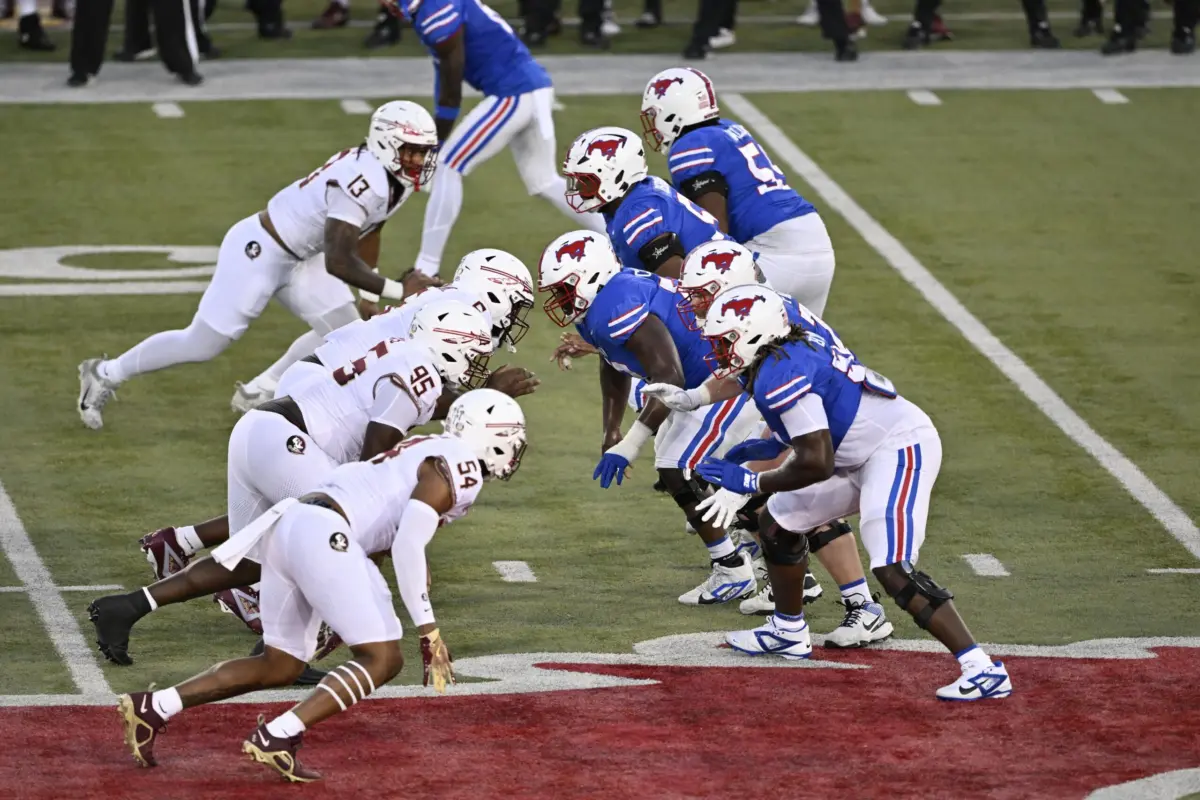

As the college football calendar turns its attention to the culmination of Week 1, a marquee Labor Day primetime matchup looms large at Doak Campbell Stadium. The Florida State Seminoles (1–0, 0–0 ACC) are set to host the preseason No. 19-ranked SMU Mustangs (0–0, 0–0 ACC) on Monday evening, in a nationally televised broadcast carried by ESPN at 7:30 p.m. ET.
This high-profile conference clash represents only the second-ever meeting between the two institutions. Their previous encounter came during the 2024 campaign in Dallas, where the Mustangs comfortably dispatched the Seminoles 42–16. For Florida State, this primetime showcase offers an immediate opportunity to rewrite the narrative following an unconvincing season-opening performance. Meanwhile, SMU enters its third year as a member of the Atlantic Coast Conference looking to reassert the national relevance that carried them to the inaugural 12-team College Football Playoff in 2024.
Beneath the glittering lights of a national television broadcast, however, lies a contest fraught with tactical intrigue, roster turnover, and fascinating structural questions. SMU arrives in Tallahassee under the guidance of fifth-year head coach Rhett Lashlee, navigating a unique transition after parting ways with its long-standing offensive and defensive coordinators. Conversely, Florida State is desperate for rapid, foundational improvements along both lines of scrimmage if head coach Mike Norvell’s squad hopes to avoid another home-field heartbreak. With historical scheduling quirks, heavy public betting trends, and contrasting team trajectories colliding in Tallahassee, this Labor Day showdown promises to shape the early-season landscape of the ACC.
Detailed Chronology and Matchup History
The historical ledger between Florida State and SMU is remarkably sparse. Despite rich histories on both sides—featuring storied decades of national prominence, Heisman Trophy winners, and eras of immense regional pride—the programs have shared a gridiron just once. That historic 2024 matchup saw SMU dismantle FSU 42–16, establishing an early psychological and physical upper hand in what has quickly blossomed into a compelling conference rivalry.
The path to this 2026 meeting has tested both programs in vastly different ways. SMU’s integration into the ACC has been nothing short of a sporting and financial marvel. After ending their debut 2024 ACC schedule with an unblemished 8–0 regular-season record, the Mustangs followed up in 2025 with a stellar 6–2 conference mark. That record could easily have been an unblemished repeat were it not for a heartbreaking one-point loss to Wake Forest and a late-game touchdown by California with just 43 seconds remaining—a sequence that ultimately derailed their repeat College Football Playoff aspirations, despite a signature victory over then-10th-ranked Miami.
For Florida State, the journey has been far more turbulent. The Seminoles limped out of the gate in their 2026 season opener, laboring to a 34–17 victory as heavy 31-point favorites against New Mexico State. Far from a dominant wire-to-wire triumph, FSU found itself locked in a nervy 17–10 battle deep into the third quarter. It wasn’t until the midway point of the fourth frame that the Seminoles finally exerted their superior athleticism to pull away.
Now, FSU must pivot quickly from an underwhelming tune-up to face a veteran, battle-tested SMU squad that has spent the entire offseason scheming for this exact primetime window.
Supporting Context and Metrics: Roster Dynamics & Coaching Shifts
The SMU Outlook: Continuity at Quarterback, Questions on the Line
SMU’s offensive engine is anchored by third-year starting quarterback Kevin Jennings. Jennings reportedly recovered cleanly from a minor index finger injury on his throwing hand—sustained during a locker room incident in fall camp that caused him to miss two crucial weeks of practice—and is locked in to start the opener. FSU fans harbor vivid memories of Jennings from the 2024 blowout, where he carved up the Seminole secondary by completing 16 of 23 passes for 254 yards, a career-high three touchdowns, and zero interceptions, guiding the Mustangs to a staggering 458 total yards of offense.
However, Jennings will be operating behind an offensive unit that must replace significant production. The Mustangs have turned the page on their top two running backs, four primary pass-catchers (two wide receivers and two tight ends), and two starting offensive linemen.
Despite these departures, SMU boasts a formidable foundation up front. Three returning starters form what scouts consider one of the conference’s premier offensive line units:
- PJ Williams: Second-Team All-ACC left tackle, preseason All-ACC selection, and Outland Trophy Watchlist member.
- Joshua Bates: All-ACC honorable mention center, preseason All-ACC pick, and a dual nominee for the Outland and Rimington Trophies.
- Addison Nichols: A high-impact transfer addition from Tennessee and Arkansas anchoring the right guard spot.
Defensively, SMU is leaning heavily on linebacker experience. Led by standout playmaker Alexander Kilgore, the Mustangs return all three starting linebackers. While heavy personnel losses hit the defensive line and secondary hard through graduation and the transfer portal, head coach Rhett Lashlee aggressively restocked the unit with experienced FBS transfers. Notable among these returns is first-team All-ACC safety Ahmaad Moses, who secured an extra fifth year of eligibility.
The Coaching-by-Committee Experiment
Perhaps the most fascinating subplot of this matchup involves SMU’s coaching staff architecture. Following the 2025 season, offensive coordinator Casey Woods departed to become the head coach at Missouri State, while defensive coordinator Scott Symons accepted an assistant coaching role with the Dallas Cowboys.
Rather than executing a traditional external hire, Rhett Lashlee made the bold decision to forgo traditional coordinators entirely:
- The Offense: Run by a collaborative committee consisting of the offensive line coach, wide receiver coach, and quarterback coach, each maintaining their individual position-group responsibilities.
- The Defense: Managed via co-defensive coordinators, with one coach handling in-game play-calling duties and the other directing the secondary.
For Florida State, exploiting any communication lapses or structural confusion in SMU’s novel coaching committee represents a prime strategic opening.
Florida State’s Roster Realities
The Seminoles possess undeniable skill-position talent surrounding quarterback Ashton Daniels. Playmakers such as Duce Robinson, Micahi Danzy, Landen Thomas, Sam Singleton Jr., and Ousmane Kromah possess the explosive capability to break a game open. Yet, the persistent query surrounding Mike Norvell’s team remains consistency: Can the offensive line establish a reliable push, and can Daniels orchestrate sustained, error-free drives?
Defensively, FSU’s performance against New Mexico State raised red flags. The Seminoles struggled to generate a consistent pass rush and surrendered critical third-and-long conversions, exposing a "bend-don’t-break" philosophy that drew sharp criticism from analysts and fans alike. To stifle Kevin Jennings and a disciplined SMU offense, the Seminole defense must execute at a vastly higher level.
Statistical Landscape & Analytical Trends
As kickoff approaches, historical data and betting markets paint a multifaceted picture of how this Labor Day contest might unfold:
- The Game-One Rest Advantage: Statistically, teams that have already played a live game cover the point spread approximately 56% of the time when facing an opponent playing its season opener.
- Home Underdog Dynamics: Over the past four seasons, home underdogs of 3.5 points or less have won outright roughly 47% of the time. While the line has nudged in SMU’s favor due to heavy public backing, historical value often leans toward the home side in primetime environments.
- Doak Campbell Resilience: Despite recent frustrations, Florida State has quietly compiled a respectable 6–2 record at home over its last eight games, with their only two losses coming by a combined margin of nine points against elite competition.
- Lashlee’s Season-Opener Trends: Under Rhett Lashlee, the Mustangs have historically navigated early non-conference challenges well, but this marks their first true road test against a historic power-conference brand under the new committee-coaching framework.
Official Statements and Insider Perspectives
The sentiment surrounding the program was eloquently captured by long-time Tomahawk Nation member and guest picker Topnole, who reflected on the shifting tides in Tallahassee:
"In my time at FSU, SMU football didn’t exist, as the NCAA gave them the ‘death penalty’… Moreover, any team coming to Tallahassee expected a 60-minute slugfest at best… My, how things have changed. Before Saturday, I was starting to feel good about FSU football based on a few positive articles I read about the big guys in the trenches… However, it would seem that yet another year of blind optimism quickly turned to pessimism and concern. Anyone watching Saturday knows we need significant progress (and quickly) from the O and D lines."
Topnole emphasized that the game ultimately hinges on line-of-scrimmage execution:
"If the O-line can block and not hold, if the D-line gets pressure and can stop the run, and if we eliminate some of the miscommunication in the secondary… If all of these happen, I think we win."
Ultimately, skepticism surrounding FSU’s trench play led him to project a 38–21 victory for the Mustangs, highlighting the challenge Florida State faces in matching SMU’s depth and veteran poise.
Future Outlook: Stakes Beyond Monday Night
Win or lose, the implications of this Labor Day matchup extend far beyond the Doak Campbell Stadium scoreboard.
For SMU, a victory in Tallahassee validates their seamless transition into the upper echelon of the Atlantic Coast Conference, reinforcing that the departure of their former coordinators has not hampered their competitive edge. It keeps the Mustangs firmly in the conversation for an expanded College Football Playoff berth and sends a clear message to traditional ACC heavyweights.
For Florida State, the stakes are existential. A polished, disciplined performance—even in a hard-fought defeat—could restore faith in Norvell’s developmental trajectory and prove that the offensive and defensive line concerns exposed against New Mexico State are correctable. Conversely, another disjointed, penalty-marred collapse on national television would plunge the program into early-season turbulence, compounding the pressure as the Seminoles prepare for the grueling remainder of their schedule.
As the stadium lights ignite and the ESPN broadcast goes live, two divergent visions of college football will collide. Whether Florida State can leverage the "Doak Effect" to engineer a statement upset, or if SMU’s veteran composure and high-powered offense will storm Tallahassee, remains the ultimate question of Week 1.

0 Comments