
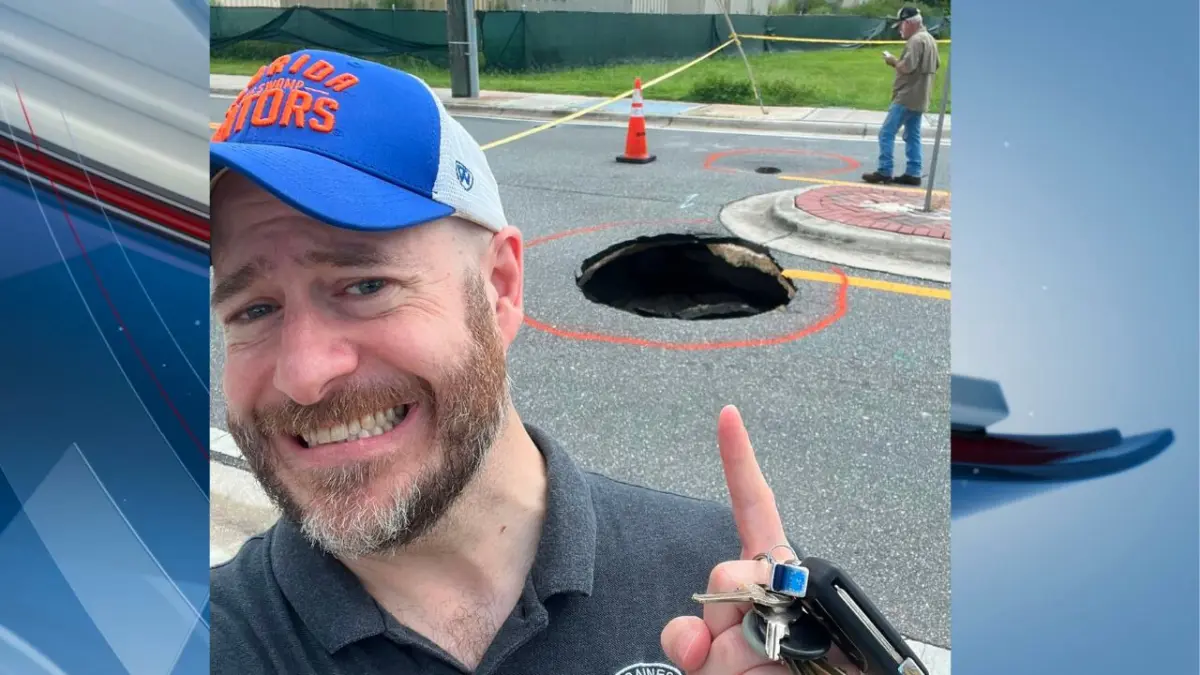

GAINESVILLE, Fla. — On Saturday afternoon, the fragile subterranean landscape of North-Central Florida made its presence felt once again. City officials, Gainesville Public Works crews, and local law enforcement officers were forced into a rapid-response mobilization following the sudden appearance of a hazardous sinkhole near a high-traffic urban corridor. The collapse, which materialized along Southwest Fourth Avenue and Sixth Street, prompted immediate emergency closures and ignited fresh concerns regarding aging municipal infrastructure, severe weather vulnerabilities, and the long-term structural resilience of the Gainesville roadway network.
The incident drew immediate public attention when Gainesville City Commissioner Casey Willits took to social media to document the hazard. Publishing a photograph that highlighted the stark scale of the ground failure—featuring the commissioner pointing directly at the jagged void—Willits and city departments urged motorists, pedestrians, and celebrants returning from local athletic events to steer entirely clear of the immediate vicinity.
While public works teams managed to initiate emergency remediation efforts before nightfall, the emergence of the sinkhole highlights a pervasive and recurring peril across Florida. Built largely upon a soluble limestone foundation known as karst topography, the region remains continuously vulnerable to catastrophic ground collapses. This comprehensive report explores the chronology of the Saturday afternoon response, the underlying geological and infrastructural context governing sinkhole formation in Alachua County, official statements from city leadership, and the proactive measures municipal engineers must adopt to safeguard Gainesville’s evolving urban core.
Detailed Chronology of the Emergency Response
The Opening Hours: Discovery and Initial Alerts
The sequence of events on Saturday, September 6, 2026, began with an unexpected disruption to normal weekend traffic patterns in downtown Gainesville. Although precise subterranean shifts likely occurred overnight or during the early morning hours, the surface manifestation—a rupture in the asphalt and sub-base along Southwest Fourth Avenue and Sixth Street—became critically apparent by midday.
Initial reports of the depression reached municipal dispatchers shortly after noon. Given the high volume of vehicular and pedestrian traffic typically associated with this intersection, the situation presented an immediate threat to public safety. Recognizing the high potential for vehicular damage, severe injury, or sudden structural expansion of the cavity, emergency dispatch protocols triggered a swift multi-agency deployment.
Field Mobilization and Tactical Interventions
Within minutes of the initial call, officers from the Gainesville Police Department (GPD) arrived on the scene to secure the perimeter. Establishing a hard traffic blockade, GPD officers diverted incoming motorists away from the intersection, implementing detours along adjacent arterials to prevent congestion and shield the hazard zone from accidental incursions.
Concurrently, heavy equipment and technical personnel from Gainesville Public Works mobilized to the site. Public works engineers conducted a rapid initial assessment of the void’s dimensions, checking for undermining beneath the surrounding asphalt and attempting to trace potential utility line failures—such as compromised stormwater pipes or broken sanitary mains—that frequently act as catalysts for urban sinkholes.
By mid-afternoon, municipal work crews were actively funneling fill materials, including graded stone and concrete slurries, into the cavity to stabilize the sub-grade. Commissioner Casey Willits arrived at the site to monitor the remediation operations firsthand. Documenting the unfolding crisis, Willits captured the scale of the opening and shared the imagery with the public via digital channels to amplify the safety warning, explicitly advising residents to avoid the corridor during their post-game day commutes and evening activities.
Supporting Context & Metrics: The Karst Reality of Alachua County
Understanding Florida’s Subterranean Vulnerability
To contextualize the emergency response on Southwest Fourth Avenue and Sixth Street, one must examine the unique and volatile geological makeup of North-Central Florida. Gainesville and the broader Alachua County region sit atop an extensive karst landscape—a geological formation shaped by the dissolution of soluble bedrock layers such as limestone, dolostone, and gypsum over hundreds of thousands of years.
In a karst terrain, acidic rainwater percolating through soil picks up carbon dioxide, turning into a weak carbonic acid. As this fluid seeps downward through porous overburden sediments, it slowly dissolves the underlying limestone, carving out complex networks of subterranean cavities, fractures, and caverns. Over time, the soil and clay sitting above these limestone voids arch downward into the cavities, a process known as raveling. When the structural integrity of the upper soil arch finally gives way, a sinkhole opens suddenly at the surface.
Urban Infrastructure and Anthropogenic Stressors
While natural geological processes form the foundational basis for sinkholes, urban environments introduce compounding stressors that drastically accelerate ground failure. Gainesville’s rapid growth, expanding asphalt footprints, and aging underground utility networks create a high-risk environment for human-induced, or anthropogenic, sinkholes.
- Stormwater Management and Infrastructure Aging: Many urban sinkholes are indirectly triggered by failing or leaking subsurface infrastructure. Corroded corrugated metal pipes, cracked clay stormwater mains, and aging cast-iron water lines can leak pressurized water into the surrounding soil. This water washes away fine sediment, creating subterranean voids that eventually propagate upward through the pavement.
- Impervious Surfaces and Hydrological Shifts: The extensive paving of urban areas alters natural drainage patterns. Heavy downpours funnel concentrated volumes of stormwater into specific catch basins and drainage systems. If these systems experience sudden surges or structural breaches, localized erosion can rapidly hollow out the sub-base beneath major thoroughfares like Southwest Fourth Avenue.
- Fluctuating Water Tables: North-Central Florida experiences significant seasonal swings in precipitation and drought. Prolonged dry spells lower the water table, removing the buoyant support that water provides to underground cavities. When subsequent heavy rains saturate the upper soils, the heavy, water-logged overburden exerts immense downward pressure on weakened limestone roofs, triggering sudden collapses.
Statistical Overview of Florida Geohazards
According to data maintained by the Florida Department of Environmental Protection (FDEP) and the Florida Geological Survey (FGS):
- Geographical Concentration: Alachua, Marion, and Citrus counties record some of the highest densities of historical sinkhole activity in the state due to relatively shallow limestone formations and dynamic hydrological conditions.
- Economic Impact: Across Florida, property damage, roadway repairs, and remediation costs associated with sinkholes amount to tens of millions of dollars annually, affecting both private residential real estate and public infrastructure.
- Predictability Challenges: Despite advancements in ground-penetrating radar (GPR), electrical resistivity tomography, and seismic imaging, predicting the exact timing and location of a sudden-onset cover-collapse sinkhole remains notoriously difficult, necessitating heavy reliance on reactive emergency response frameworks like the one deployed in Gainesville on Saturday.
Official Statements and Municipal Accountability
The rapid handling of the Southwest Fourth Avenue and Sixth Street sinkhole highlighted both the responsiveness and the underlying anxieties of Gainesville’s municipal leadership.
Commissioner Casey Willits’ Public Address
Commissioner Casey Willits, whose district and public advocacy brought widespread attention to Saturday’s emergency, emphasized the necessity of civic vigilance and swift inter-departmental cooperation. In statements accompanying his on-site documentation, Willits praised the tireless labor of the Gainesville Public Works personnel and GPD officers who worked through the weekend afternoon to secure the site and initiate emergency backfilling.
"Our frontline public works crews and police officers acted with remarkable speed today to secure Southwest Fourth Avenue and Sixth Street," Willits noted in communications regarding the event. "Incidents like this remind us of the hidden vulnerabilities beneath our feet in a karst landscape. We urge every resident navigating post-game day traffic to respect the closures, exercise extreme caution, and allow our engineering teams the necessary space to complete permanent structural repairs safely."
Public Works and Engineering Assessment
Behind the scenes, municipal engineers initiated forensic evaluations to determine the primary catalyst of the collapse. While initial remediation focused heavily on stabilizing the immediate hole with aggregate and concrete slurry to restore structural support to the roadway, secondary investigations were launched to inspect adjacent sewer and stormwater lines.
City engineers noted that urban sinkholes often manifest as symptom-bearers of deeper infrastructural decay. If an aging stormwater pipe suffered a structural joint failure or rupture, the resulting soil migration could easily destabilize the intersection. Public Works representatives confirmed that camera scoping of surrounding utility corridors would continue throughout the week to ensure no secondary voids remained hidden beneath the newly patched asphalt.
Future Outlook: Infrastructure Resilience and Preventive Engineering
As Gainesville continues to grow, balancing economic development with the immutable realities of a fragile karst geology will remain a defining challenge for city planners, civil engineers, and elected officials. The Saturday afternoon incident on Southwest Fourth Avenue serves as an urgent reminder that municipal maintenance schedules must adapt to the accelerating wear-and-tear placed upon underground systems.
Enhancing Subsurface Monitoring Technologies
To transition from a strictly reactive posture to a proactive maintenance model, Gainesville municipal authorities are increasingly looking toward advanced diagnostic technologies. Traditional visual inspections of roadways only reveal problems after the surface has compromised. However, emerging non-destructive testing (NDT) methods offer a glimpse beneath the pavement:
- Ground-Penetrating Radar (GPR): By deploying vehicle-mounted or handheld GPR arrays along high-risk corridors and older downtown intersections, engineers can detect subsurface anomalies, hidden cavities, and soil density variations long before they manifest as surface sinkholes.
- Fiber-Optic Strain Sensing: Implementing smart infrastructure monitoring—such as fiber-optic cables embedded along major utility lines—allows real-time detection of ground movement, pipe deflection, and stress concentrations, enabling preemptive repairs before catastrophic failures occur.
Capital Improvement Priorities
Future municipal budgets in Gainesville will likely face heightened pressure to allocate dedicated funding toward the systematic rehabilitation and replacement of aging stormwater and wastewater infrastructure. Many of the city’s underground utilities were installed decades ago, during periods of lower population density and less rigorous engineering standards. Modernizing these systems with corrosion-resistant materials, flexible joint systems, and redundant drainage pathways will be essential to mitigating the anthropogenic triggers of urban sinkholes.
Furthermore, updating urban drainage designs to better manage extreme weather events—which are becoming more frequent across the southeastern United States—will help prevent the sudden hydraulic surges that frequently scour subsurface soils and destabilize urban foundations.
Conclusion
The Saturday sinkhole incident on Southwest Fourth Avenue and Sixth Street ended without reports of injuries, vehicle damage, or structural loss to adjacent buildings—a testament to the swift, coordinated intervention of Gainesville Public Works and the Gainesville Police Department. Yet, the event stands as a potent symbol of the subterranean challenges facing Central Florida communities. Through sustained investment in advanced monitoring, rigorous utility maintenance, and proactive infrastructural engineering, Gainesville aims to fortify its streets against the shifting earth below, ensuring long-term safety and resilience for residents, motorists, and visitors alike.

0 Comments