
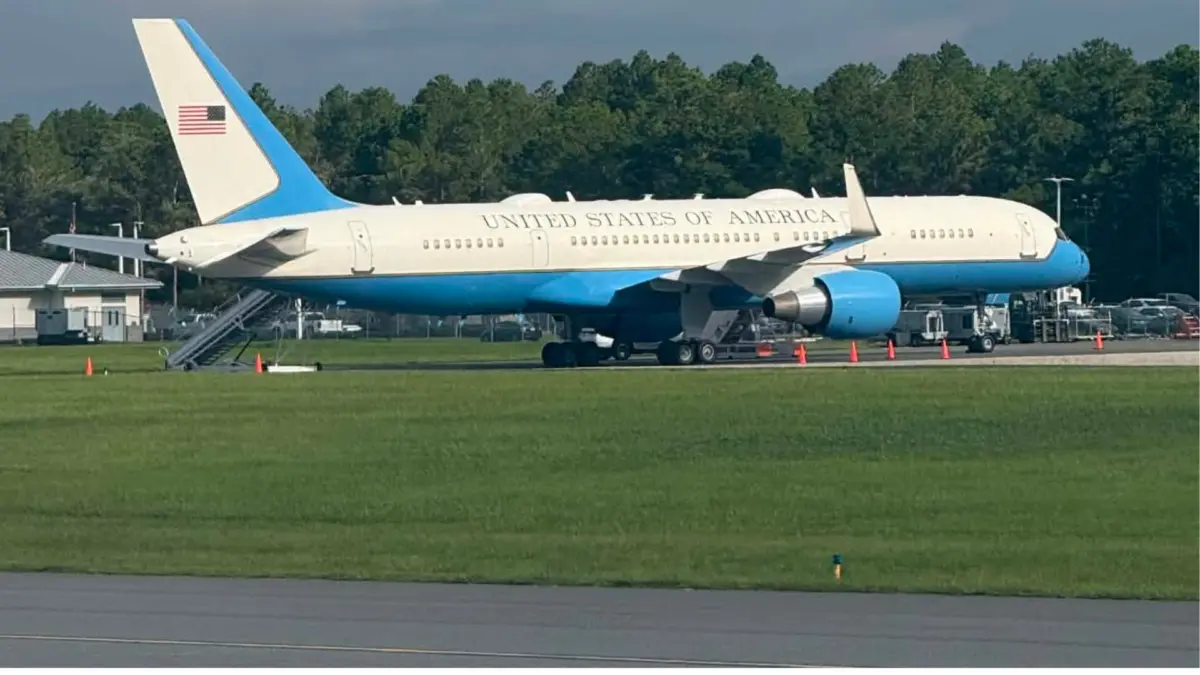

GAINESVILLE, Fla. — Aviation enthusiasts, local residents, and security watchers alike found themselves staring skyward on a crisp Saturday afternoon as a heavily modified, VIP-configured Boeing C-32 military transport aircraft touched down at Gainesville Regional Airport (GNV). Sporting the iconic "UNITED STATES OF AMERICA" livery across its polished white-and-blue fuselage, the arrival of the elite United States Air Force aircraft immediately triggered a flurry of speculation, intense digital tracking, and local intrigue across North Central Florida.
The aircraft, which descended onto the GNV tarmac at approximately 2:00 p.m. local time, is a familiar sight to those who monitor the movements of America’s highest-ranking executive branch officials. While the plane shares the exact structural blueprint and luxury executive configuration of the aircraft universally recognized as "Air Force One," strict military and presidential protocol dictates that the precise call sign is only active when the President of the United States is physically on board. As of publication, airport authorities, federal liaisons, and municipal representatives have maintained a posture of strict silence regarding the nature of the visit, the identity of any passengers, and the ultimate flight plan of the high-security asset.
This comprehensive investigative report examines the timeline of Saturday’s unusual arrival, details the sophisticated tracking data that traced the aircraft’s path from the nation’s capital through the Northeast, and analyzes the unique capabilities of the Boeing C-32 platform. Furthermore, we explore the logistical footprint such a high-profile military visit leaves on a regional civilian airport, review the protocols surrounding executive travel, and assess the broader context of VIP movements through North Central Florida.
Detailed Chronology: Tracking the Flight Path from D.C. to Gainesville
The journey of the mysterious Boeing C-32 began well before its wheels met the asphalt in Alachua County. According to comprehensive historical flight log data compiled from open-source military tracking platforms, including ADS-B Exchange, the aircraft’s operational day commenced within the heavily restricted airspace surrounding the National Capital Region.
Phase 1: Departure from the Capital Region
In the pre-dawn and early morning hours of Saturday, aviation monitors identified the aircraft preparing for departure from a primary military installation in the Washington, D.C., metropolitan area—traditionally either Joint Base Andrews in Maryland or a nearby secure airfield utilized by the 89th Airlift Wing. The aircraft departed under standard military instrument flight rules (IFR), maintaining encrypted transponder protocols during the initial ascent before standardizing its digital signature for regional transit.
Phase 2: The Northern Leg and New York Layover
Flight tracking records indicate that the aircraft did not fly a direct route south to Florida initially. Instead, the Boeing C-32 executed a northern vector, establishing a flight path toward the state of New York. While the exact rationale for the New York stopover remains unconfirmed, executive transport aircraft frequently perform brief, highly secure intermediate stops for logistical support, crew rotation, or the embarkation of supplementary personnel and classified cargo. The aircraft spent a brief window on the ground at an unclosed New York airfield before filing a flight plan that would take it down the Eastern Seaboard toward the Sunshine State.
Phase 3: Descent into Gainesville Regional Airport (GNV)
As the aircraft crossed into Florida airspace over early Saturday afternoon, local aviation spotters armed with specialized receivers began tracking the distinct radar signature. By 1:45 p.m., visual confirmation was established as the jet began its descent profile over rural Alachua County.
At precisely 2:00 p.m., the Boeing C-32 touched down smoothly on Gainesville Regional Airport’s primary runway. Ground operations observed standard high-security protocols upon arrival:
- Tarmac Isolation: The aircraft was directed away from the standard commercial terminal gates and toward a secure, restricted ramp area typically utilized by military detachments or fixed-base operators (FBOs) handling classified or diplomatic arrivals.
- Perimeter Security: Local law enforcement agencies, in coordination with federal security details, established a temporary safety perimeter around the aircraft’s immediate footprint, restricting vehicular and pedestrian traffic near the taxiway.
- The Departure Mystery: Unlike standard commercial turnarounds, the duration of the aircraft’s stay on the ground at GNV was tightly controlled. Observers noted minimal visible ground activity before the aircraft was prepared for its subsequent leg, though officials have steadfastly refused to disclose whether passengers disembarked, transferred to secondary motorcades, or remained on board during the brief layover.
Supporting Context & Metrics: Decoding the Boeing C-32 Platform
To understand the magnitude of Saturday’s arrival at Gainesville Regional Airport, it is essential to examine the aircraft itself. The Boeing C-32 is not a standard commercial airliner, nor is it a run-of-the-mill military transport. It is an elite, highly specialized strategic asset designed to transport the nation’s top civilian and military leadership securely and efficiently across the globe.
Specifications of the Boeing C-32
Derived from the commercial Boeing 757-200 airframe, the C-32 has been extensively modified by the United States Air Force to meet the rigorous demands of executive transport. Key technical metrics of the platform include:
| Metric Category | Specification Detail |
|---|---|
| Manufacturer | Boeing Integrated Defense Systems |
| Powerplant | Two Pratt & Whitney PW2040 turbofan engines |
| Thrust | Approximately 43,000 pounds of thrust per engine |
| Wingspan | 124 feet, 10 inches |
| Length | 177 feet, 5 inches |
| Range | Approximately 5,500 nautical miles (unrefueled) |
| Service Ceiling | 42,000 feet |
| Cruising Speed | Mach 0.80 (approx. 530–540 mph) |
The Interior Configuration
Unlike the larger VC-25 (the Boeing 747 variant traditionally known as Air Force One), the C-32 is optimized for mid-range intercontinental missions and airports with shorter runways—making regional facilities like Gainesville Regional Airport (GNV) accessible when necessary.
The interior of the C-32 is divided into distinct operational zones:
- The Forward Compartment: Configured as a secure communications and conference center, allowing leadership to maintain continuous contact with the White House, the Pentagon, and global command centers.
- The Executive Quarters: Features private staterooms, a private lavatory, and dedicated seating for the primary principal passenger and their immediate staff.
- The Staff and Media Area: Provides standard business-class seating for accompanying aides, secret service agents, military attachés, and traveling press pools.
The Semantics of "Air Force One"
A persistent point of confusion among the general public during high-profile military aircraft sightings is the application of the term "Air Force One."
Aviation law and military regulation dictate that Air Force One is not a specific airplane. Rather, it is the official radio call sign given to any United States Air Force aircraft carrying the President of the United States. When the sitting president boards a C-32, that specific flight is designated Air Force One. However, if the exact same aircraft is transporting the Vice President, the First Lady, the Secretary of Defense, or members of the Joint Chiefs of Staff, the call sign shifts to designations such as Air Force Two or standard military mission call signs (e.g., SAM – Special Air Mission).
Because federal authorities have not confirmed the passenger manifest for Saturday’s flight into Gainesville, labeling the aircraft as "Air Force One" would be technically inaccurate; however, confirming that a C-32 touched down underscores that a high-ranking official within the executive branch or military hierarchy was the subject of the transport mission.
Official Statements and Institutional Silence
In the immediate aftermath of the aircraft’s arrival, regional journalists and digital investigators reached out to multiple local, state, and federal entities to piece together the purpose of the flight. The response from official channels, however, was characterized by a blanket of institutional discretion.
Gainesville Regional Airport Administration
Officials with the Gainesville Regional Airport (GNV) issued a concise, carefully worded statement noting that they were unable to comment on the arrival of the military aircraft. Under federal aviation guidelines and standard operating procedures for military VIP transport, regional civilian airports are frequently bypassed regarding the specific operational details of Department of Defense or executive branch flights.
An airport spokesperson emphasized that while GNV operates as a public-use facility capable of accommodating large commercial and military aircraft, the management of national security flights falls under the purview of federal agencies and the United States Air Force. Consequently, local airport staff directed all inquiries regarding passenger manifests and flight itineraries to federal public affairs offices.
Federal and Military Non-Disclosure
Inquiries directed to the United States Air Force 89th Airlift Wing—which operates the presidential and executive airlift fleet out of Joint Base Andrews—yielded no specific disclosures regarding Saturday’s routing through New York and Gainesville.
As a matter of operational security (OPSEC), the Department of Defense routinely withholds advance itinerary details for executive transport missions until flights are completed or until such time as public disclosure does not compromise the safety and security of the principals on board. This standard operating procedure is designed to protect leadership from potential security threats, surveillance tracking vulnerabilities, and unauthorized disruptions on the ground.
Future Outlook: Implications and Regional Significance
The sudden appearance of an elite Air Force transport aircraft in Gainesville naturally raises questions regarding the strategic importance of North Central Florida in broader national dialogues. While the immediate reason for Saturday’s stop remains shrouded in administrative discretion, several broader implications emerge from such events.
Infrastructure and Strategic Readiness
The successful landing and servicing of a Boeing C-32 at Gainesville Regional Airport highlights the robust infrastructural capabilities of GNV. With a primary runway capable of handling heavy commercial and military airframes, the airport serves as a viable, secure alternative to larger metropolitan hubs in Jacksonville, Orlando, or Tampa for high-profile governmental transit.
As regional airports across the United States increasingly integrate dual-use military and civilian capabilities, local facilities must maintain readiness for unexpected VIP stopovers, emergency diversions, and specialized security operations.
Continued Monitoring by Aviation Enthusiasts
The rise of open-source intelligence (OSINT) and consumer flight-tracking applications has fundamentally changed how the public interacts with government and military movements. Platforms like ADS-B Exchange, Flightradar24, and specialized social media networks ensure that no major executive asset can traverse domestic airspace anonymously.
Moving forward, local communities can expect similar instances of high-security aviation activity to generate immediate public interest. As transparency tools evolve, the gap between classified military logistics and public curiosity will continue to narrow, placing a premium on timely, accurate reporting from local news institutions like WCJB.
Copyright 2026 WCJB. All rights reserved. This investigative report was compiled using real-time flight telemetry data, historical aviation archives, and official agency guidelines.

0 Comments