

Executive Overview
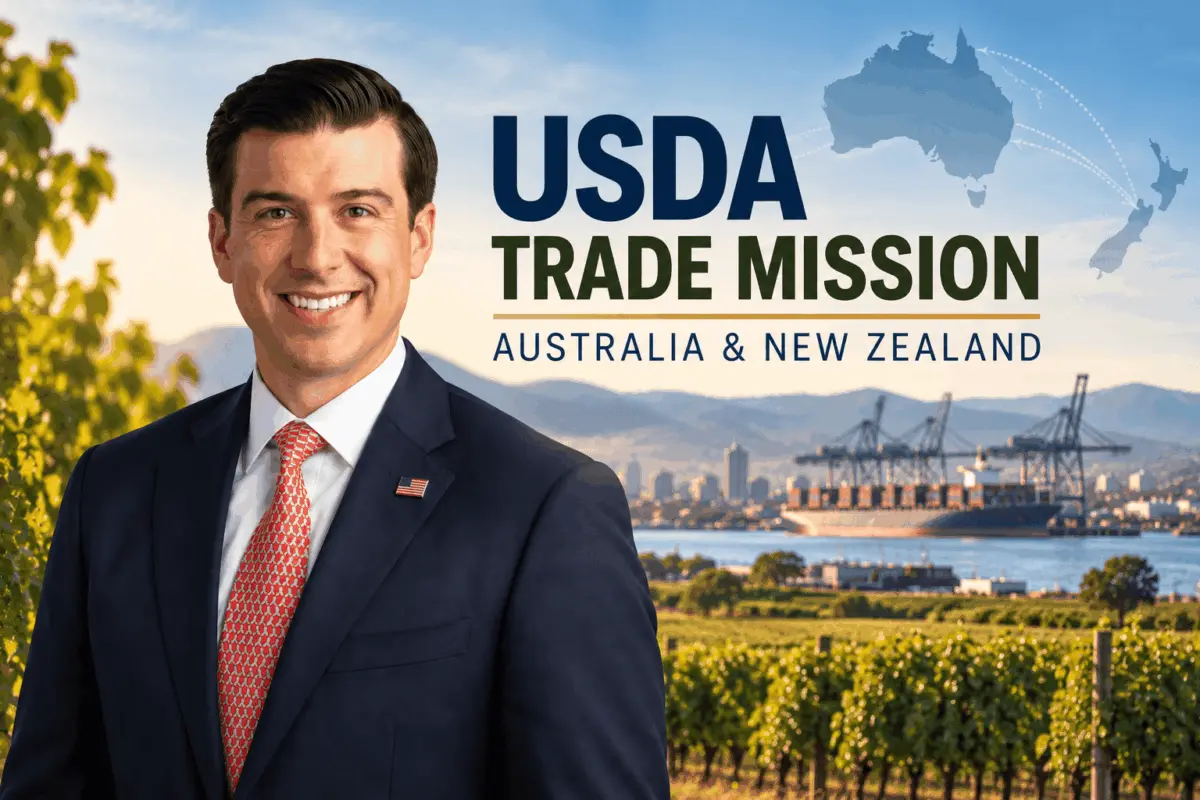
In an aggressive push to diversify and expand global market access for American farmers, ranchers, and agricultural enterprises, United States Department of Agriculture (USDA) Under Secretary for Trade and Foreign Agricultural Affairs Luke Lindberg recently spearheaded a high-stakes trade mission to Australia and New Zealand. This strategic initiative brought together a robust delegation of more than 60 U.S. agribusinesses, alongside leadership and trade representatives from 11 state departments of agriculture and 15 major agricultural industry organizations.
While Australia and New Zealand are globally renowned as agricultural powerhouses in their own right, the USDA-led delegation identified and capitalized on unique, complementary niches within these markets. Rather than viewing these Oceania nations solely as competitors, the mission focused on seasonal variations, specialized product demands—ranging from fresh produce and organic goods to high-quality pork—and the export of critical U.S. agricultural inputs designed to support overseas livestock production.
Beyond general product promotion, the delegation engaged in high-impact diplomacy and direct commerce, facilitating over 150 targeted business-to-business (B2B) meetings. These sessions aimed to break down non-tariff trade barriers, streamline regulatory hurdles such as organic certification recognition, and negotiate expanded entry pathways for specific American commodities, including fresh blueberries and apples. This mission represents a vital component of the USDA’s broader, long-term strategy to reduce the domestic agricultural sector’s reliance on a concentrated pool of traditional trading partners by continuously forging inroads into dynamic, high-value international economies.
Detailed Chronology of the Oceania Trade Mission
The multi-day trade mission was meticulously structured to maximize exposure, foster strategic partnerships, and secure tangible commitments from foreign buyers and regulatory authorities.
Phase One: Arrival and Initial Briefings
Upon touching down in the region, the U.S. delegation—comprising a diverse cross-section of American agricultural enterprise from independent producers to large-scale processors—participated in comprehensive market orientation briefings. Led by agricultural attachés stationed at U.S. embassies in Canberra and Wellington, these sessions provided delegates with up-to-date intelligence on consumer trends, regulatory landscapes, and competitive dynamics unique to the Australian and New Zealand economies.
Phase Two: Business-to-Business (B2B) Matchmaking
A central pillar of the itinerary was the execution of over 150 curated B2B matchmaking sessions. American producers and exporters sat down directly with Oceania importers, wholesalers, and retail buyers. These meetings allowed U.S. businesses to showcase the superior quality, traceability, and sustainability of American agricultural products. Products taking center stage included sustainably raised pork, specialty grains, organic food items, and premium fresh-market produce. For many small-to-medium-sized U.S. enterprises participating in the mission, these direct connections served as the crucial bridge needed to secure initial export contracts or establish permanent distribution channels in the Southern Hemisphere.
Phase Three: Government-to-Government Consultations
Simultaneously, Under Secretary Lindberg and senior USDA trade officials engaged in high-level bilateral discussions with Australian and New Zealand government counterparts, as well as key agricultural industry leaders. These talks moved past introductory diplomacy to tackle concrete market access barriers that have historically limited the full potential of bilateral agricultural trade.
Key regulatory hurdles addressed during the mission included:
- Phytosanitary and Sanitary Market Access: Negotiating terms for the entry of U.S. fresh blueberries into New Zealand and U.S. apples into Australia.
- Pork Trade Expansion: Identifying opportunities to increase the volume and market share of American pork exports to meet localized demand gaps.
- Regulatory Harmonization: Advancing discussions to establish mutual recognition agreements for organic certifications, which would significantly reduce administrative burdens and costs for certified organic producers in both countries.
Supporting Context & Metrics: The Mechanics of Trans-Pacific Trade
To understand the strategic significance of the USDA’s recent mission, one must examine the macro-level metrics and structural realities governing agricultural trade between the United States, Australia, and New Zealand.
Complementary Growing Seasons
A foundational premise of the trade mission is the concept of counter-seasonal complementarity. Because Australia and New Zealand are situated in the Southern Hemisphere, their peak agricultural harvesting and production cycles occur during the North American winter. While both nations are formidable exporters of beef, dairy, wine, and sheep meat, their domestic markets experience seasonal supply deficits for specific fresh fruits, vegetables, and specialized agricultural inputs.
By leveraging these counter-seasonal windows, U.S. producers can supply fresh, high-quality agricultural goods to Oceania consumers when local supplies are low, thereby maintaining year-round availability on supermarket shelves without undercutting domestic producers.
The Power of Collective Delegation
The composition of the U.S. delegation underscores the collaborative approach required to successfully penetrate modern international markets. Bringing together:
- 60+ U.S. Businesses: Ranging from innovative tech startups in ag-tech to established food processing and exporting corporations.
- 11 State Departments of Agriculture: Amplifying regional agricultural strengths and connecting local producers directly to global supply chains.
- 15 Agricultural Industry Organizations: Providing sector-wide advocacy, technical data, and unified marketing messages.
This multi-tiered representation ensures that foreign buyers view the United States not merely as a collection of disparate sellers, but as a reliable, highly organized, and diverse global supplier capable of meeting rigorous international standards.
The Imperative of Market Diversification
For decades, American agricultural exports have relied heavily on a small group of mega-markets. However, modern geopolitical shifts, supply chain vulnerabilities, and shifting global consumer demographics have made market diversification an existential priority for the USDA. Expanding into developed, high-income markets like Australia and New Zealand establishes stable, high-value outlets for U.S. goods, insulating American farmers against localized economic downturns or trade disputes in other regions.
Official Statements and Insights from Leadership
In an exclusive post-mission interview with AgNet Media, USDA Under Secretary Luke Lindberg provided deep insights into the strategic intent, outcomes, and broader vision driving the department’s international trade agenda.
Lindberg emphasized that trade missions of this caliber are designed to unlock doors that individual businesses often find too costly or politically complex to open on their own.
"Australia and New Zealand present some unique, highly strategic opportunities for American agriculture," Lindberg noted during the interview. "While both countries are major agricultural powerhouses in their own right, the realities of global geography and distinct growing seasons create complementary markets—particularly for fresh produce and specialized inputs—that benefit producers on both sides of the Pacific."
Addressing the nuances of trade negotiations, Lindberg stressed that the mission went far beyond superficial promotional events. The inclusion of rigorous government-to-government policy discussions ensured that tangible regulatory barriers were actively confronted.
"We didn’t travel halfway across the world just to shake hands; we went to deliver results for our producers," Lindberg explained. "By facilitating over 150 direct B2B meetings and sitting down face-to-face with regulatory officials, we laid the groundwork to open new pathways for American blueberries, apples, and pork, while taking major steps forward in making organic certification mutually recognizable."
Furthermore, Lindberg highlighted that the lessons learned and relationships forged in Oceania are part of a broader, systemic campaign to reshape the geography of American agricultural exports.
Future Outlook: Beyond Oceania and into Southeast Asia
While the Australia and New Zealand trade mission achieved significant immediate milestones, USDA leadership views these efforts as stepping stones toward a much larger objective: the comprehensive diversification of U.S. agricultural export destinations across the Indo-Pacific region.
The Rise of Southeast Asia as an Economic Frontier
Looking ahead, the USDA is intensifying its focus on Southeast Asia, a region characterized by surging middle-class populations, rapid urbanization, and a rapidly expanding appetite for high-quality imported food and agricultural products.
Among these emerging economies, Vietnam has been singled out by Under Secretary Lindberg and trade analysts as a market of extraordinary potential. With a dynamic economy, a young demographic, and an increasingly sophisticated retail and foodservice sector, Vietnam represents a prime frontier for American agricultural goods—ranging from feed grains and livestock genetics to consumer-ready food products and fresh fruits.
Strategic Implications for American Producers
The systematic expansion into markets like Australia, New Zealand, and Southeast Asia signals a new era for American agriculture. By actively dismantling trade barriers, securing mutual regulatory recognitions, and introducing U.S. brands to receptive international buyers, the USDA is working to ensure long-term profitability and resilience for the American farmer and rancher.
As these trade initiatives mature, U.S. agriculture stands well-positioned to meet the evolving demands of the global consumer, securing America’s status as an indispensable leader in worldwide food security and agricultural innovation.

0 Comments