

Executive Overview
In a decisive break from decades of college football tradition, the Florida State University (FSU) Seminoles football program has announced it will not release a public depth chart ahead of its highly anticipated season-opening matchup against the New Mexico State Aggies. The news, initially broken by Kolby Crawford of Noles247, marks a significant shift in how the program manages pre-game information transparency.
For fans, sports bettors, media members, and opponents alike, the traditional Monday-of-game-week depth chart has long served as a roadmap for understanding roster hierarchy, player development, and tactical intentions. By opting out of this ritual, Florida State head coach Mike Norvell has signaled a broader philosophical shift toward modern tactical obfuscation. Rather than neatly categorizing athletes into rigid "starter" and "backup" designations, the Seminoles’ coaching staff is embracing a fluid, position-less approach to modern collegiate football—one where players transition seamlessly across multiple personnel groupings depending on situational demands.
This executive overview serves to introduce a comprehensive investigative report detailing the mechanics behind Norvell’s decision, the broader implications for college football transparency, the tactical framework of FSU’s multi-faceted offense and defense, and a full preview of the upcoming Saturday night showdown at Doak Campbell Stadium. As the landscape of college athletics becomes increasingly competitive, high-stakes decisions regarding information control are drawing intense scrutiny. This report will unpack the multi-layered rationale behind FSU’s blackout of pre-game data, analyze the structural realities of modern football schemes, and explore what fans can expect when the Seminoles finally take the field under the primetime lights of The CW network.
Detailed Chronology of the Announcement
The Breaking Report and Immediate Reaction
The revelation that Florida State would withhold its customary depth chart first surfaced on X (formerly Twitter) via Noles247 beat writer Kolby Crawford. Within minutes, the report reverberated across college football circles, triggering widespread discussion among national analysts, conference observers, and the passionate FSU fanbase.
For the better part of a century, the weekly depth chart has been a staple of sports journalism. Media outlets rely on it to craft preview articles, broadcast teams use it to populate their game-day spotter charts, and opposing coaching staffs comb through it for any tactical hints regarding injuries or position battles. The sudden elimination of this document by one of the Atlantic Coast Conference’s (ACC) marquee programs immediately raised questions regarding competitive advantages, strategic secrecy, and athletic department communication policies.
Norvell’s Thursday Press Conference: Unpacking the Rationale
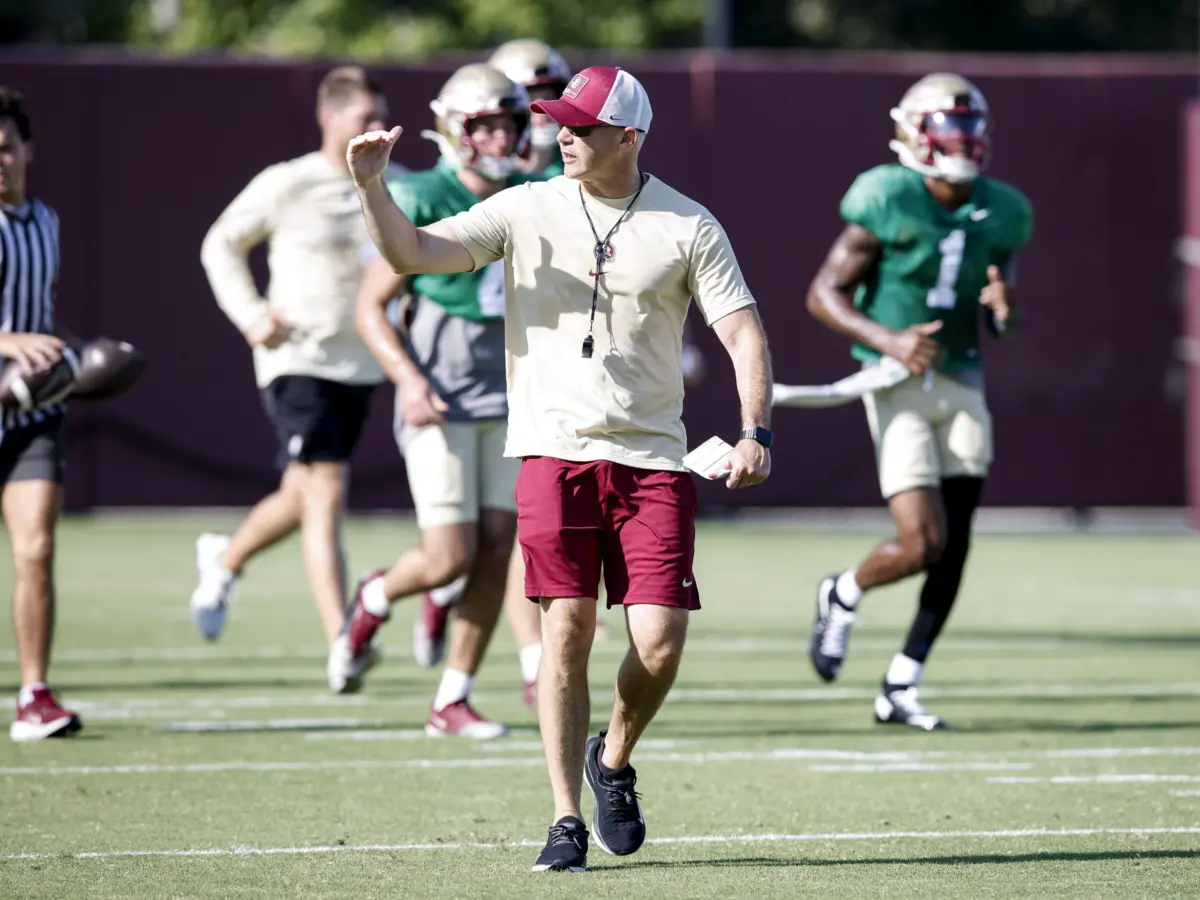
The context behind the social media report was solidified last Thursday during head coach Mike Norvell’s weekly media availability. Addressing the assembled press corps, Norvell did not mince words regarding his disdain for the traditional depth chart format, framing it as an antiquated relic that fails to reflect the complexity of modern football utilization.
“As we look at different dynamics of how guys might be utilized in certain packages… if you have four different personnel packages and a guy’s starting in a handful of them and not starting in any others, well is he a starter? Is he not? It’s still kind of up in the air,” Norvell explained to reporters.
The fifth-year head coach elaborated further, stripping away any diplomatic veneer to offer a blunt assessment of the document’s utility to his own staff:
“Depth charts to me are, whatever they are. And I don’t see really ultimately great value in putting one out and all of it.”
This candid breakdown provided a window into Norvell’s coaching philosophy. In an era where hybrid players—such as defensive safeties playing linebacker roles, tight outs lining up as wide receivers, and dynamic running backs functioning as slot receivers—dominate elite rosters, putting a single player’s name next to a static position label can be misleading at best and strategically disadvantageous at worst.
The Immediate Aftermath and Transition to Game Week
Following Norvell’s remarks, the university’s sports information department confirmed that no formal depth chart would be distributed ahead of the New Mexico State fixture. This move shifted the focus entirely to the field, intensifying the mystery surrounding key positional battles that had been waged quietly behind closed doors throughout fall camp.
While fans accustomed to scanning the depth chart for returning veterans or breakout freshmen were left empty-handed, opposing coaches and analysts were forced to pivot. Rather than preparing for specific named individuals at designated spots on the gridiron, New Mexico State’s coaching staff—led by their own defensive and offensive coordinators—must now prepare for a wide spectrum of schematic possibilities. The timeline of this decision highlights a growing trend across major collegiate programs: leveraging administrative discretion to maximize competitive secrecy right up until kickoff.
Supporting Context & Metrics: The Death of the Traditional Depth Chart
The Evolution of Personnel Groupings in Modern Football
To truly understand Mike Norvell’s dismissal of the traditional depth chart, one must examine how the structural anatomy of football has evolved over the past decade. Historically, football offenses lined up in a predictable "pro-style" or "I-formation" framework: one quarterback, one running back, one fullback, two wide receivers, a tight end, and five offensive linemen. Defenses mirrored this with a base 4-3 or 3-4 alignment. In such rigid structures, a depth chart was remarkably accurate; if Player A was listed as the starting X-receiver, he played roughly 80 to 90 percent of the snaps at that position.
Today, however, spread offenses, run-pass options (RPOs), and complex passing concepts have dismantled those rigid boundaries. Modern play-callers utilize specialized personnel groupings defined by personnel tags—such as "11 personnel" (1 running back, 1 tight end, 3 wide receivers), "10 personnel" (1 running back, 0 tight ends, 4 wide receivers), or "12 personnel" (1 running back, 2 tight ends, 2 wide receivers).
Within these packages, a player’s role changes dramatically. For instance, a dynamic offensive weapon might be a primary starter in a 10-personnel spread package, serving as an outside vertical threat, but completely leave the field when FSU transitions to a heavier 12-personnel ground-and-pound package featuring two traditional tight ends and a fullback. If that same player also moonlights as a wildcat quarterback or a motion slot specialist, labeling him simply as a "backup wide receiver" on a piece of paper grossly misrepresents his value and deployment within the game plan.
Defensive Versatility and Strategic Obfuscation
The defensive side of the ball has undergone an equally radical transformation. The proliferation of spread offenses has forced defenses to recruit hybrid athletes who defy traditional positional definitions. The emergence of the "Star," "Leo," or "Buck" linebacker/defensive end hybrids means that a player might put his hand in the dirt as a pass-rusher on third-and-long, drop into zone coverage as a flat defender on first down, and walk out over a slot receiver in man-to-man coverage on second down.
By withholding a depth chart, Mike Norvell and his defensive staff achieve several strategic goals:
- Denying Tendency Data: Opposing analysts use depth charts combined with snap counts to chart opponent tendencies. Without a definitive baseline, NMSU’s offensive staff must spend valuable preparation time anticipating multiple personnel combinations rather than keying in on specific individual matchups.
- Protecting Competitive Advantages: If FSU has developed a specialized sub-package designed specifically to exploit a perceived weakness in New Mexico State’s offensive line or secondary, keeping the personnel participating in those packages hidden prevents early-week scouting adjustments.
- Maximizing Internal Accountability: In closed-door practices, keeping the depth chart fluid fosters a meritocracy. When players know that starting roles are distributed based on weekly execution across various packages rather than a permanent ink designation on a public document, complacency is minimized.
Regulatory and Institutional Standards
It is worth noting that unlike the National Football League (NFL), which enforces strict injury reporting and roster transparency guidelines due to its partnership with the sports betting and media industries, the NCAA grants individual member institutions and conferences vast autonomy regarding pre-game documentation. While some conferences or specific media contracts historically encouraged or requested depth charts for broadcast purposes, there is no blanket federal or NCAA mandate requiring coaches to publish a public depth chart.
Norvell’s decision places Florida State among a growing cadre of high-profile head coaches—including figures like Nick Saban in his later years at Alabama, Kirby Smart at Georgia, and Dabo Swinney at Clemson—who view public roster transparency as an unnecessary concession to opponents.
Official Statements & Institutional Perspectives
Mike Norvell’s Philosophy on Player Evaluation
To appreciate the depth of Norvell’s stance, it is helpful to analyze his broader public statements regarding player development and evaluation. Throughout his tenure in Tallahassee, the head coach has consistently emphasized that performance is multi-dimensional. A player who excels in leadership, special teams execution, and situational blocking may surpass a more athletically gifted peer who lacks consistency in minor assignments.
When Norvell remarks that traditional depth charts do not capture the reality of modern utilization, he is speaking directly to the granular nature of game planning. In a typical game, Florida State will run upwards of 70 to 80 offensive snaps and a similar volume on defense. Across those snaps, the coaching staff deploys a matrix of formations designed to stress opposing defenses.
By refusing to publish a depth chart, Norvell is subtly pushing back against a media and fan culture that craves simple, binary narratives ("Starter vs. Backup"). In modern football, those lines are blurred. A player might not take the field for the first offensive snap of the game, yet end up logging more total plays and scoring more touchdowns than the player designated as the nominal starter.
Program Transparency vs. Fan Engagement
The decision to withhold the depth chart has sparked an ongoing debate regarding the balance between program competitiveness and fan engagement. Athletic departments rely heavily on fan enthusiasm, ticket sales, and media consumption, all of which are traditionally stoked by pre-game hype materials like depth charts. For ardent supporters, poring over the depth chart is a cherished rite of passage during the scorching days of late August.
However, the modern arms race of college athletics—accelerated by Name, Image, and Likeness (NIL) monetization, the unrestricted NCAA Transfer Portal, and multi-million-dollar media rights deals—has tilted the scales firmly toward competitive secrecy. For athletic director Michael Alford and the FSU administration, protecting the football program’s on-field product supersedes the nostalgic desire for a pre-game roster list. Institutional messaging around the team continues to emphasize a unified focus: winning football games by any tactical means necessary.
Game Preview: Florida State vs. New Mexico State
Matchup Overview and Broadcast Details
With the administrative drama of the depth chart announcement behind them, the attention of the Seminole faithful turns squarely to the field. Florida State is set to kick off its season this Saturday at 7:00 PM EST against the New Mexico State Aggies.
The primetime matchup will be broadcast nationally on The CW, reflecting the network’s expanding footprint in collegiate sports broadcasting. For FSU, opening the season at home inside the iconic Doak Campbell Stadium provides an electric atmosphere for a roster that has undergone significant evolution through recruiting and the transfer portal.
Analyzing the Opponent: New Mexico State Aggies
Led by their coaching staff, the New Mexico State Aggies enter Tallahassee as clear underdogs, but they are a program accustomed to playing the role of spoiler. Known for physical, disciplined football, the Aggies will look to control the line of scrimmage, shorten the game through sustained rushing attacks, and capitalize on any early-season execution errors or overconfidence from the heavily favored Seminoles.
For NMSU, preparing for an FSU team that has deliberately withheld its depth chart presents a unique psychological and tactical challenge. Defensive coordinators must prepare their secondary for a wide range of potential receiving threats and formations, while the offensive line must brace for an aggressive, multiple-front FSU pass rush whose exact personnel rotation remains shrouded in mystery.
What to Watch For on Saturday Night
As the opening whistle blows on Saturday evening, the intrigue surrounding the depth chart blackout will instantly give way to on-field execution. Key areas to monitor include:
- Quarterback Play and Offense Fluidity: How FSU’s signal-caller distributes the ball across various personnel groupings will immediately reveal whether Norvell’s philosophy of position-less deployment translates into explosive early-game production.
- Defensive Rotation: Observing how frequently FSU substitutes players on the defensive side of the ball will test the theory that multiple personnel packages are the primary reason for abandoning the traditional depth chart.
- Special Teams Execution: Often overlooked in early-season previews, special teams units—where depth charts matter even less and raw assignment discipline matters most—will serve as a key barometer of overall team preparedness.
Future Outlook: A New Norm for College Football?
Will Other Programs Follow FSU’s Lead?
As college football continues to professionalize, the decision by Florida State to withhold its season-opening depth chart may well establish a new precedent across major conferences. When pioneering programs successfully challenge longstanding traditions in the name of competitive advantage, peer institutions frequently take notice.
In the coming weeks and seasons, it would not be surprising to see an increasing number of Football Bowl Subdivision (FBS) programs abandon the weekly depth chart entirely, or replace it with vague, heavily padded rosters that list multiple "or" designations across every single position. While this may frustrate beat writers, broadcasters, and fantasy-style analysts, the calculus of modern coaching is merciless: wins and losses dictate employment, and any information freely given to an opponent is viewed as a tactical vulnerability.
The Broader Impact on Sports Media and Fanning Culture
For sports media covering the Atlantic Coast Conference and national college football at large, reporting will have to adapt. Journalists will increasingly rely on practice observations, insider sourcing, and real-time game tracking rather than pre-printed administrative documents.
For fans, the cultural shift may take time to digest, but the ultimate currency of college football remains victory. If Mike Norvell and the Florida State Seminoles translate this operational secrecy into an explosive, well-executed victory over New Mexico State on Saturday night, the absence of a preseason depth chart will quickly be forgiven—and perhaps celebrated as another stroke of modern coaching ingenuity.
As the clock ticks down to Saturday at 7 p.m. on The CW, the mystery of FSU’s exact lineup remains intact. But one thing is certain: when the Seminoles emerge from the tunnel into the Tallahassee night, they will be entirely focused on letting their play on the field speak louder than any piece of paper ever could.

0 Comments