

Executive Overview
With precisely 11 days remaining before the Florida State Seminoles take the gridiron for their highly anticipated season opener, the glaring spotlight of fall camp remains firmly fixed on the team’s offensive line. Historically, the fortunes of any championship-caliber college football program are dictated by the collective grit, cohesion, and execution of the men in the trenches. For Florida State, the ongoing evolution of this position group has served as one of the most heavily scrutinized storylines of the preseason.
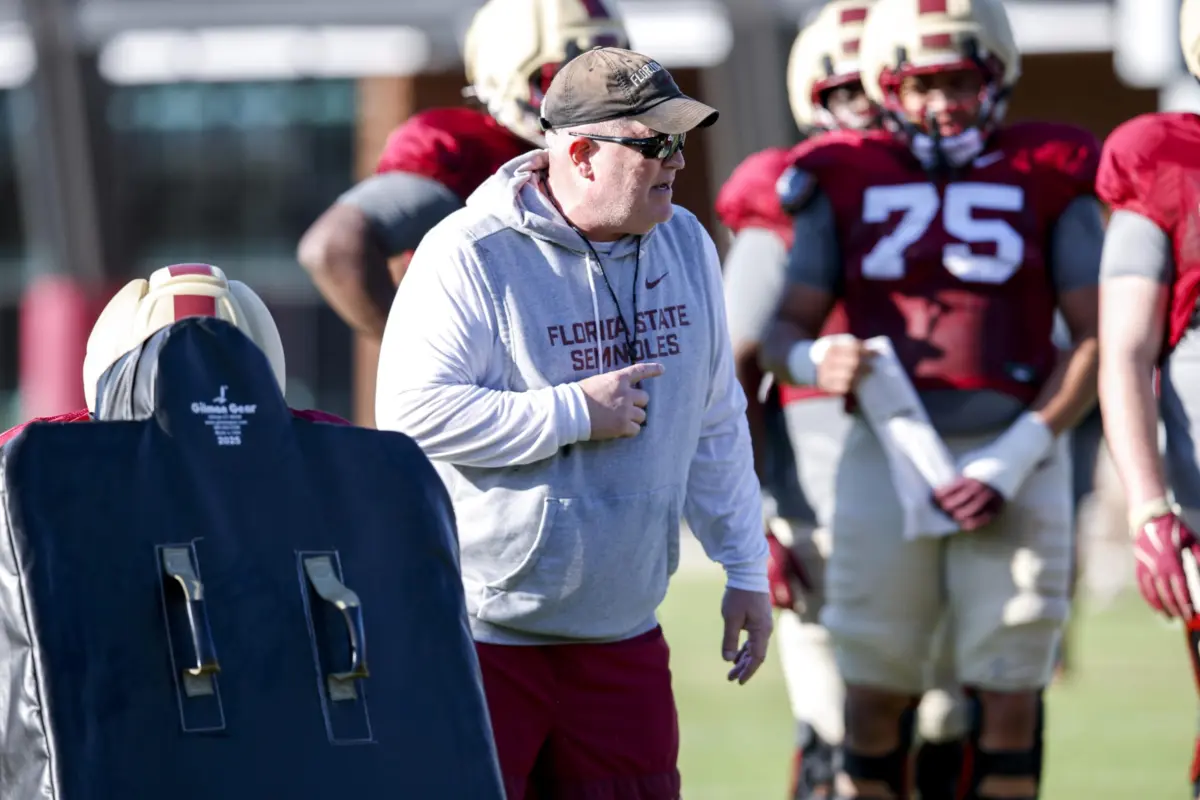
On Wednesday, offensive line coach Herb Hand and veteran lineman Nate Pabst addressed local media in a joint media availability, offering candid insights into the current state, cultural identity, and tactical progression of the unit. While Hand stopped short of officially locking in his starting five, his message was characterized by cautious optimism and a clear vision for the group’s trajectory. Backed by the steady presence of seasoned transfers like Pabst—a veteran with 38 career starts at his previous stop—the Seminoles are working furiously to cement a unit built on physical dominance, technical precision, and an unwavering, blue-collar work ethic.
This comprehensive report examines the tactical philosophy driving Florida State’s front five, the cultural standards instilled by the coaching staff, individual player development, and the overarching outlook for an offensive line aiming to set the tone for the Seminoles’ championship aspirations in the upcoming campaign.
Detailed Chronology: Fall Camp Progression and the Road to the Opener
The journey toward establishing a cohesive starting five along the offensive line is rarely linear, and Florida State’s fall camp has been no exception. As the calendar winds down toward the opening kickoff, the urgency within the program’s indoor practice facility has reached a fever pitch.
The Early Weeks: Installing the Foundations
When fall camp opened weeks ago, Herb Hand inherited a room rich in diverse backgrounds but lacking the finality of a definitive rotation. The early phase of camp focused heavily on installation—drilling base blocking schemes, testing combinations of personnel, and evaluating how younger players mixed with seasoned veterans.
Throughout these initial practices, the offensive line room experienced the typical growing pains associated with new schemes, physical fatigue, and intense competition against a talented Florida State defensive front. However, as the weeks progressed, coaches noted a distinct shift in communication and synergy. Players who struggled with assignment recognition early on began reacting with instinctual fluidity.
Wednesday’s Media Availability: Clarity Amid Competition
With just 11 days left before game week truly settles in, Wednesday’s press conference provided a transparent window into the coaching staff’s mindset. When pressed about the final composition of the starting lineup, Herb Hand maintained a pragmatic stance.
"Nothing’s set in stone right now, we still have whatever it is—11 days, or something like that—before we kick things off, and a lot can happen in 11 days," Hand told reporters. "I think we’re getting there. We’ll be fine by the time we get ready to kick it off. But I like the way that the unit’s coming together."
Hand’s reluctance to name a definitive starting five is standard operating procedure for veteran coaches looking to maintain competitive pressure through the final days of camp. Complacency is the enemy of progress, and by keeping starting spots fluid, Hand ensures that every lineman continues to fight for positioning until the depth chart is officially locked.
Supporting Context & Metrics: Defining the Culture and Tactical Identity
To truly understand Florida State’s offensive line room heading into the season, one must examine both the philosophical framework established by the coaching staff and the technical metrics used to evaluate elite line play.
The Physical Downhill Identity
In modern college football, offensive schemes often lean toward hyper-finesse, utilizing wide splits, RPOs (run-pass options), and perimeter screens to stretch defenses horizontally. While Florida State incorporates modern schematic elements to leverage athletic linemen in space, Herb Hand made it explicitly clear that the program’s foundational DNA remains rooted in old-school, smash-mouth football.
"Our DNA is we’re going to be a physical downhill running team." — Herb Hand, FSU Offensive Line Coach
Hand emphasized that every single tactical wrinkle, specialized package, or open-field blocking assignment stems from this core identity. If the Seminoles are to control the tempo of games in the grueling Atlantic Coast Conference (ACC), it will be because their interior linemen can consistently win the line of scrimmage, reset the line of linebackers, and pave the way for explosive rushing attacks.
The Anatomy of an Elite Lineman
What separates a serviceable college offensive lineman from an elite performer? According to veteran Nate Pabst, the answer has less to do with five-star athletic measurables and everything to do with psychological resilience and consistency.
Pabst defined a great offensive lineman not by his highlight-reel blocks or individual accolades, but by his quiet dependability. "You’re not going to be on the big screen when you’re doing something," Pabst explained. "But if the guys that go out there, no matter what the circumstances or what the situation is, they can go out there and perform and do their job. That’s what a great offensive lineman in my mind is."
This perspective highlights the thankless nature of the position. Linemen operate in a world where success is often anonymous, but failure is magnified on every television broadcast. Cultivating players who embrace this anonymity is a primary objective for Hand and his staff.
The "Give-a-Crap" Factor
Perhaps the most memorable and revealing concept discussed during Wednesday’s media session was what the coaching staff refers to as the "give-a-crap" factor. This metric transcends X’s and O’s, focusing entirely on effort, hustle, and cultural buy-in.
Pabst detailed how player evaluations begin the moment individuals step onto the practice field:
- The Sprint Standard: The very first thing coaches evaluate during practice is how players run onto the field. This is not an assignment-based drill or a schematic requirement; it is a raw measurement of enthusiasm and readiness.
- Culture Tape: Hand frequently shows the room historical "culture tape"—footage of former players he has coached executing effort plays, such as chasing down distant ball-carriers, pushing piles forward, and finishing blocks long after the whistle.
- Relentless Pursuit: This intangible drive is explicitly coached and rewarded within the Florida State program, setting a high baseline for what is expected on game days.
Official Statements: Insights from Hand and Pabst
The media availability provided direct commentary from two critical pillars of the Florida State offensive front: the architect guiding them and the veteran anchoring them.
Herb Hand on Consistency and Nate Pabst
When asked by reporters to identify the most consistent performer in his position room through fall camp, Hand initially deployed classic coaching humor, deflecting with a smile: "That’s like asking who’s your favorite kid. I’m not going to answer that one."
However, Hand quickly pivoted to praise his seasoned transfer, highlighting the value that experience brings to a locker room.
"Nate’s just a solid lunch pail dude that comes to work every day," Hand said. "He’s a vet, you know, I mean, you can tell that he’s played a lot of football. He’s a 38-game starter at the previous place. And, you know, they did a great job with him. I’m glad we have him."
For a Florida State room looking to establish vocal leadership and poise under pressure, Pabst’s extensive collegiate experience serves as an invaluable asset.
Nate Pabst on Personal Evolution and Technical Growth
Pabst also offered a transparent assessment of his own development since arriving in Tallahassee. By reviewing game and practice film, he has been able to chart his transition from a newcomer adjusting to a new system to a confident anchor of the line.
"If I go back and watch my day one film, I’m like ‘ah’ and didn’t really like it," Pabst admitted. "Now, I’m like, okay, this is the player I’m kind of used to seeing, maybe a little bit better."
Pabst specifically highlighted two technical areas where he has made significant strides over the summer and through fall camp:
- Rocking Back Mechanics: Describing an advanced offensive line movement, Pabst noted improvements in his ability to "rock back" to help his tackles when interior defenders cross the center’s face. This technique prevents penetration and maintains pocket integrity in passing situations.
- Hand Placement and Usage: Refining the precision and timing of his initial punch has allowed him to neutralize quicker pass-rushers more effectively.
Future Outlook: What Lies Ahead for the Seminoles’ Front Five
As the countdown to opening day enters its final single-digit days, the microscope on Florida State’s offensive line will only intensify. The ambitions of the Seminoles’ offense—spanning explosive downfield passing concepts and a punishing rushing attack—hinge almost entirely on the execution of the group currently being shaped by Herb Hand.
Key Questions Facing the Unit
- Who Earns the Final Starting Spots? While veterans like Pabst appear secure in their standing, the battle for the remaining slots will dictate the unit’s depth. Quality offensive line play requires more than five capable bodies; it demands a rotation capable of weathering the physical attrition of a full college football season.
- Translating Camp Progress to Game Speed: Fall camp excellence must translate cleanly under the bright lights of a hostile road environment or a high-pressure home opener. The communication protocols installed by Hand will be rigorously tested against complex defensive fronts.
- Establishing Early Dominance: If Florida State is to live up to its identity as a "physical downhill running team," the offensive line must establish dominance early in the first quarter of the season opener, setting a tone that opponents will have to respect for four quarters.
Conclusion
The narrative surrounding Florida State’s offensive line is one of transition, grit, and purposeful construction. Through the demanding installation periods of fall camp, Coach Herb Hand and veterans like Nate Pabst have laid the groundwork for a unit aiming to reclaim the storied physicality of Seminole football. With 11 days left to iron out the final details, the room is embracing the challenge—armed with a lunch-pail mentality, a commitment to relentless effort, and a shared vision of dominance in the trenches.

0 Comments