

Executive Overview
In a case blurring the traditional lines between childhood horseplay and criminal behavior, a routine physical education class in rural Arizona has culminated in a juvenile misdemeanor assault prosecution. Abel Schipper, a 13-year-old student at Mayer High School in Mayer, Arizona, now finds himself facing a formal charge in the Yavapai County Juvenile Justice system following a December 2025 dodgeball game.
What began as a standard warm-up drill involving soft, compressible foam balls escalated into a legal battle after an opposing player—who happened to be Schipper’s ex-girlfriend—sustained visible bruising. The incident triggered an external medical report, a police investigation conducted without parental notification, and a subsequent court summons that has left the teen’s family and legal observers questioning the proportionality of the juvenile justice system.
The case has ignited a wider discourse surrounding the criminalization of youth behavior, the parameters of school-sanctioned sports, and the role of mandatory reporting when traditional school disciplinary frameworks are bypassed. As the matter heads to a judicial hearing, the incident forces a critical examination of where routine adolescent conflict ends and criminal liability begins.
Detailed Chronology
The December 2025 Incident
The sequence of events commenced during an eighth-grade physical education class at Mayer High School in mid-December 2025. According to police records and student accounts, the class was utilizing standard, soft foam dodgeballs during a warm-up drill preceding a standard gym class game.
Abel Schipper and two peers acknowledged throwing the foam projectiles in the direction of Schipper’s ex-girlfriend. Schipper stated that the action was standard gameplay. "We threw around the dodgeballs, and then, I throw it at her. I hit her," Schipper recounted to local media. "One of the kids missed. The other kid also hit."
The nature of the equipment used is a point of contention. The balls in question were lightweight, compressible foam spheres designed specifically for school athletic programs to minimize physical impact. Schipper noted his initial perception of the equipment: "I didn’t think a dodgeball would hurt, and these are small ones too. So, you can squeeze them and they compress and stuff."
The Medical Report and Hospitalization Claim
Two days following the gym class incident, the Yavapai County Sheriff’s Office received an external tip from a social worker at Banner Health. The medical professional reported that a female minor had been the victim of a coordinated assault by three boys. According to the police report, the tipster alleged that the students had "relentlessly assaulted her with dodgeballs when she came out of the bathroom" and asserted that the student required hospitalization.
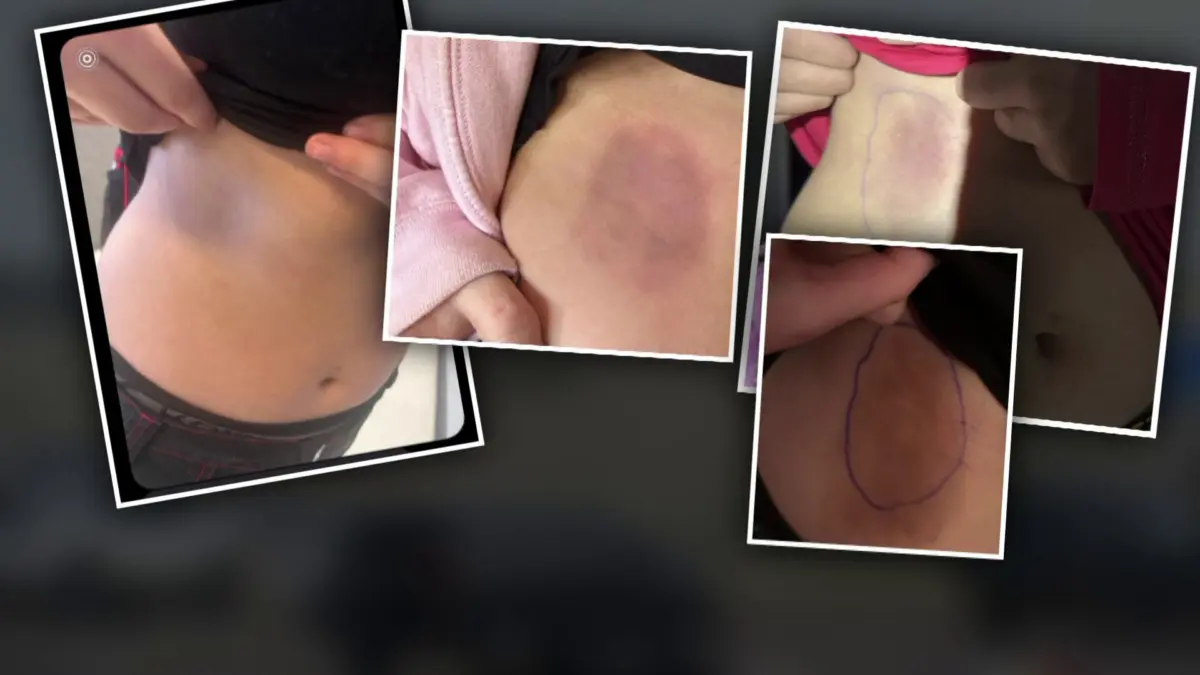
Photographs subsequently submitted by the victim’s mother documented two softball-sized, blue-and-purple contusions located on the upper right rib cage and the lower right abdomen of the student.
The Police Investigation
Law enforcement initiated an inquiry based on the medical report, interviewing the students involved on school grounds. During questioning, all three boys maintained they possessed no malicious intent to cause physical harm. Schipper acknowledged during his interview with a sheriff’s deputy, "I’m not going to lie. I did target her a little bit."
Schipper later clarified that the concept of targeting is an inherent mechanic of dodgeball. "Obviously, I’m going to have to target somebody for dodgeball. It’s dodgeball. You have to choose somebody, throw the ball, then try to get them out," he explained.
Lack of School Discipline and Notification
A central element of the chronology involves the administrative response from Mayer High School. According to Cecily Schipper, the boy’s mother, school officials issued zero disciplinary actions regarding the incident. Furthermore, the school administration provided no communication to the family informing them that the event had occurred, nor that local law enforcement had interrogated a minor on school property without parental presence or consent.
Months elapsed before the family learned of the investigation, arriving in the form of an official notification letter from the Yavapai County Juvenile Justice Center detailing a misdemeanor assault charge.
Supporting Context & Metrics
The Mechanics and Mechanics of School Dodgeball
Dodgeball has long occupied a contentious space within American physical education curricula. While proponents view the game as a traditional method for teaching agility, hand-eye coordination, and teamwork, critics and school districts nationwide have periodically banned the activity over concerns regarding bullying, aggressive behavior, and potential physical injury.
In recent decades, school districts across multiple states have transitioned away from traditional rubber-skinned playground balls toward high-density foam or cloth-covered balls to mitigate injury risks. Despite these design alterations, high-velocity throws can occasionally result in localized contusions, particularly when individuals are struck at close range.

Legal Thresholds for Juvenile Assault in Arizona
Under Arizona law, misdemeanor assault generally involves intentionally, knowingly, or recklessly causing any physical injury to another person. In the context of a school sports environment, prosecutors must establish that a student’s actions exceeded the reasonable bounds of athletic participation and met the threshold of recklessness or intentional harm.
Legal analysts note that transitioning an in-school athletic incident into the criminal justice system is exceptionally rare. Typically, such matters are handled through administrative remediation, detention, suspension, or parent-teacher conferences rather than police intervention and court summonses.
Social and Personal Dynamics
The relationship between Schipper and the complainant adds a layer of social complexity to the case. Schipper described their prior dynamic as mixed, noting previous interpersonal friction followed by a mutual cooling of tensions.
Crucially, the Schipper family points to post-incident interactions as evidence of an absence of severe malice or ongoing fear. Cecily Schipper highlighted that text message logs recovered after the December incident demonstrated the complainant asking her son for rides home. Additionally, the Schipper family noted pre-existing social ties between the respective parents, underscoring the unexpected nature of the criminal escalation.
Official Statements
The Schipper Family Perspective
Cecily Schipper has emerged as a vocal critic of the legal proceedings, expressing deep frustration with both the educational institution and the juvenile justice system.
"It is absolutely ridiculous. This is a game that every kid in the nation plays at some point in their life," Cecily Schipper stated during interviews with regional media. "They’re considering the dodgeball a weapon and that he knowingly or willingly, recklessly harmed this girl just playing dodgeball in PE."
Addressing the procedural handling of the case by the school, she added:
"If it was a situation where boys will be boys, then he deserves punishment for that. But I also think… my son is getting injustice here when it comes to the court situation."
Institutional Silence
Requests for comment directed to Mayer High School administration regarding their disciplinary protocols, failure to notify parents of police interrogation, and handling of the gym class incident went unanswered. Similarly, representatives for the complainant and her family declined to issue public statements regarding the upcoming judicial proceedings.
Future Outlook
The Upcoming Judicial Hearing
The case is scheduled for a formal hearing before a juvenile court judge. According to legal counsel and family statements, two of the three accused boys are slated to appear in court to contest the misdemeanor assault charge.
The defense is expected to center on the argument that the actions occurred within the authorized boundaries of a school-sanctioned physical education class utilizing standard equipment, and that the element of criminal intent or recklessness required for an assault conviction is absent.
Broader Implications for Schools and Law Enforcement
Regardless of the judicial outcome, the case highlights systemic questions regarding inter-agency communication between healthcare mandatory reporters, law enforcement, and public school districts.
- Parental Rights and School Interrogations: The fact that a minor was interviewed by a sheriff’s deputy on school grounds without the knowledge or presence of a parent has drawn scrutiny from civil liberties advocates.
- Criminalization of Playground Disputes: Legal experts suggest the case could establish a precedent—either limiting or expanding—regarding the extent to which on-campus athletic injuries can be funneled into the criminal court system rather than managed through administrative channels.
As the juvenile court prepares to hear arguments, the Mayer High School dodgeball case remains a flashpoint illustrating the complex boundaries where adolescent peer dynamics, educational administration, and the penal system intersect.

0 Comments