
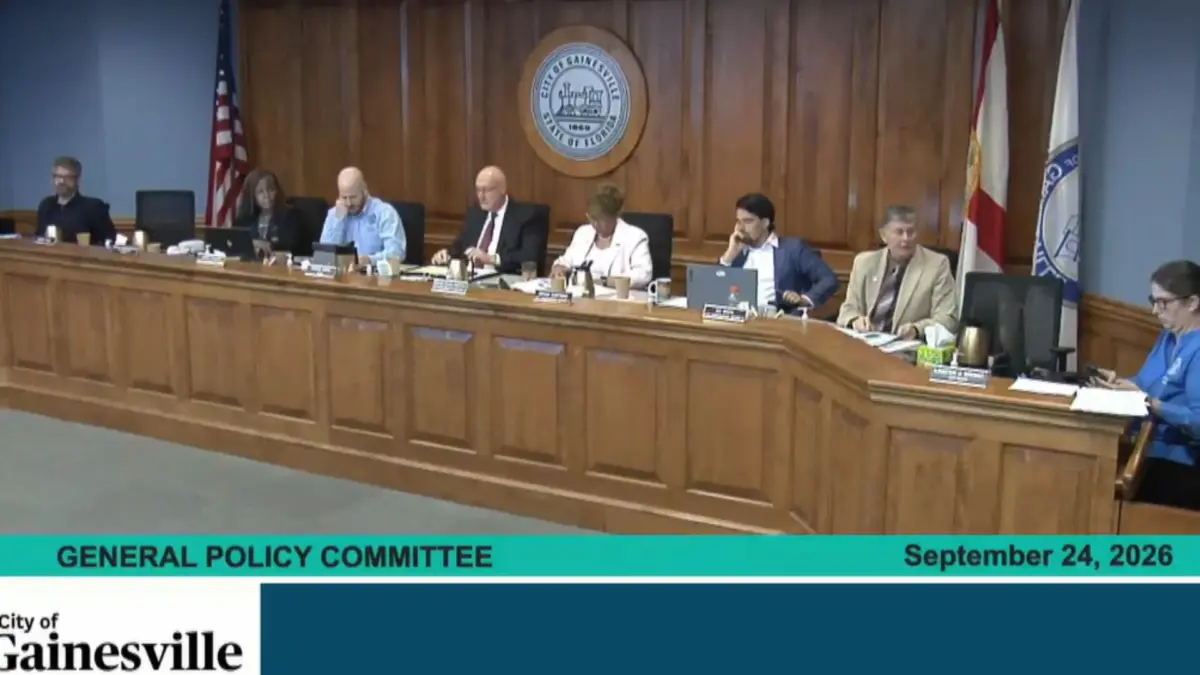

GAINESVILLE, Fla. — In a decisive legislative move aimed at reinforcing student safety and community health standards, the Gainesville City Commission voted unanimously to expand the mandatory buffer zones separating alcohol-selling establishments from local schools. The adjustment increases the restricted perimeter from the historical 400-foot standard to 500 feet, marking a notable shift in municipal zoning regulations regarding the proximity of substance availability to minors.
The sweeping policy changes, enacted during a recent packed commission session, also set the stage for further regulatory scrutiny regarding places of religious assembly. While definitive action was taken on educational facilities, city leaders opted to exercise caution on parallel proposals concerning houses of worship, directing municipal staff to conduct exhaustive research before any final determinations are made.
The unified nature of the vote underscores a growing bipartisan and community-backed consensus among local policymakers regarding the need to reevaluate how commercial zoning intersects with public health and youth-centric spaces. As Gainesville continues to experience rapid residential growth, commercial densification, and shifting urban dynamics, the regulatory framework governing alcohol licensing has emerged as a central battleground for municipal planning.
Executive Overview
The decision to expand alcohol sales buffer zones around schools from 400 feet to 500 feet represents one of the most substantial updates to Gainesville’s land development code regarding controlled substances in recent years. Municipal leaders and urban planning experts have framed the adjustment as a preventative health measure designed to mitigate the documented negative impacts associated with the high density of alcohol vendors near youth-frequented environments.
Core Policy Actions Taken:
- Educational Buffer Expansion: The mandatory distance between schools and new establishments engaging in the sale of alcoholic beverages was formally increased from 400 feet to 500 feet, passing by a 6-0 vote.
- Redefining Establishment Classifications: City staff have been officially tasked with drafting a comprehensive, modern legal definition of what precisely constitutes an "alcoholic beverage establishment" to close potential loopholes in current municipal code.
- Religious Assembly Buffer Retained Pending Study: Commissioners chose to defer a final decision on eliminating or altering the existing 300-foot buffer zone protecting places of religious assembly, opting instead to direct the planning department to gather empirical data and comparative municipal models.
- Unanimous Legislative Support: Both approved motions carried with unanimous 6-0 support from the commissioners present, though Commissioner James Ingle was absent from the proceedings.
The policy adjustments do not inherently force existing, lawfully operating businesses to shutter or relocate—a practice traditionally protected under grandfather clauses for non-conforming uses. However, they establish a significantly higher bar for any future businesses seeking licensing, zoning variances, or land-use changes within the designated perimeter.
Detailed Chronology of the Legislative Process
The path to the recent commission vote was neither instantaneous nor isolated; it represents the culmination of months of behind-the-scenes administrative review, public discourse, and zoning board evaluations.
The Genesis of the Review
Initial conversations regarding Gainesville’s alcohol-buffering framework began in earnest following routine municipal audits of land development codes. City planning staff noted that Gainesville’s existing proximity regulations had remained largely static while the urban core underwent major architectural and commercial transformations. Mixed-use developments, downtown revitalization projects, and suburban sprawl had increasingly placed commercial storefronts, convenience retailers, and dining establishments in closer physical proximity to school zones and neighborhood campuses than was anticipated when the original 400-foot rule was drafted.
Recognizing potential vulnerabilities in how alcohol retailers are distributed across neighborhoods, the commission requested a comprehensive review of local ordinances compared with state guidelines and peer municipalities across Florida.
Committee Discussions and Public Input
In the weeks leading up to the final vote, the proposals wound their way through various municipal advisory boards, including the City Plan Board. During these preliminary sessions, urban planners presented mapping data illustrating where current alcohol licenses overlap with educational pathways, school walking routes, and institutional boundaries.
Public commentary during committee hearings reflected a deeply engaged citizenry. Representatives from parent-teacher associations, neighborhood civic groups, and public health advocacy organizations voiced overwhelming support for increased protective buffers. Proponents argued that limiting the visual and physical accessibility of alcohol near schools plays a crucial role in shaping adolescent behavioral norms, reducing underage drinking rates, and enhancing pedestrian safety around school zones.
Conversely, representatives from local business coalitions and hospitality groups raised questions regarding property rights, commercial viability, and the potential reduction of developable urban parcels. However, modifications to the language—ensuring that existing establishments would be granted non-conforming grandfather status—helped mitigate immediate industry pushback, paving the way for the broad consensus ultimately reached on the dais.
The Commission Session
During the legislative session itself, debate centered on the practical implications of expanding the radius by 100 feet. City planners demonstrated via geographic information systems (GIS) mapping that a 500-foot buffer would effectively capture newly emerging commercial corridors that currently skirt the edge of school zones, thereby providing a more robust protective boundary.
The motion to expand the school buffer was introduced, seconded, and swiftly moved toward a vote. Following its unanimous passage, attention turned to the more contentious debate regarding places of religious assembly. Recognizing the complex legal, constitutional, and community-velied dimensions of regulating proximity to churches, temples, and mosques, the commission altered its course from immediate repeal to structured inquiry. The resulting directive orders municipal staff to conduct a thorough legal review and present a detailed report at a subsequent public hearing.
Supporting Context & Metrics: The Public Health and Urban Planning Framework
To fully understand the weight of the Gainesville City Commission’s decision, one must examine the broader socioeconomic, public health, and urban planning metrics that inform modern alcohol policy.
Public Health Implications of Proximity
Decades of public health research establish a direct correlation between the physical availability of alcohol and rates of consumption, particularly among vulnerable populations such as adolescents and young adults. Studies published in journals such as the Journal of Studies on Alcohol and Drugs consistently demonstrate that higher outlet densities near schools and residential areas correspond to:
- Elevated rates of underage binge drinking.
- Increased incidents of public nuisance, loitering, and property damage in neighborhood corridors.
- Higher rates of alcohol-related motor vehicle accidents involving young pedestrians.
By expanding the buffer zone from 400 feet to 500 feet—an increase of 25%—Gainesville has effectively pushed new points of sale further away from the daily paths traveled by students. While 100 feet may seem nominal on paper, in urban design, it often represents the difference between a storefront being directly adjacent to a school walking route and being separated by an entire city block or major intersection.
The Challenge of Defining an "Establishment"
One of the most critical directives issued during the meeting was the order for city staff to legally and operationally define what constitutes an "alcoholic beverage establishment."
In contemporary retail environments, the lines between traditional bars, package stores, convenience outlets, gas stations, grocery stores, and hybrid entertainment venues have become increasingly blurred. A restaurant might derive 80% of its revenue from food but still operate a prominent cocktail lounge; a convenience store might dedicate only a fraction of its shelf space to beer and wine while remaining a primary point of purchase for youth.
Without a precise legal definition, enforcement becomes subjective, and zoning boards face continuous litigation or administrative ambiguity when evaluating conditional use permits. The commission’s mandate requires staff to establish clear criteria based on:
- Percentage of gross revenue derived from alcohol sales.
- Floor area dedicated to the display, storage, and consumption of alcoholic beverages.
- Primary business licensing classifications issued by the Florida Department of Business and Professional Regulation (DBPR).
Comparative Municipal Landscape in Florida
Gainesville’s actions do not occur in a vacuum. Municipalities across Florida handle alcohol buffering zones through a patchwork of local ordinances permitted under state home-rule powers, though always subject to state-level licensing statutes governed by the Division of Alcoholic Beverages and Tobacco (ABT).
While state law establishes baseline statewide frameworks, cities routinely impose stricter local zoning restrictions to address unique community character, student populations, and neighborhood preservation goals. Cities like Orlando, Tallahassee, and Tampa have implemented varying proximity rules—ranging from 300 to over 1,000 feet depending on the zoning district, the type of establishment (package store versus on-premise consumption), and the presence of sensitive land uses like schools, parks, and churches.
Gainesville’s adjustment to 500 feet positions the city firmly in line with progressive municipal standards aimed at balancing commercial growth with child safety and community welfare.
Official Statements and Stakeholder Perspectives
The unanimous nature of the vote reflects a rare alignment among municipal leaders, yet the broader community represents a diverse mosaic of interests, ranging from neighborhood advocates to commercial developers.
Perspectives from the Dais
While specific individual remarks during the debate highlighted different facets of the issue, the overarching sentiment among commissioners was rooted in preventative governance.
Proponents of the 500-foot school buffer emphasized that municipal zoning is one of the few direct tools local governments possess to shape the physical environment in a manner that protects public health. Commissioners noted that as Gainesville continues to densify around university and K-12 educational hubs, proactive land-use policies are essential to prevent the clustering of vice-oriented retail in spaces heavily trafficked by children and teenagers.
Regarding the deferred vote on religious assembly buffers, commissioners stressed the need for prudence. Regulating land use around houses of assembly triggers complex constitutional considerations under the federal Religious Land Use and Institutionalized Persons Act (RLUIPA). By halting an immediate repeal and ordering staff research, the commission ensured that any future action would be legally defensible and sensitive to Gainesville’s diverse faith communities.
Community and Neighborhood Response
Neighborhood associations and parent advocacy groups have largely lauded the expansion of the school buffer zone. Representatives from local school advisory councils pointed out that walking and biking to school initiatives rely heavily on safe, family-friendly corridors free from commercial distractions associated with alcohol retail.
At the same time, business advocacy groups have maintained a watchful stance. While relieved that existing businesses are protected under non-conforming use statutes, commercial real estate brokers have expressed concern over the shrinking pool of viable parcels available for hospitality and retail development. In a college town where the hospitality sector serves as a major economic engine, every foot of restricted zoning carries economic weight. The success of the upcoming staff definitions regarding "alcoholic beverage establishments" will be critical in determining whether the new rules create undue administrative hurdles for multi-use dining establishments or focus strictly on high-risk package stores and standalone bars.
Future Outlook and Next Steps
As the ink dries on the commission’s recent vote, the implementation phase now shifts to city administrative departments, urban planning staff, and legal teams. The true impact of the policy will depend heavily on how these administrative directives are executed in the coming months.
Immediate Administrative Milestones
- Drafting the Establishment Definition: City planners and the city attorney’s office must formulate a legally rigorous definition of an "alcoholic beverage establishment." This definition will undergo review by the City Plan Board before returning to the commission for a formal public hearing and adoption.
- Religious Assembly Research Report: Municipal staff have been instructed to compile a comprehensive dossier examining the history, legal precedents, and practical implications of the 300-foot buffer zone for places of religious assembly. This report is expected to explore how peer cities regulate religious proximity, evaluate potential RLUIPA liabilities, and assess the original legislative intent behind the rule.
- GIS Mapping Updates: The city’s geographic information systems team will update municipal zoning maps to reflect the expanded 500-foot educational buffers. These updated maps will serve as the definitive tool for developers, real estate agents, and zoning officials when evaluating future commercial permitting applications.
Long-Term Policy Trajectory
Looking further ahead, the commission’s actions signal a broader willingness to re-examine Gainesville’s land development code in response to shifting urban demographics. As debates surrounding housing density, commercial mix, and public space continue to dominate local politics, the intersection of commerce and community welfare remains a central theme.
For Gainesville residents, parents, business owners, and city planners alike, the months ahead will provide a clearer picture of how the expanded 500-foot buffer functions in practice. Whether the city ultimately decides to modify, retain, or eliminate the religious assembly buffer, the recent 6-0 vote demonstrates a unified commitment to deliberative, health-conscious urban planning that prioritizes the safety and well-being of Gainesville’s youngest citizens.

0 Comments