

Executive Overview
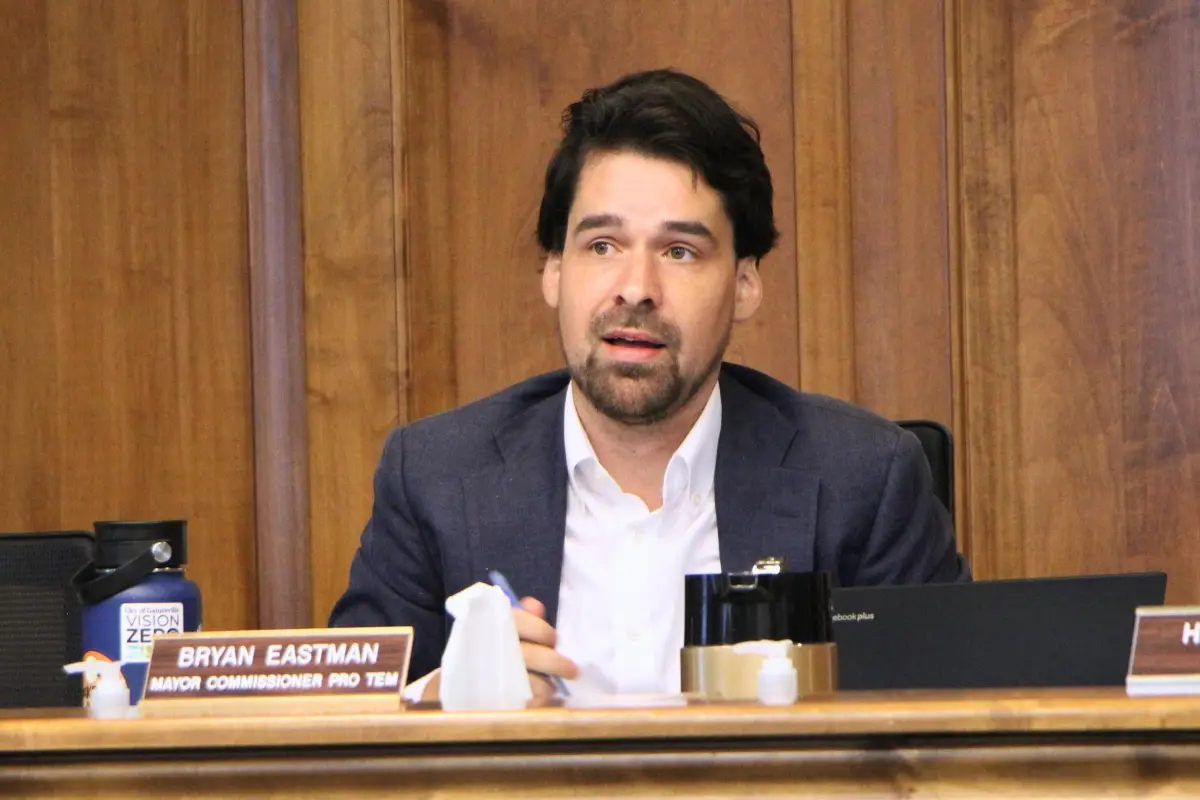
In a milestone moment for municipal housing policy in Florida, Gainesville City Commissioner Bryan Eastman was named the 2026 Local Government Housing Champion by the Florida Housing Coalition. The award was presented during the Coalition’s 39th annual REPAIR Conference held in Orlando, a flagship gathering recognized as the state’s largest assembly of affordable housing developers, lenders, advocates, and policy leaders.
Eastman shared the statewide honor with State Senator Alexis Calatayud, who was recognized as the 2026 State Government Housing Champion for her legislative leadership on affordable housing initiatives.
The designation highlights Gainesville’s transition from a typical college town facing severe rent burdens to a policy testing ground for urban planning reform. Over recent years, Gainesville has systematically overhauled its land-use regulations. The City Commission has pursued progressive policies including the elimination of mandatory parking minimums, the adoption of targeted inclusionary zoning, and the passage of landmark "Starter Home" legislation aimed at increasing missing-middle housing stock.
As Florida grapples with unprecedented population growth, surging insurance costs, and acute housing unaffordability, Gainesville’s proactive land-use interventions are increasingly viewed by urban planners and state officials as a potential blueprint for municipalities across the region.
Detailed Chronology: Gainesville’s Policy Trajectory
+-----------------------------------------------------------------------------------+
|                            REFORM TIMELINE & MILESTONES                           |
+-----------------------------------------------------------------------------------+
|  • Phase 1: Diagnostic & Early Land-Use Debates                                   |
|    - Identification of severe housing cost-burden in Alachua County.             |
|    - Initial debates over density caps and restrictive zoning near UF core.       |
|                                                                                   |
|  • Phase 2: Structural Regulatory Overhauls                                       |
|    - City Commission votes to eliminate citywide minimum parking requirements.     |
|    - Passage of inclusionary zoning frameworks for targeted corridors.            |
|    - Targeted parcel rezonings approved (e.g., "The Knot" project).               |
|                                                                                   |
|  • Phase 3: Codification of Missing-Middle Frameworks                              |
|    - Finalization and passage of the "Starter Home" Ordinance.                     |
|    - Reduction of minimum lot sizes and streamlining of infill approvals.         |
|                                                                                   |
|  • Phase 4: Statewide Recognition                                                 |
|    - August 24–26, 2026: Florida Housing Coalition REPAIR Conference in Orlando.  |
|    - Commissioner Bryan Eastman awarded 2026 Local Government Housing Champion.    |
+-----------------------------------------------------------------------------------+
1. Early Diagnoses and Structural Challenges
The roots of Gainesville’s housing interventions trace back to severe structural pressures within the local market. Anchored by the University of Florida, the city faces unique demographic pressures: a large student population competing with working-class families for standard rental units, paired with legacy zoning codes that restricted micro-units, multi-family infill, and accessory dwelling units (ADUs).
2. Regulatory Deregulation and Parking Reforms
Recognizing that traditional zoning codes were artificially inflating development costs, the Gainesville City Commission initiated a series of deregulatory measures led by forward-thinking commissioners, including Bryan Eastman. A critical early step was the complete elimination of minimum parking requirements citywide. By removing mandatory parking ratios, which had previously forced developers to allocate large portions of valuable real estate to unbuilt asphalt, the city freed up land parcel capacity for actual residential density.
3. Targeted Rezonings and Parcel-Level Development
Alongside macro-level code adjustments, the commission advanced parcel-specific rezonings designed to catalyze infill construction. High-profile deliberations—such as land-use approvals allowing key workforce projects like "The Knot" to move toward construction—underscored a growing willingness to adjust local zoning maps to meet urgent housing targets.
4. The Starter Home Ordinance
The defining piece of Gainesville’s reform agenda came with the codification of its "Starter Home" legislation. Designed specifically to re-introduce missing-middle options (such as duplexes, triplexes, townhomes, and cottage courts), the ordinance streamlined administrative approvals, reduced minimum lot size constraints, and scaled back setback requirements, lowering the capital barrier for residential builders.
5. Statewide Honors in Orlando
The culmination of these local efforts reached a statewide stage during the Florida Housing Coalition’s REPAIR Conference (held August 24–26, 2026). At the event, Commissioner Eastman was officially recognized alongside Senator Calatayud before hundreds of housing sector leaders, solidifying Gainesville’s reputation as a leader in municipal land-use innovation.
Supporting Context & Metrics: The Mechanics of Reform
To understand why Gainesville’s municipal policies have gained statewide attention, it is necessary to examine the specific regulatory levers used by the city and their underlying economic impacts.
                  GAINESVILLE HOUSING POLICY REFORM STACK

    +---------------------------------------------------------------+
    |                  STARTER HOME ORDINANCE                       |
    |  • Reduces lot sizes   • Permits missing-middle density       |
    +---------------------------------------------------------------+
                                    |
                                    v
    +---------------------------------------------------------------+
    |              PARKING REQUIREMENT ELIMINATION                  |
    |  • Cuts construction costs   • Increases buildable lot coverage|
    +---------------------------------------------------------------+
                                    |
                                    v
    +---------------------------------------------------------------+
    |                INCLUSIONARY & INFILL ZONING                   |
    |  • Incentivizes affordable units  • Streamlines infill sites   |
    +---------------------------------------------------------------+
Eliminating Minimum Parking Requirements
Historically, municipal parking mandates required developers to construct a fixed number of parking spaces per residential unit, regardless of market demand or proximity to public transit. Studies in urban economics demonstrate that structured parking can cost between $20,000 and $40,000 per space to construct, costs that are invariably passed down to tenants in the form of higher monthly rent.
Gainesville’s decision to remove these mandates allowed developers to right-size parking based on actual consumer demand, directly lowering construction costs per unit and allowing constrained urban lots to accommodate additional housing units instead of surface asphalt.
| Metric / Policy Area | Traditional Regulatory Framework | Gainesville Reformed Framework | Economic Impact |
|---|---|---|---|
| Parking Mandates | Fixed spaces per residential unit/bedroom | 100% eliminated citywide | Lowers construction capital outlay; maximizes buildable square footage. |
| Minimum Lot Sizes | Large lot thresholds restricting infill | Reduced lot size minimums via Starter Home rules | Allows land subdivision; enables small-scale localized developers. |
| Permitted Housing Typologies | Predominantly single-family detached | Expanded missing-middle (duplex, triplex, ADUs) | Increases urban residential density without massive high-rise development. |
| Development Approvals | Protracted discretionary review cycles | Streamlined administrative review for compliant infill | Shortens land-holding timelines and financing interest burdens. |
The Starter Home Framework as a Statewide Model
Florida’s rapid population growth has placed immense pressure on sub-markets, driving single-family home prices out of reach for median-income households. Gainesville’s Starter Home framework directly tackles this by adjusting dimensional standards:
- Lot Size Flexibility: Standardizing smaller parcel footprints so entry-level buyers can purchase homes without paying for excess land.
- Floor-Area Ratio (FAR) Adjustments: Permitting a higher square-footage ratio relative to lot size, facilitating multi-story townhomes and cottage developments.
- Administrative Efficiency: Reducing the length of entitlement phases for projects that align with density and affordability metrics.
As state lawmakers evaluate statewide housing policies following the implementation of the Live Local Act (SB 102), Gainesville’s Starter Home framework serves as a practical example of how local municipalities can voluntarily update land codes to spur naturally occurring affordable housing.
Official Statements and Policy Discourse
In an official statement released by the City of Gainesville following the announcement in Orlando, Commissioner Bryan Eastman framed the recognition as a collective victory for the community and a validation of proactive local governance:
"It’s an incredible honor to receive this award, but more than anything, I’m proud of the work we’ve done in Gainesville. We’ve shown that local government can address the housing crisis head-on and make real progress on housing affordability. I’m proud of what we’ve accomplished together and honored to have that work recognized statewide."
— Bryan Eastman, Gainesville City Commissioner
(2026 Local Government Housing Champion)
The award was presented by the Florida Housing Coalition, a statewide nonprofit organization dedicated to advancing housing solutions and ending homelessness. Leaders within the coalition emphasized that honoring both a local official (Eastman) and a state legislator (Senator Alexis Calatayud) highlights the essential link between state legislative frameworks and local municipal execution.
       STATE-LOCAL POLICY ALIGNMENT FOR HOUSING AFFORDABILITY

   +------------------------+          +------------------------+
   |  STATE LEVEL REFORMS   |          |  LOCAL LEVEL EXECUTION |
   |  (Sen. Alexis          |  ======> |  (Comm. Bryan          |
   |  Calatayud)            |          |  Eastman)              |
   |  • Capital Allocations |          |  • Land Use & Zoning   |
   |  • Tax Incentives      |          |  • Parking Deregulation|
   |  • Statewide Mandates  |          |  • Infill Approvals    |
   +------------------------+          +------------------------+
While housing reforms often spark local political debates over neighborhood character and urban density, supporters argue that Gainesville’s balanced approach—combining parking reform, starter home legislation, and target rezonings—provides a sustainable path forward that respects community needs while accommodating necessary growth.
Future Outlook: Challenges and Policy Scalability
As Gainesville celebrates this statewide recognition, municipal officials and urban planners face the long-term work of implementing these policies and measuring their impact.
+-------------------------------------------------------------------------------+
|                            FUTURE LOOK AHEAD                                  |
+-------------------------------------------------------------------------------+
|  [!] TRACKING PERMITTING VOLUMES                                              |
|      Monitoring construction starts for missing-middle housing typologies.    |
|                                                                               |
|  [!] STATE-LEVEL REPLICABILITY                                                |
|      Evaluating how Gainesville's Starter Home framework can be adapted       |
|      by other Florida municipalities under the Live Local Act.                |
|                                                                               |
|  [!] BALANCING DENSITY AND INFRASTRUCTURE                                     |
|      Ensuring utility grid capacity, stormwater management, and transit       |
|      networks expand concurrently with infill density.                        |
+-------------------------------------------------------------------------------+
Key Priorities Moving Forward
- Monitoring Infill Construction: Policy experts will closely track whether the Starter Home ordinance and parking deregulation lead to a measurable increase in new building permits for duplexes, triplexes, and small-lot single-family homes over the next 24 to 36 months.
- Evaluating Affordability Metrics: Analysts will evaluate whether new infill inventory successfully stabilizes market rents and creates attainable ownership options for local workers, university staff, and young families.
- Potential Statewide Replication: With the Florida Housing Coalition elevating Gainesville’s reforms, other Florida cities facing similar growth pressures may use Gainesville’s starter home and parking policies as a template for their own land-use updates.
By taking a proactive approach to land-use regulation, Gainesville has transformed its local housing strategy into a statewide model. The recognition of Commissioner Bryan Eastman at the 2026 REPAIR Conference highlights how local government leadership can drive meaningful policy change in the face of widespread housing affordability challenges.

0 Comments